Kathmandu, September 21
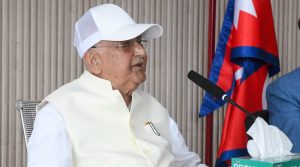
CPN-UML Chair KP Sharma Oli has made clear that he has no intention of stepping down as party chairman, arguing that replacing the leadership cannot by itself be described as party reorganisation.
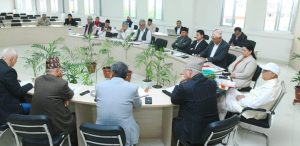
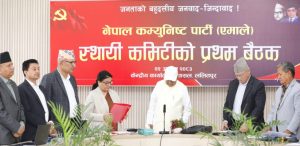
Presenting his political report at the UML Central Committee meeting on Monday, Oli argued that the debate over party reorganisation should be understood in its proper historical and organisational context and should not be treated as a matter of impulse.
Oli said leadership cannot be displaced without considering the condition of the party and the broader circumstances surrounding it.
His report covers national politics, problems within the party and the tasks ahead, while also citing three major instances of reorganisation in the history of Nepal’s communist movement.
He referred to the period following Keshar Jung Rayamajhi’s move towards the palace, the Jhapa movement and the party’s reorganisation in 1960, and the reorganisation carried out after the split of the Nepal Communist Party in 1962.
Oli argued that each of those reorganisations took place under circumstances in which the party and movement faced serious organisational or political crises.
“What is reorganisation? Under what circumstances does it take place? Is replacing the leadership what we call reorganisation? We need to properly understand how many times and when reorganisation took place in our political movement. Party reorganisation is not a matter of desire or impulse,” Oli said in the report.
Three examples of reorganisation
According to Oli, the first major reorganisation took place after Keshar Jung Rayamajhi, then the party’s general secretary, openly moved towards the monarchy following King Mahendra’s 1960 coup.
Oli said Rayamajhi welcomed the royal takeover and moved towards supporting the Panchayat system while holding a majority in the party’s Central Committee.
He argued that the party had to be reorganised because the leadership and majority had moved towards the right and there was no other way to protect the movement.
Oli said the party’s minority subsequently organised zonal committees and held the Third General Convention, leading to the first reorganisation.
He described the second reorganisation as having taken place in 1970, when the party had become organisationally weak and fragmented under Panchayat repression.
According to Oli, the Jhapa movement and subsequent formation and expansion of new communist organisations were part of an effort to rebuild the movement with a clear objective of establishing a people’s democratic republic.
He said the process eventually developed through the Jhapa movement, Appeal, the Coordination Committee, CPN (Marxist-Leninist) and eventually the CPN-UML.
Oli said the third reorganisation took place after the communist movement had reached a strong position through organisational expansion, party unification and electoral success, but internal conflict later led to the split of the Nepal Communist Party.
He said his leadership was again involved in reorganising the UML after the split.
“These and similar major organisational steps taken under compelling circumstances and which had a positive impact on the life of the movement were reorganisation,” Oli said.
He argued that the current calls for reorganisation do not fit that historical definition.
“The talk of reorganisation being carried out at this time carries neither the literal nor the substantive meaning of the term and does not match its justification, necessity or context,” he said.
‘Transformation does not mean erasing history’
Oli also sought to distinguish between transformation, handover of responsibility and generational transition.
He said transformation should not mean erasing the party’s history or rejecting its political struggle, ideology, sacrifices and organisational traditions.
“Transformation means changing the working style; changing the language used to speak with the people; making the decision-making process more efficient; turning committees from formal meeting structures into centres for solving people’s problems; and changing leadership from a level that gives orders to one that listens, understands and delivers results,” Oli said.
He used the metaphor of a tree to argue that organisational renewal does not require cutting off its roots.
“New shoots do not grow on an old tree by cutting its roots. The roots must be nourished so that new shoots can grow. UML’s history is the root and the new generation is the shoot,” he said.
Oli also argued that leadership handover should not be treated as a sudden or arbitrary decision.
He said responsibility, knowledge, experience, institutions, political culture and decision-making capacity should be transferred in a planned manner, warning that a handover without preparation could create a vacuum.
He further said generational transition should not be reduced to age.
“Generational transition is not merely the arithmetic of age. It is a process of giving the new generation responsibility, training, experience, opportunities and a place in decision-making. Being young is not qualification in itself, and being older is not disqualification in itself. A combination of energy and experience is necessary,” Oli said.
Oli’s position comes amid an ongoing dispute within the UML over party reorganisation and leadership.