

Chandardevi Mukhiya, 45, of Betauna in Golbazar Municipality–12, Siraha, has a hand pump right in her courtyard. But for the past several years, no water has come out of it. Since her own pump stopped working, she and other locals have depended on a submersible pump installed at the house of her neighbour, Mohan Jha.
Around 200 households in Betauna-Haripur face the same situation. Most have hand pumps in their yards, but since they’ve stopped drawing water, the entire village now depends on a single borewell. Long lines form in the morning and evening as people wait to fill water; locals say it can take hours just to fill two buckets.
Resident Ashadevi Mukhiya installed a special supersession motor to help draw water more easily from her hand pump. But she says even years after installing the motor, no water has come.
Ward chairperson Ganesh Mukhiya has two hand pumps on his property, one fitted with a supersession motor, yet even his pump has stopped drawing water.
According to resident Mohan Jha, the water problem in Betauna has been worsening over the past five years. In the past, sufficient monsoon rain would keep some water flowing into the pumps for a while, but this year’s prolonged lack of rainfall has made the situation far worse.
“We’ve had this water problem for the last five years. When there was good rain in June-August, we’d get a little water in the hand pumps until November-January,” Jha said. “But this year, with a long stretch of insufficient rain, the pumps have stopped giving water altogether.”
Jha says the added strain of running irrigation motors and pumps simultaneously to water paddy fields during the drought has put further pressure on groundwater levels. He added that since most locals also go to the fields to bathe and wash clothes, pressure on the village’s lone submersible pump is somewhat reduced.
“The motors and fire pumps in the fields are running for paddy irrigation. Since most people go to the paddy fields to bathe and wash clothes too, there’s some relief here,” Jha says. “If those motors over there weren’t running, this one submersible pump alone couldn’t sustain the whole village.”
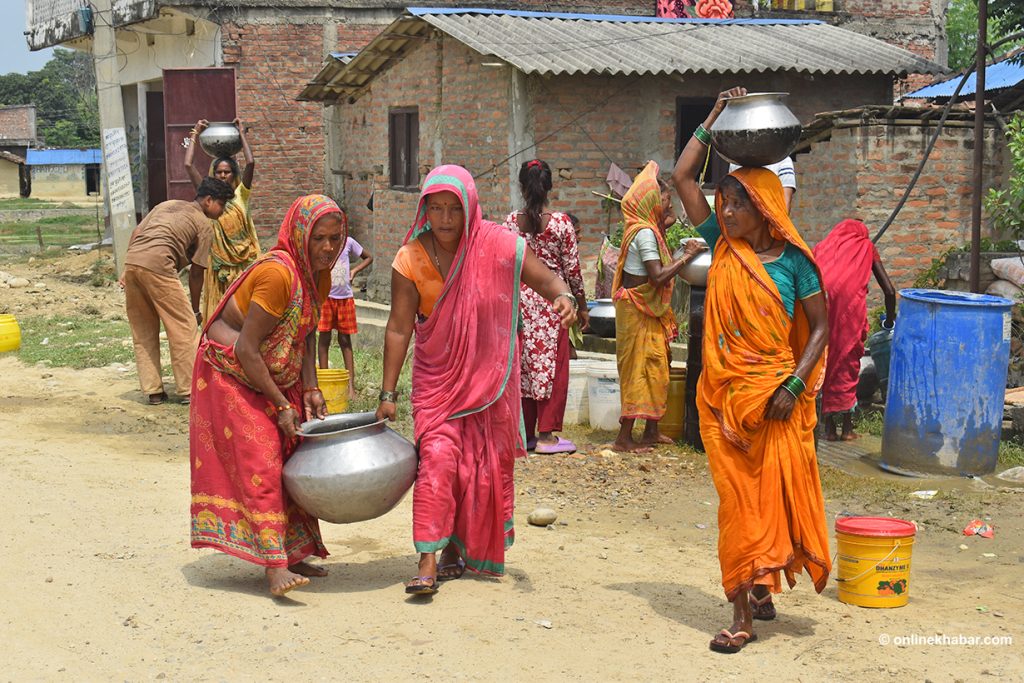
He warned that without immediate alternative arrangements, Betauna residents will face an even bigger water crisis. Ward chairperson Ganesh Mukhiya acknowledged that a major water shortage now exists even for basic household use, but said the ward is not currently in a position to provide a separate submersible pump to every household.
“There’s a serious shortage of water even for everyday household use. But the ward is not in a position to give a submersible pump to every individual household,” Mukhiya says. “Due to the prolonged drought and the simultaneous operation of motors in the paddy fields, groundwater levels have dropped, causing the hand pumps to stop working.”
Although Golbazar Municipality spends millions of rupees every year in the name of drinking water and irrigation, former divisional drinking-water engineer Devnath Mahato says the practice of merely distributing hand pumps to individual households and scattering budgets across small projects will not resolve the long-term problem.
“Simply distributing hand pumps household by household will no longer solve the drinking water problem,” Mahato says. “Local governments need long-term plans, targeting a village or neighbourhood as a unit, to build shared borewells, small overhead tanks, and organised distribution systems.”
This year’s prolonged drought appears set to affect not just household water use in Betauna but agricultural production as well. Insufficient rainfall has increased irrigation demand in the fields, while excessive extraction of groundwater is drying up drinking water sources too.
Experts say the deepening drinking water crisis isn’t limited to Betauna; falling groundwater levels have worsened water shortages across various parts of the Tarai-Madhesh region in recent years.
Specialists note that uncontrolled extraction in the Chure region, erratic rainfall, prolonged drought, excessive groundwater use, encroachment on traditional ponds and reservoirs, and rising temperatures have all weakened the natural water-recharge system. With rising heat on one hand and falling groundwater levels on the other, the risk of a compounded crisis, affecting drinking water, agriculture, and the environment alike, is growing across the Tarai-Madhesh region.