Kathmandu, November 25
The government is preparing to implement a $50 million project, worth around Rs 7 billion, to reduce the risk of glacial lake outburst floods (GLOFs) from four high-risk glacial lakes in Nepal.
The project, named ‘Sanjivani’, comes amid growing concerns that climate change is accelerating glacier melt in the Himalayas and making glacial lakes increasingly unstable.
Sanjiv Baral, executive director of the Centre for Hydrology and Meteorology Research, said the project aims to protect vulnerable communities, livelihoods and property from floods caused by glacial lake outbursts and other climate-related disasters.
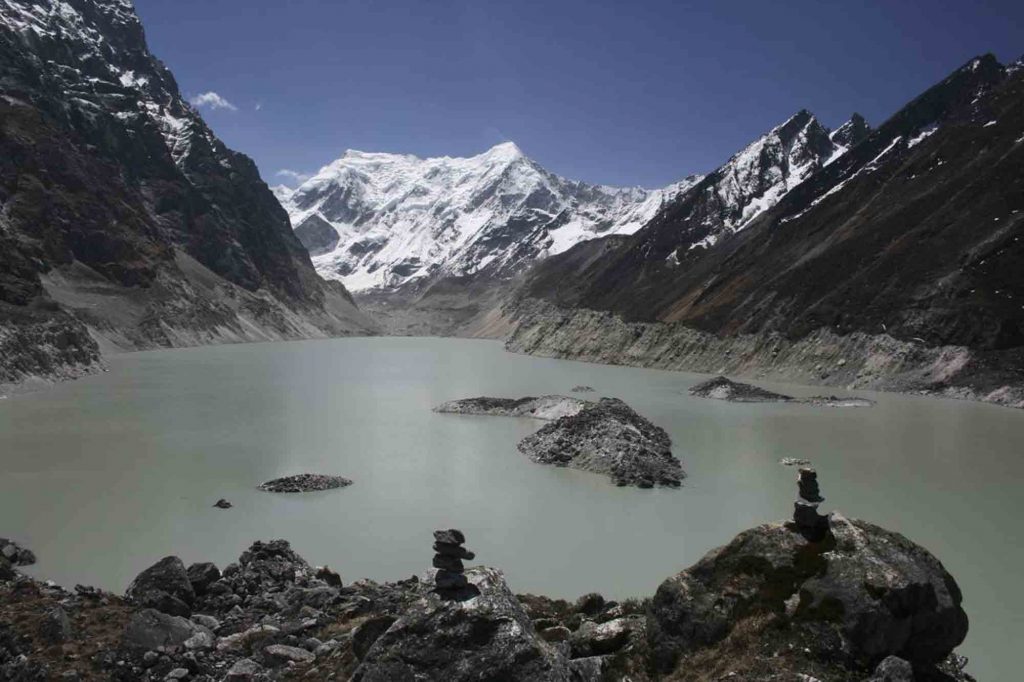
The project will target four lakes — Hongu-2 and Lumding Tsho in Solukhumbu, Lower Barun in Sankhuwasabha and Thulagi Lake in Manang.
According to Baral, the project will focus on lowering water levels in the lakes, developing monitoring and early warning systems, and implementing protection measures in downstream areas.
Under the preliminary design, the water level of Hongu-2 will be lowered by one metre, while that of the other three lakes will be reduced by three metres each.
Baral said the Himalayan cryosphere is changing rapidly, increasing the frequency and risks of glacial lake-related disasters and snow avalanches. He stressed that risk reduction efforts must be accelerated rather than carried out at long intervals.
He cited studies showing that glaciers across the Hindu Kush Himalaya retreated 65 per cent faster between 2011 and 2020 than in the previous decade. The Thulagi glacier in Manang alone is retreating by around 30 metres annually, he said.
Baral also presented data showing that the overall area of glacial lakes declined by around 23 per cent between 1987 and 2017, while glacier retreat and the expansion of individual lakes have contributed to growing risks.
More than 30 glacial lake outburst events have been recorded in Nepal and surrounding areas over the past six decades. Around 15 occurred in Nepal, 11 in Tibet and others in neighbouring areas, according to Baral.
Citing the 2016 Bhote Koshi glacial lake outburst, he said the disaster caused an estimated $112 million in economic losses, despite originating from a lake covering only around 0.017 square kilometres.
A 2020 study conducted by the United Nations Development Programme (UNDP) and the International Centre for Integrated Mountain Development (ICIMOD) identified 47 glacial lakes with a high potential to cause damage in Nepal. Of these, 21 are in Nepal, 25 in Tibet and one in India.
Forty-two of the identified lakes are located in the Koshi basin, including nine in the Dudh Koshi basin. Baral warned that an outburst from a large glacial lake could cause devastating damage downstream.