

On the morning of August 26, Yogesh Dangol took one last walk around Betrawati without knowing it would become the last time he would see the town as he knew it.
He went to Uttargaya Dham, crossed the suspension bridge connecting Trishuli with Tupche, visited Maranghat Pati and watched the Lakhey. He also stopped by the building of the club he had chaired for eight years.
He was returning home and had just reached the middle of Betrawati Bazaar when someone warned him: “The flood is coming.”
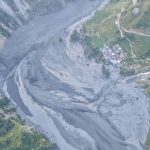
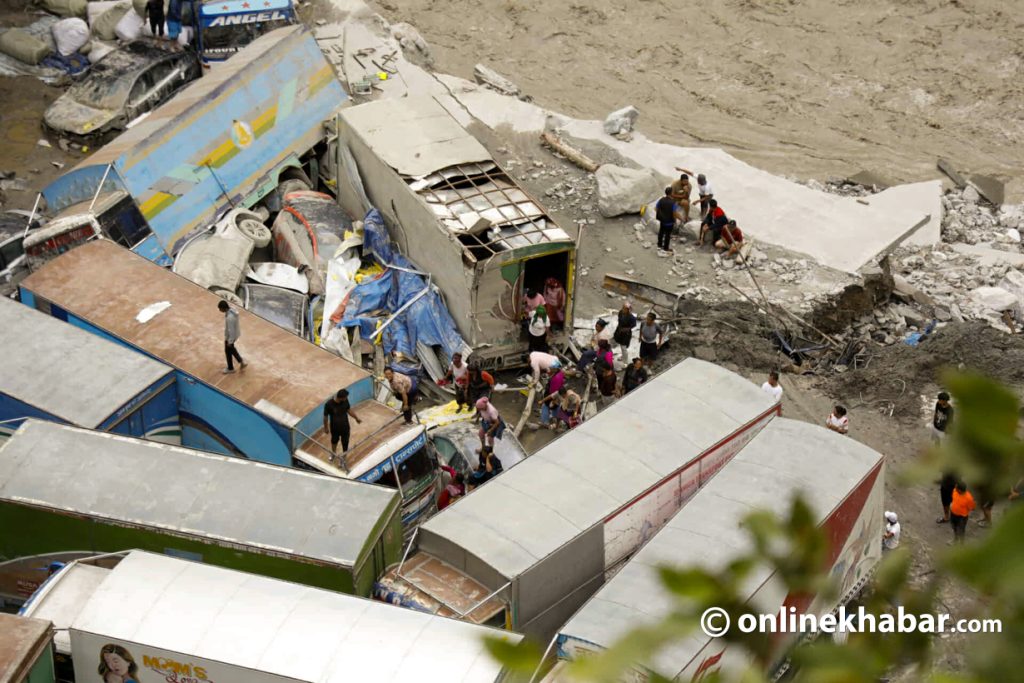
It was around 9:20 am when the flood entered the settlement. Within 15 to 20 minutes, Betrawati had been devastated.
Dangol began looking for his son and his parents as the water swept through the town. Buses were being carried away. People were running across the fields on the other side of the river. The bridge was crowded with people and vehicles.
“I cannot imagine what happened to the people in that field,” he said. “There were people all over the bridge. Vehicles were running. Everything was swept away.”
Four or five large container trucks and cars parked in front of the Betrawati police post were carried away. Some of them had people inside. School buses were also swept away.
“It was a terrifying situation,” Dangol said, struggling to put what he witnessed into words.
He had barely crossed the Betrawati bridge when he saw his maternal aunt and her husband being swept away.
“When the flood reached my aunt’s house, panic began. A white torrent came down from the temple. After that, my mind stopped working,” he said.
Dangol had a five-storey house in the middle of the town. The flood reached the fourth floor.
His house was not an exception. Homes across Betrawati were swept away within minutes.
“Betrawati, this sacred place, was turned into ruins,” he said.
A town with a history

For Dangol, the loss is about more than homes.
Betrawati has long held historical and religious significance. Dangol says the area had a settlement even before the 1849 treaty with Tibet and that temples and guthis have existed there for generations.
The town was also home to generations of Dangols, as well as Tamang, Brahmin and Magar families.
“There were around 170 to 180 Dangol households alone,” he said. “There were also Tamang settlements, Brahmin families and Magar families on the other side.”
He estimates that around 230 to 235 households lived in Betrawati, with a population of between 700 and 800.
The town was also a trading centre, attracting people from surrounding areas to buy goods. It was home to Uttargaya Dham, an important religious site, and was known for its Lakhey and other festivals held throughout the year.
“It was a package in itself — fertile land, clean water, the confluence of rivers, the sacred land of Uttargaya and Lakhey festivals,” Dangol said.
Betrawati was also an important route towards Rasuwa and the Rasuwagadhi border point.
Now, there is nothing.
Dangol says 61 members of the Dangol community are believed to have been swept away. Others remain missing. Children are among those unaccounted for.
“There is no confirmed figure yet,” he said. “My aunt, my paternal aunt, my paternal aunt’s daughter, my sister’s daughter, and neighbours and brothers from around the area were swept away right in front of my eyes.”
He had come home to celebrate
Dangol had returned to Nepal from the United States just two weeks before the flood.
He had come home as preparations were underway for the local festivals. T-shirts had already been printed. The community was preparing for Ghode Jatra and Gaijatra.
“But the settlement itself is gone,” he said.
Betrawati had already been through one major disaster. The 2015 earthquake devastated the town. After the earthquake, Dangol was among those who worked to rebuild it.
“I started by saying I would build my own house first,” he said. “We had to save Betrawati and make it beautiful.”
He built a distinctive clock tower-like structure on top of his house, with clocks facing in different directions.
The clock had been made in Britain and brought from India. Dangol spent Rs 1.2 to 1.3 million on it around nine years ago.
Every morning at 6, it would begin chiming, continuing every hour until 9. It became part of the town.
“Now, the clock has stopped.”
‘Betrawati has to remain’

Dangol had built the house and then returned to the United States. He could not come back when his mother fell ill. After her health improved, the family finally returned to Nepal.
“I brought my mother to Nepal to show her the country after her treatment,” he said. “It feels like I brought her to see it for the last time.”
Even after building the house, Dangol spent only about five nights there — two nights initially and another three nights later.
Now, discussions have already begun about rebuilding Betrawati.
For Dangol, rebuilding is not simply an option. It is something that must happen.
“Betrawati has to remain. We will keep it there,” he said. “If we are told to leave Betrawati and settle somewhere else, that is not acceptable. Betrawati has to be there. We will build it again as it was.”
The town that survived an earthquake has been reduced to a riverbed again, only a decade after it was rebuilt.
But Dangol is already thinking about bringing it back.
“I have great hope that it will be built again,” he said.