


Betrawati, August 30
When Biwash Shrestha and Bishwas Shrestha arrived in Betrawati on the day after the flood, they were looking for their parents.
The two brothers, who live in Kathmandu for work, had rushed to the settlement after learning that their 72-year-old father and 65-year-old mother had been swept away. They knew the chances of finding them alive were slim, but they still hoped they would.
Instead, they found themselves searching through mud and debris for their parents.
On Friday, they were informed by locals that their mother’s body had been found near their home. But even then, bringing her back proved difficult.
“We came after locals informed us that they had seen our mother’s body. But we could not retrieve it,” Bibash said from Keraghari, where the brothers had been staying about two hours uphill from Betrawati. “The administration has not come for rescue. There is no one left in the village.”
The brothers had tried to reach their home as soon as they arrived in Betrawati, but thick mud blocked their way.
“We moved towards our house as soon as we reached Betrawati to look for our mother, but we could not get there because of the mud. So we came back and stayed in Keraghari,” Bibash said.
They returned to Betrawati early the following morning. The body was still difficult to recover.
“On the fourth day (August 29), we retrieved our mother’s body ourselves,” he said. “We performed her last rites yesterday. My heart is still crying. I haven’t been able to sleep.”
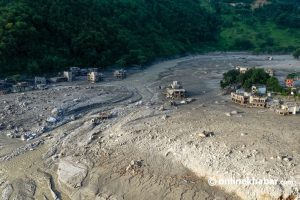
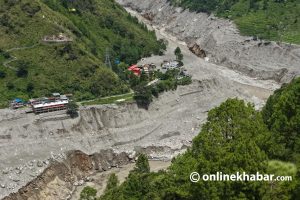
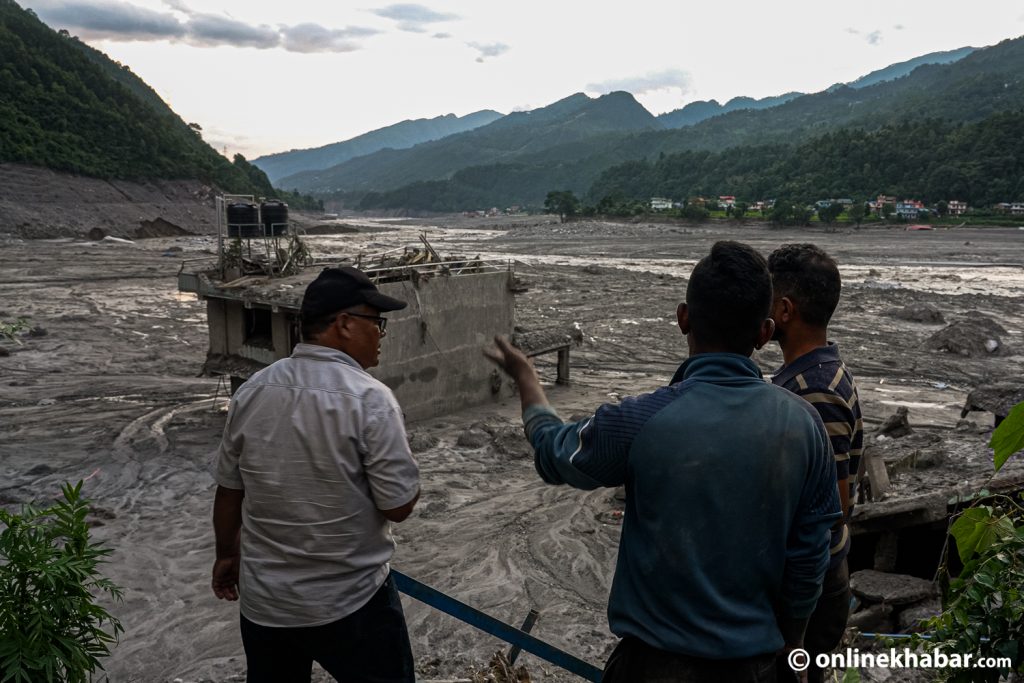
For the brothers, recovering their mother was only part of what they had to confront. The flood had destroyed much of the settlement, leaving very few people behind.
“There were only four or five of us. The entire settlement has been swept away. There was hardly anyone to attend the funeral,” Bibash said.
His uncles and a cousin helped with the funeral, while another local resident brought firewood. But the flood had also destroyed the places where funerals were traditionally held.
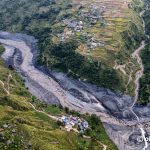
“The river is now flowing where our house used to be. There is no road to take the body elsewhere. We could not cremate her on someone else’s land, so we did it in front of our own house and washed the place with river water,” Bibash said.
There was no house left in which the brothers could perform the mourning rituals, so they returned to Kathmandu.
The brothers began the mourning rituals for their mother in Kathmandu on Sunday. They also brought their uncle with them because, otherwise, he would have been left alone in the devastated settlement. Thier father is still missing.
Bodies remain as residents flee

The Shrestha brothers’ experience reflects a wider difficulty in Betrawati, where recovering bodies and performing funerals has become increasingly difficult as the settlement has been largely emptied by the disaster.
“Many people were swept away. The fear of the flood is still there. There are no houses to live in. Those who survived have scattered,” said local resident Narayanlal Dangol. “Bodies lying here and there in the river have started to smell.”
When an Onlinekhabar team reached Betrawati on the afternoon of the day after the flood, local resident Ashish Tamang was involved in rescue efforts.
Tamang had recovered his sister-in-law’s body from near the Betrawati clock tower and brought it to higher ground. But there was no one available to take the body away.
“When we informed the police, they did not come. They said they would come, but we did not know when,” he said.
His sister-in-law had worked at the NIC Asia Bank branch near the clock tower. While other employees managed to escape, she was caught in the floodwaters.
Her husband, Navaraj Tamang, arrived the following day and took the body for cremation.
“Her husband came and took the body. He took it to Keraghari the next day and performed the last rites,” said Dangol.
According to Dangol, the settlement, once densely populated, now has very few people left.
“It used to be a densely populated settlement. Now there are no houses. People have been swept away and there is still fear of another flood,” he said. “In almost every house—this one, that one, the house across and the one below—someone has been swept away.”
Local resident Yogesh Dangol said some families had lost every member, leaving no one to perform their last rites.
“In some houses, everyone has been swept away. We do not know who will perform their last rites,” he said.
The exact number of families in which all members are missing has not yet been established.
“They have all been swept away. Who will even report them as missing? I saw people being swept away with my own eyes. My legs are still shaking,” Yogesh said.
He estimated that more than 1,000 people lived in the settlement, which had more than 200 households, although no official figure is available.
“The settlement has become like a deserted cremation ground. It is in mourning. We are speechless,” Dangol said.
Those who survived have also been scattered, with many left without homes or food.
“Some have gone to Keraghari, some to Gerku and some to the district headquarters. They have gone wherever they have relatives. Some have come to Kathmandu,” said local resident Indramaya Dangol.
Residents say they were not prepared for the scale of the flood
Residents say they received warnings that flooding was coming, but did not receive information about the scale and severity of the disaster.
Bibash said the lack of a clear warning contributed to the loss of life.
“They should have told us how big the flood was going to be. For people here, floods were considered normal, so no one could have imagined this,” he said.
“If they had told us that Syafrubesi, Chilime, Timure and this place would also be swept away and that nothing would remain, this kind of loss would not have happened.”
Bodies swept downstream by the flood remain scattered around Betrawati, according to locals.
But with most residents displaced, there are few people left to recover them. Locals also say government rescue teams have yet to reach many areas.
“An APF team came on the afternoon of the third day. They did not bring relief supplies. They came with a dog and walked around. Then there was a rumour that another flood was coming, so they left without carrying out a rescue,” Dangol said.
“The smell is spreading because of the human bodies and dead animals. We are waiting for the government.”