

Kathmandu, September 9
Flames of anger were raging across the streets of Kathmandu. What had begun as a relatively ordinary protest by the Gen Z group on September 8 quickly turned violent that same day.
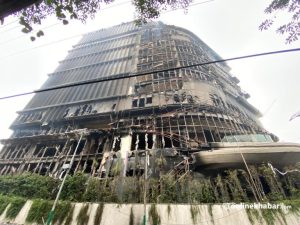
By the following day, September 9, the situation had spiralled out of control, taking an increasingly violent and chaotic turn. Government offices were engulfed in smoke, public infrastructure was being vandalised, and the homes of political leaders and party workers were being set on fire.
Amid the chaos, an unruly crowd made its way towards the Tribhuvan University (TU) Cricket Ground in Kirtipur—a venue where the future of Nepali cricket and the dreams of millions were taking shape.
At the time, the TU ground was undergoing a major transformation, with its upgrading work nearing completion. Modern stands built at a cost of millions of rupees, floodlights that were nearly ready to illuminate the ground and other infrastructure were briefly at risk of becoming targets of the angry crowd.
On one side was the raging unrest; on the other was a venue regarded as the heart of Nepali cricket. But at that critical moment, the vigilance of security personnel, awareness among residents and the sound judgment of those working at the construction site helped prevent the crowd from causing damage.
Had reason not prevailed that day and the wave of violence destroyed the infrastructure, it could have left a dark chapter in the history of Nepali cricket. Instead, the ground was saved—and thanks to that timely intervention, the TU Cricket Ground later came alive under bright floodlights during the Nepal Premier League (NPL).
Millions of rupees at risk
The decision to upgrade the TU Cricket Ground was taken by the Cabinet led by then-Prime Minister KP Sharma Oli in Asar, 2081BS. The government had set a target of installing floodlights and constructing spectator stands within 300 days.
Accordingly, construction of the stands began on Falgun 21, 2081 BS, following a religious ceremony. The initial plan was to complete the work by Baisakh 24, 2082 BS, but the project could not be completed on schedule. Prime Minister Oli subsequently directed that the work be completed by the end of Ashad, at any cost, leading to an extension of the deadline.
However, construction was delayed again due to natural conditions and technical reasons. Although the foundations for the floodlights had been completed, installation could not proceed because the required materials did not arrive on time. After the Ashad deadline passed, the construction company continued working while paying a daily penalty.
With construction of the stands in its final stage, the protests on September 8 and the circumstances they created placed the multimillion-rupee infrastructure at risk.
Security guard Manoj Bam recalls some people attempting to enter the ground, saying, “This was built by the KP Oli government, so it should also be burned.”
“There were other people here as well. We all tried to explain to them that this was national property and made them understand. They then moved towards another area,” Bam said.
Prem Poudel, operator of BKOI-KCDC-BG JV, the company constructing the stands, was also near the gate at the time. After being called by the security guards, he and several technicians came outside and tried to reason with the crowd. “If they had forcibly entered the ground at that time, there could have been significant damage. Thankfully, they listened to our appeal and did not enter,” Poudel said.
Journalist Rishi Khatiwada, who was also at the site, said the active efforts of those present helped prevent damage. “We were near the gate. We told them, ‘This is the future of our sports. There is nothing to gain by damaging it. Please leave.’ One person then said, ‘Let’s go, let’s go,’ and they headed towards Balkhu,” Khatiwada said.
Shortly after the crowd moved towards Balkhu, a plume of smoke could be seen rising from a nearby police post.
The TU ground lights up
Despite the delays, construction of the stands was completed before Dashain. Floodlight installation then proceeded, and the ground was prepared to host the Nepal Premier League.
Although the national cricket facility was caught in a moment of uncertainty for several minutes during the most violent phase of the Gen Z protests, it survived.
A year later, as the TU Cricket Ground takes shape as an international-standard stadium, memories of that day remain fresh.
The protests caused damage to numerous structures, but this important national sporting facility was spared thanks to the restraint of those present and the active intervention of locals.
The TU Cricket Ground was subsequently completed and illuminated for the long-awaited Nepal Premier League, with the second edition of the NPL held under floodlights.