


Governance reform is about changing and improving the systems of government so that they better serve citizens. It requires institutional accountability, transparency, professionalism and a willingness to challenge practices that no longer work.
The governance reform agenda was a major component of the Rastriya Swatantra Party’s manifesto for the House of Representatives election of 2082. The single-party government led by Balendra Shah has also unveiled a 100-point agenda for governance reform, demonstrating the priority the government places on changing the way the state functions.
But the government’s enthusiasm for radical reform risks being undermined if reform is confused with aggressive behaviour. In recent months, the conduct of some ministers, lawmakers and political appointees has raised an important question: Is intimidation being mistaken for accountability?
Holding public officials accountable is essential to good governance. But accountability does not require humiliation, intimidation or threats.
Accountability is not intimidation
Whether in the House of Representatives, the National Assembly or during official monitoring visits, public officials and elected representatives are expected to question, scrutinise and demand answers. They are also expected to do so within the norms of democratic institutions.
Aggressive and threatening language cannot simply be justified as part of a reform agenda. When criticism turns into personal attacks, intimidation or humiliation, it risks becoming bullying rather than accountability.
The conduct of the Home Minister has attracted criticism on several occasions for the way he has responded to questions from lawmakers, including members of opposition parties. Rather than addressing criticism through substantive political debate, aggressive exchanges and personal remarks can shift attention away from the issue being raised.
Similar concerns have emerged in the National Assembly. The use of threatening language towards the media over criticism of the government raises another concern. A government committed to reform should be able to tolerate scrutiny, including uncomfortable questions from journalists and political opponents.
Reform cannot mean creating an environment in which criticism is treated as disloyalty.
Ministers must also be accountable for their conduct
Similar concerns have been raised about the conduct of other ministers.
The Minister for Industry, Commerce and Supplies has faced criticism after making allegations against employees over alleged collusion with businesspeople and threatening action against gas industries, including the possibility of revoking licences. Serious allegations involving businesses and public officials require evidence, due process and appropriate institutional mechanisms.
Threatening businesses or individuals from a position of political authority does not strengthen governance. If wrongdoing is suspected, the proper response is investigation, evidence and action under the law.
The Minister of Finance has also faced criticism over his responses to opposition lawmakers questioning budget information leaks, tax-rate adjustments and changes to the Finance Bill. Threatening to expose alleged past scandals involving political opponents from the parliamentary rostrum does little to strengthen public confidence in parliamentary oversight.
The same principle applies when ministers respond to journalists. Questioning a journalist’s professional or technical ability in a way that appears intended to humiliate them does not advance public accountability.
Governance reform does not give those in power a licence to vent anger at others.
Power must come with restraint

Threatening language from ministers has increasingly appeared to be treated as normal political behaviour.
The problem extends beyond Singha Durbar. A statement by the Minister for Infrastructure Development about breaking the legs of a contractor over delays in completing a project drew criticism for its threatening nature. Instructions to cancel contracts may be legitimate when supported by law and contractual provisions, but intimidation is not a substitute for due process.
A government seeking to reform public administration should be especially careful about the distinction between authority and coercion.
The same applies to lawmakers.
There have been several instances in which lawmakers from the ruling party have been criticised for their conduct in public places. Reports of lawmakers scolding a school principal for not coming out to welcome an MP, berating an army officer over road expansion, or confronting members of a hospital management committee and threatening action have raised questions about the understanding of governance reform among some elected representatives.
An elected representative has considerable authority. But that authority comes from the public and is exercised within the limits of law and institutional responsibility. It does not provide a licence to humiliate public servants or other citizens.
Parliament must protect institutional credibility
A recent incident involving an MP making allegations against the Inspector General of Police during a meeting of the Public Accounts Committee also attracted considerable attention.
Questions raised by lawmakers about the functioning of security institutions are legitimate and necessary. But allegations against senior officials, particularly those responsible for national security, must be handled carefully and through appropriate parliamentary procedures.
When accusations are made without sufficient regard for institutional process, they can damage the credibility of both the individual being questioned and the institution conducting the oversight.
These are not isolated concerns. They form part of a wider pattern in which the language of reform risks becoming associated with confrontation, humiliation and the public display of power.
Political appointees are not above institutional norms
The issue also extends to political appointees.
Reports that advisers to the Prime Minister used threatening language towards officials of the Commission for Investigation of Abuse of Authority (CIAA), including commissioners, in connection with the e-passport controversy have raised questions about the independence of constitutional bodies.
If political appointees attempt to pressure constitutional officials into taking immediate action, that would raise serious concerns about institutional independence and the limits of political authority. Such allegations should be investigated through appropriate channels rather than dismissed or normalised as part of a reform-oriented government.
Similarly, the reported presentation of a farewell certificate to the Chief Secretary by the Prime Minister’s Political Advisor was criticised as inconsistent with established administrative norms. Even lawmakers from the ruling party questioned the appropriateness of the incident.
Institutional reform cannot succeed if informal political authority begins to replace established administrative procedures.
Reform requires rebuilding trust
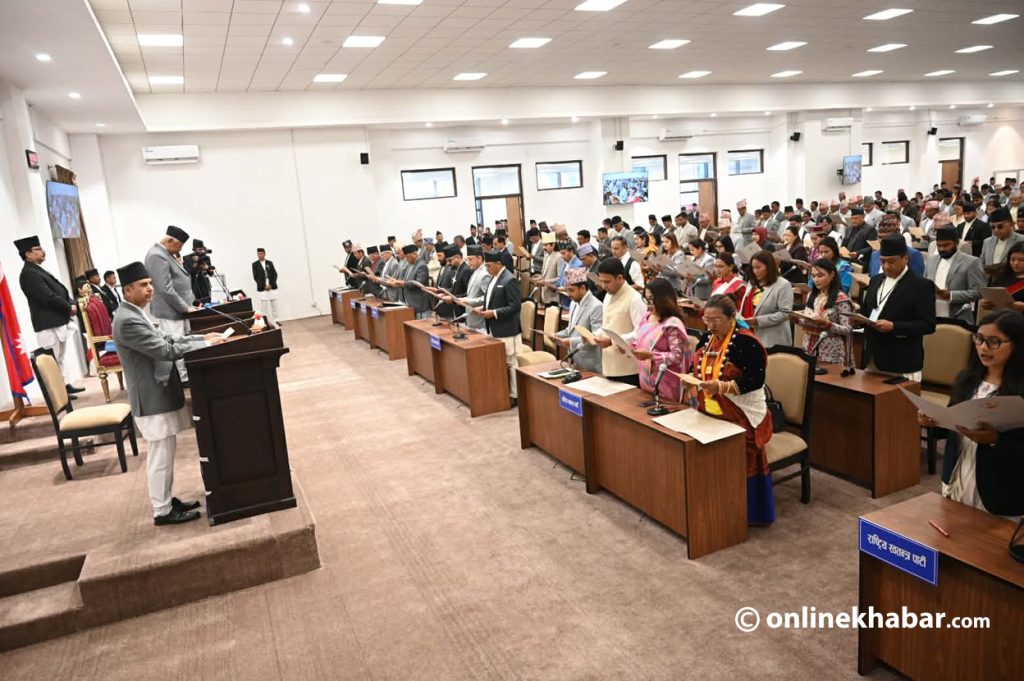
The RSP-led government came to power with significant public support and high expectations for political and administrative transformation.
That mandate carries both opportunity and responsibility.
Strong public support does not mean that ministers, lawmakers or political appointees can disregard their roles, responsibilities or limits of authority. Opposition lawmakers do not lose their right to ask questions simply because they belong to parties associated with the old political establishment.
Similarly, civil servants do not become legitimate targets for humiliation simply because the government wants to demonstrate that it is different from previous administrations.
Nepal’s recent Gen Z movement has already brought profound political and social change. The destruction of police stations, government offices, Singha Durbar, courts, media houses, Bhat-Bhateni outlets and other public and private property caused not only physical damage but also affected the morale of many people working in public institutions.
At such a moment, the government has an opportunity to rebuild confidence in the state.
That requires working with Parliament rather than treating political disagreement as an obstacle. It requires restoring the morale of civil servants rather than intimidating them. It requires engaging the private sector through rules and institutions rather than threats. And it requires protecting constitutional bodies from political pressure.
Reform must be institutional
A government does not achieve governance reform simply by adopting the word “reform” as a political slogan.
Real reform is institutional. It means improving procedures, strengthening accountability, clarifying responsibilities, enforcing laws fairly and ensuring that decisions are made through established mechanisms.
It also requires political leaders to demonstrate the behaviour they expect from the institutions they seek to reform.
There is nothing inherently wrong with being firm. Ministers and lawmakers should be able to demand answers, challenge officials, investigate wrongdoing and take action when laws or procedures have been violated.
But firmness is not intimidation. Accountability is not humiliation. Political authority is not a licence to threaten.
The RSP-led government has been given an opportunity to demonstrate that governance in Nepal can be different. That change will ultimately be measured not by how loudly leaders speak or how aggressively they confront opponents, but by whether institutions become more accountable, professional and trustworthy.
Governance reform should reinforce institutional accountability, professionalism and adherence to rules and procedures. It should not normalise intimidation or humiliation.
Misbehaviour is not reform. And a government serious about reform should be the first to understand the difference.