
Kathmandu, October 5
The stage at the Nepali Congress’s 15th General Convention was filled with leaders from across Nepal’s political spectrum.
Almost all of the office-bearers elected at the party’s 14th General Convention were present, with only four exceptions. Photographs of the party’s late presidents and prominent leaders were placed at the front of the stage. But one face was missing.
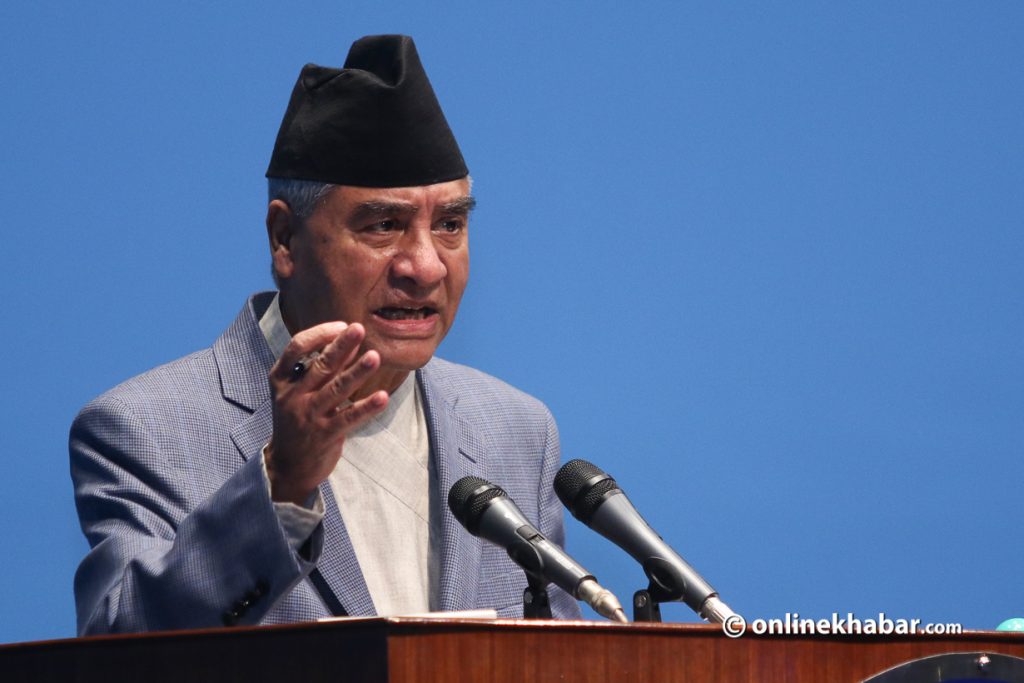
Former party president Sher Bahadur Deuba was not there.
According to Nepali Congress President Gagan Thapa, a chair had been kept for Deuba in his honour. His photograph was also included in the logo of the 15th General Convention. The party had formally invited him to attend the opening ceremony as chief guest. But the invitation never reached him.
Leaders including General Secretary Yogendra Chaudhary were turned back by security personnel when they attempted to deliver it.
Even shortly before the opening ceremony began, some Nepali Congress leaders, including Vice President Pushpa Bhusal, were still holding on to a faint hope that Deuba might appear.
He did not.
For a politician who has spent nearly six decades at the centre of Nepal’s democratic movement, Deuba’s absence from the Congress convention was more than the absence of a former president.
It marked the growing distance between Deuba and the party he once dominated.
Deuba had established a separate office to organise activities around the 15th General Convention and had been conducting political activities across the country. Some within Congress therefore expected that he might make a last-minute decision to attend.
He chose not to.
Instead, Deuba has continued on an uncertain political path, refusing to recognise the leadership elected by the party’s special convention as legitimate. In doing so, he has also gradually lost many of the political companions who stood beside him for years.
The people who once formed his closest political circle are no longer walking the same path.
The roots of the split lie in the questions raised about Deuba’s leadership following the Gen Z movement. Gagan Thapa and other Congress leaders openly challenged his leadership.
Deuba appears to have failed to recognise how quickly those questions were gaining strength.
The special convention eventually removed him from the party leadership.
For a politician with a six-decade history in the democratic movement, the more significant question was not simply that he lost the leadership. It was that he was unwilling to accept questions raised against him through a democratic process.
Thapa appeared to allude to this when he used Khulamanch as a metaphor during Sunday’s convention.
“The special feature of Khulamanch is that it brings different people together. But coming to Khulamanch does not mean all differences disappear. We need many more such open forums. People should not be expelled from the party simply for asking questions,” Thapa said.
Thapa himself had once been expelled from the party by Deuba after demanding a special convention under the party’s constitutional provisions.
Thapa also offered Deuba a difficult reminder about what it means to honour a political leader.
“Sher Bahadur Deuba’s honour will not be determined by how many times people salute at his door. It will be determined by how much they expand the party that Sher Bahadur Deuba built,” he said.
Thapa said Congress respected Deuba’s history and that was precisely why a chair had been reserved for him on the convention stage. But the symbolism went further.
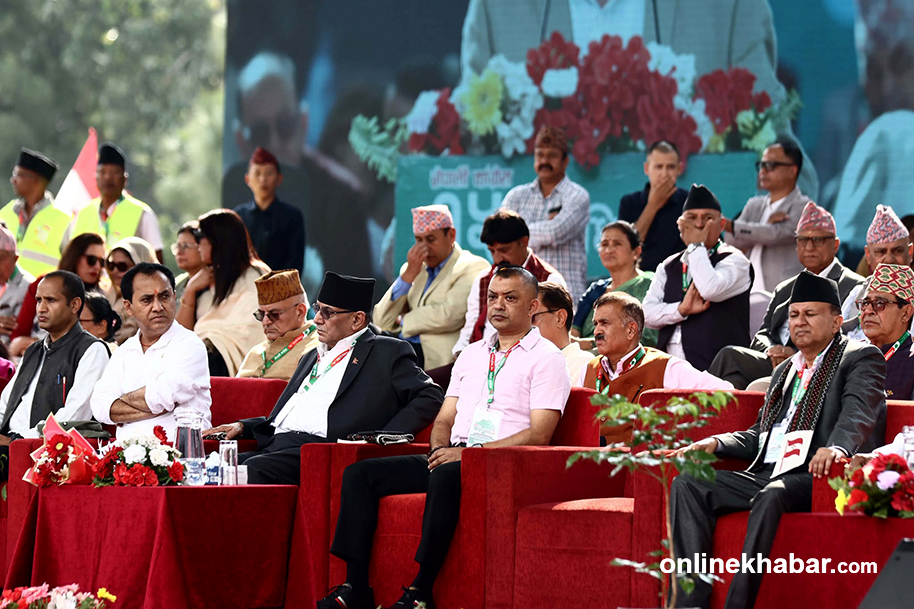
The 15th General Convention was set to bring the party its largest-ever number of representatives and potentially make significant changes to its leadership and political direction.
By staying away, Deuba may have lost an opportunity to shape the final chapter of his political career.
Deuba is not an ordinary figure in Nepali politics.
He has been jailed for his political activities, won elections repeatedly, served as home minister and become prime minister five times. He split the Nepali Congress in 2059 BS, later returned to the party and eventually transformed himself from an outsider into one of the central figures of the party establishment.
But near the end of his political career, he now finds himself in a role that appears increasingly difficult to justify.
His final political battle is no longer against a rival at an election, an opponent in Parliament or even a monarch.
It is against his own time.
Deuba has based his claim to political legitimacy on a case currently pending before the Supreme Court. But even if the court eventually restores that legitimacy, it may not be enough to restore his political relevance.
The mood at Khulamanch suggested that the party’s energy had moved elsewhere.
The new expectations and enthusiasm were directed toward a Congress that was trying to transform itself.
The party’s leaders were also sending a broader message—that Congress could continue without Deuba and some of the second-tier leaders who have remained close to him.
Thapa put it bluntly.
“I do not know where the sons of BP Koirala and Ganesh Man Singh are. But the spirit of BP and Ganesh Man is here,” he said.
RSP Chair Rabi Lamichhane added his own interpretation.
Sometimes, he said, instead of continuing to persuade people inside a party who constantly complain, create trouble and drain the organisation’s energy, it may be better to let them go.
It was a veiled political message, but its target was not difficult to identify.
Deuba’s absence has cost Nepali Congress the presence of several second-generation leaders associated with him, including Shashank Koirala, the son of BP Koirala; Prakashman Singh, the son of Ganesh Man Singh; Bimalendra Nidhi, the son of Mahendra Narayan Nidhi; and Shekhar Koirala.
Some older party workers have also been left outside the new Nepali Congress arrangement. But for Deuba himself, something more consequential may have been lost.
An important chapter of his nearly six-decade political history is missing. There was little left for Deuba to prove in conventional political terms.
He had served as prime minister five times. He had led Nepali Congress twice. He had split the party and eventually become part of its establishment. He had overtaken many of his contemporaries to reach the top.
He had fought against the monarchy and challenged the dominance of the Koirala family within Nepali Congress.
He had repeatedly won elections and secured the support of voters.
Had he voluntarily handed over leadership in the final phase of his career, he might have achieved another kind of victory—the victory of knowing when to leave.
He could have done so at the special convention.
Even if that opportunity had been missed, he could have used the 15th General Convention as a chance to correct course, particularly after the Supreme Court had already provided legal recognition in the matter he had been contesting. He chose not to. And that decision has left his political ground increasingly unstable.
Deuba’s political character does not require a great deal of documentation to understand. His five terms as prime minister tell much of the story.
Few contemporary politicians have understood the psychology of power as instinctively as Deuba.
He knows the arithmetic required to reach government. He knows when to remain silent, whom to bring into an alliance and when to make a decision.
But the question now is whether he has recognised that the question facing him is no longer simply who controls power.
It is whether he remains politically relevant.
There were also substantive achievements during his time in government.
The Mahakali Treaty, implementation of value-added tax, the declaration of the liberation of bonded labourers, efforts to strengthen the Commission for the Investigation of Abuse of Authority, and policy attempts to bring women, Dalits, indigenous communities, Madhesis and people from historically marginalised regions into the mainstream were among them.
Yet the central thread running through Deuba’s political career remained power.
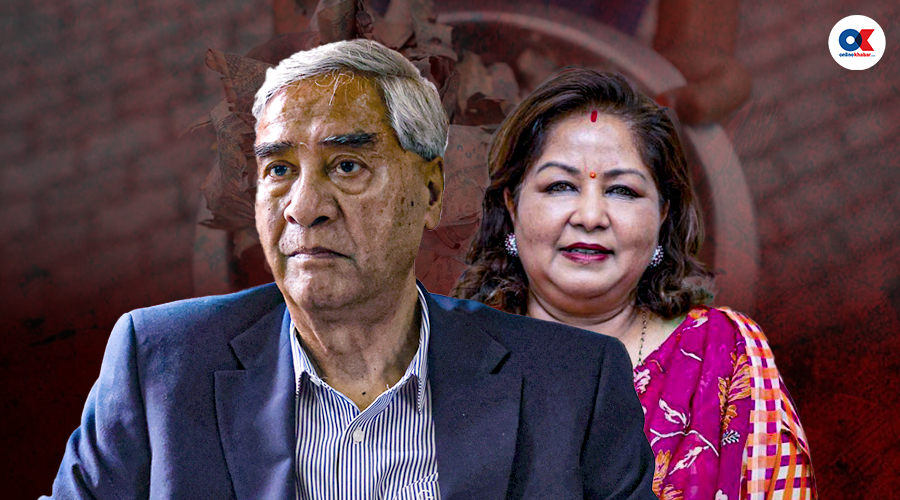
In recent years, he was also seen as trying to position his wife, Arzu Deuba, as his political successor.
That further damaged his public standing.
The depth of the public anger became visible during the Gen Z movement, when the situation deteriorated to the point that Deuba himself faced a physical attack.
For decades, Deuba’s greatest political strength was the network of people around him.
Ministers, lawmakers and political appointees who benefited from his patronage helped sustain his influence. That network is now weakening.
Many of his closest political allies have already moved away.
For now, one thin thread of hope remains—the case pending before the Supreme Court.
But even a favourable verdict may not answer the larger question confronting Sher Bahadur Deuba.
The question is no longer whether he can reclaim a position he once held. It is whether the political era in which that position mattered has already passed.