
In a quiet classroom at the University of Vienna, Nepali words fill the air. Students from different countries practise Nepali, Sanskrit, Limbu and Nepal Bhasa. But this is not simply a language class.
Alongside vocabulary and grammar, they learn about Nepal’s politics, society, history and literature. They write poems, sing Nepali songs, perform dances and stage plays. Sometimes, the classroom becomes a small theatre; at other times, it turns into a celebration of Nepali culture.
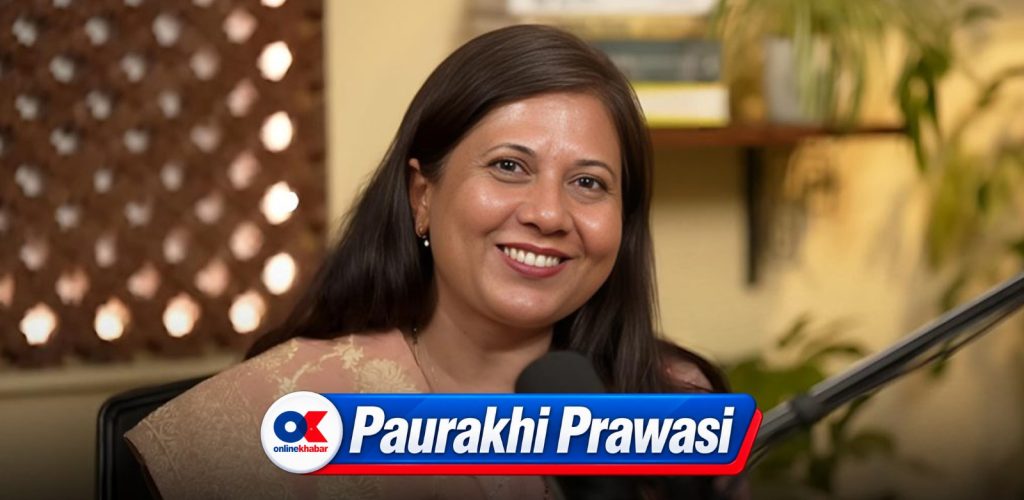
At the centre of it all is Dr Alka Atreya Chudal.
A writer, researcher and linguist, Chudal has spent nearly two decades teaching Nepali language and literature at the University of Vienna. She holds a PhD in the intellectual history of South Asia, with a particular focus on Indian scholar and writer Rahul Sankrityayan.
Her journey to Vienna, however, began long before she entered a European university classroom. It began at home, with a father who believed education was not optional.
Learning at home
Chudal was born on July 6, 1976, in Taulihawa, Kapilvastu. Her father, Prof Dr Vishnu Raj Atreya, was a scholar who carried on the traditions of the gurukul system. Her earliest education took place at home.
“I was taught by my father at home. There was an atmosphere of education in our family. My aunts and uncles had studied at least up to the Acharya level. We were not financially well-off, but education was considered essential. The belief was that everyone, sons and daughters alike, had to study,” she recalls.
Her father was working at Banaras Hindu University in India, where he served as the Nepal Chair, and the family lived in university quarters. Every morning, he taught his daughter before leaving for the university. He brought home old examination papers and gave her assignments.
“That is how I learned self-study,” she says.
At the time, India allowed students to sit private examinations from Grade 8 onwards. Chudal prepared for her exams at home and appeared for them once a year.
She was also had to look after her younger siblings.
“My brothers and sisters were very young, so I was almost like their guardian,” she recalls.
Her education was heavily focused on Sanskrit grammar, literature and philosophy. She did not have the usual pressure to study subjects such as mathematics and science. That early immersion in language would shape the rest of her life.
She passed the Purva Madhyama examination at the age of 10. She later completed an Acharya degree in Sarvadarshan from Nepal Sanskrit University and a master’s degree in Nepali from Tribhuvan University.
By the time she was 18, she had already completed postgraduate studies in three subjects. And before she was even 18, she had begun teaching as an assistant professor at Nepal Sanskrit University.
“I owe all of this to my father’s inspiration and guidance,” she says.
Not having attended a conventional school occasionally made her feel that she had missed something. But teaching soon filled that gap.
“At first, it felt strange teaching students who were much older than me. But I began to enjoy it. Teaching itself became my inspiration,” she says.
From the classroom to the microphone
There was another childhood dream.
Growing up in Banaras in the 1980s, Chudal would sometimes visit friends’ homes to watch television because her family did not have one. She was fascinated by the newsreaders appearing on the black-and-white screen.
As a child, she imagined herself doing two things — teaching and becoming a newsreader. The second dream came true remarkably early.
In 1987, at just 11 years old, she began presenting a children’s programme called Sanskritam on Nepal Television. A few years later, she became a newsreader.
She presented news in three languages — Nepali, Sanskrit and Hindi.
From 1996 to 2006, she remained associated with Nepal Television. Her radio career began in 1994, when she was contacted by phone about a plan to broadcast Sanskrit news. Her love of Sanskrit made the decision easy. Soon, her voice became familiar to audiences on both radio and television.
“Even during festivals such as Dashain and Tihar, there was no real possibility of taking a holiday. We had to work day and night,” she recalls.
At the time, professors and highly educated people were more visible in the media. Later, as FM radio stations expanded, a younger generation entered broadcasting and many of the older voices gradually disappeared from the mainstream.
Chudal, however, never saw broadcasting as the final destination. Her deeper interest remained teaching and research. Even today, she has strong views about the way news is presented.
She believes the increasingly loud style of television newsreading is at odds with the character of the Nepali language.
“Newsreading has increasingly become a shouting style. But the beauty of Nepali is that it should flow gracefully, like a river. Sometimes it feels as if we are copying Aaj Tak rather than maintaining our own style,” she says.
For her, language should be heard as naturally as it is written.
A new chapter in Vienna
Around 18 years ago, Chudal’s life took another turn. She moved to Austria and joined the University of Vienna. The university, founded in 1365, is the oldest university in the German-speaking world and has a long tradition of Sanskrit studies. Chudal became part of its Department of South Asian, Tibetan and Buddhist Studies, a field closely connected to Nepal and India.
Language is central to the department’s work. Chudal remembers entering the application process without personal connections or recommendations.
“I didn’t know anyone there. I had no recommendation. They were looking for someone who understood both Nepal and India and was proficient in Sanskrit, Nepali and Hindi,” she says.
After a demanding application process, she reached the final stage and received an email informing her that she had been selected.
She was invited to Vienna for an interview. After the interview, she was offered the position.
The move gave her something she had long wanted — the opportunity to pursue higher research while working with languages and cultures she had studied since childhood.
At the University of Vienna, she went on to complete her PhD on the intellectual history of South Asia, focusing on Rahul Sankrityayan. But Vienna also gave her something else.
It gave her a platform from which to introduce Nepal to students who might otherwise never encounter its language, literature and culture.
“Perhaps if I had stayed in Nepal, I would not have been able to do as much for the Nepali language. But coming abroad gave me an opportunity to present Nepali language and literature in a much broader way. That makes me extremely happy,” she says.
Bringing Nepal into the classroom
Chudal’s classroom is therefore about much more than learning Nepali words.
“We don’t only teach the Nepali language,” she says. “Students learn about Nepal’s history. They understand the development of its literature. They become interested in what is happening in Nepal today. They are just as curious about its politics, society and culture as people living in Nepal.”
Her teaching reflects that philosophy. A lesson might move from grammar to a song, from a discussion of history to a poem, or from language practice to a performance. Students sing Nepali songs, write poems, dance and sometimes write and perform their own plays. They are also introduced to languages such as Limbu and Newari.
Interestingly, Chudal herself learned Newari and Limbu after moving to Austria.
“I learned Newari here in Austria. I learned Limbu here as well,” she says.
Most of her students are Austrian, but students from other parts of Europe and the United States also travel to Vienna to study Nepali. She says the University of Vienna is currently the only university where Nepali is formally taught as part of an academic curriculum. Keeping students engaged is central to her approach. Even numbers can become a song.
When teaching numbers, for example, she uses familiar Nepali lyrics and wordplay to make students remember them.
For grammar and verbs, she often uses songs. One of her examples is Ani Choying’s Chitta Shuddha Hos, Mero Boli Buddha Hos.
The method allows students to encounter pronunciation, rhythm, grammar and culture at the same time.
“This is my way of teaching. You have to consider both the students’ interests and the curriculum. It makes learning easier, enjoyable and more lasting,” she says.
Why language matters
For Chudal, language is closely connected to the way people think.
A limited vocabulary, she argues, can limit the range of ideas a person is able to express and explore. Learning another language, meanwhile, can expand the way we understand the world. But she is equally wary of the idea that anyone can ever become completely finished with learning a language.
Language, she believes, is something people continue learning throughout their lives.
That is also why she is concerned about children from Nepali families growing up abroad without learning their parents’ languages.
She gives the example of a Limbu-speaking couple living in Spain who speak Nepali at home but do not teach either Nepali or Limbu to their children. The children grow up speaking only Spanish.
The consequence, she says, goes beyond language.
It can make communication with grandparents and other relatives more difficult and weaken a child’s connection with Nepal.
“If parents made an effort to teach their children their mother tongue, the children could participate in family conversations,” she says. “So teaching a mother tongue is not only about language skills. It is also a foundation for intellectual development and maintaining cultural connections.”
A book that became personal
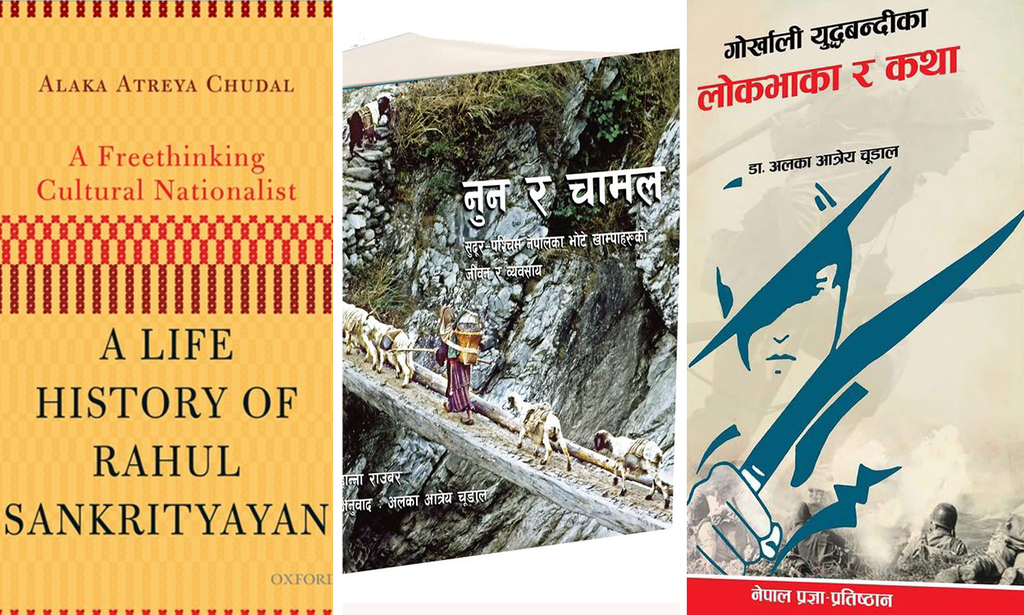
Chudal’s work has also taken her beyond the classroom and into translation. One of the most emotionally significant projects of her career was her Nepali translation of Of Salt and Rice, a book by Swiss anthropologist Dr Hanna Rauber about the lives and businesses of the Bhote-Khampa community.
Rauber had spent decades studying and developing a deep affection for Nepal. She wanted her work to be available in Nepali. At the age of 82, she sent Chudal her first email.
“I’m already very old. I want to see this English book translated into Nepali,” she wrote.
The sentence stayed with Chudal.
Rauber had already tried to have the book translated elsewhere, but the results had not satisfied her. The two women began communicating by email and later by phone. Chudal started translating the book afresh.
Translation was unfamiliar territory for her. Understanding every sentence and capturing its precise meaning took time. Her other responsibilities repeatedly pushed the project back. Then came unexpected news.
Rauber had been diagnosed with cancer.
From that point, the translation became more than a literary project. It became a personal responsibility. In September 2024, Chudal travelled to Switzerland to meet Rauber in person. Despite her illness, Rauber remained remarkably energetic.
She walked with a cane, but still had a smile on her face and a sparkle in her eyes.
For 15 days, the two women worked almost continuously, from 7 in the morning until 11 at night. They went through the book line by line, revisiting words and sentences.
At times, Chudal urged her to rest.
“You are unwell. We shouldn’t work like this,” she would tell her.
Rauber would smile and reply, “I want to keep working until I die.”
Their intense collaboration brought the two women closer. Doctors had told Rauber that she might have only a week left. Yet even from her hospital bed, she continued checking every line of the book. She had one wish — to hold the book in her own hands.
Eventually, Chudal was able to place a dummy copy of Nun Ra Chamal (Salt and Rice) in her hands. For Chudal, the moment was deeply emotional. It also brought back memories of her own father, who had died of cancer. In his final days, she had placed a dummy copy of his work Vararuchi in his hands.
“I had the opportunity to introduce two people who were dear to me to their own creations in the final moments of their lives,” she recalls.
Rauber passed away in January 2025. But her wish was fulfilled. Salt and Rice was eventually published in Nepali.
For Chudal, the book remains a tribute to Rauber’s lifelong love for Nepal and a reminder of how translation can carry not only words, but relationships and memories across languages.
Returning Nepal’s forgotten voices
Her work with language and culture has also led her into historical research.
Chudal has collected and published folk songs and stories associated with Nepali Gurkha prisoners of war who were held abroad more than a century ago. She began researching the material in 2015.
As she searched through archives and historical collections, she gradually discovered more stories, voices and details. Much of the material had been preserved in a museum in Germany. For Chudal, it raised a simple question — why should the voices of Nepalis remain locked away in a foreign archive?
“We often think of a country’s wealth as physical structures and money,” she says. “But language, literature and culture are also national wealth.”
She wanted those voices to return to Nepal.
“I strongly felt that the voices of these Nepalis needed to come back home,” she says. “That is why I also felt that this book should be published in Nepal.”
The resulting work is more than a collection of wartime stories. According to Chudal, it offers a window into history, society, language and literature. Readers can learn how the prisoners lived, what communities they came from, what they thought and how they expressed themselves through songs, poems and stories.
“For me, it is really a historical document,” she says.
A life in language
Chudal’s own writing has followed many different paths. She has written two books in German, including work developed with a colleague. She has also written Ramro Nepali, a book designed particularly to help German-speaking students learn Nepali.
She has written the long poem Ninad Vallari and, around 18 years ago, published her autobiography Balyakal Sanga Lobhindai Balyakal. More recently, she completed an English translation of Swasthani with a friend.
She continues to work on presenting the stories and folk songs of Nepali Gurkha prisoners of war to English-speaking audiences.
Her research interests also include Nepali political consciousness, the history of Nepali women, and the linguistic and cultural development of Nepali society.
Across all these projects, however, there is a common thread. Language is never merely language for Chudal. It is history. It is memory. It is culture. It is a way of connecting generations and allowing one society to be understood by another.
Nearly two decades after arriving in Vienna, she continues to bring Nepal into classrooms thousands of kilometres from home — through its words, songs, stories, history and literature.
“My goal is to take Nepali identity to the world,” she says.
And that work continues, one word, one book and one classroom at a time.