

Kathmandu, November 4
Nepal has formally proposed that six additional mountain peaks above 8,000 metres be recognised as independent summits by the International Climbing and Mountaineering Federation (UIAA).
The proposal was presented at the UIAA General Assembly held in Kathmandu, which brought together representatives from 45 countries.
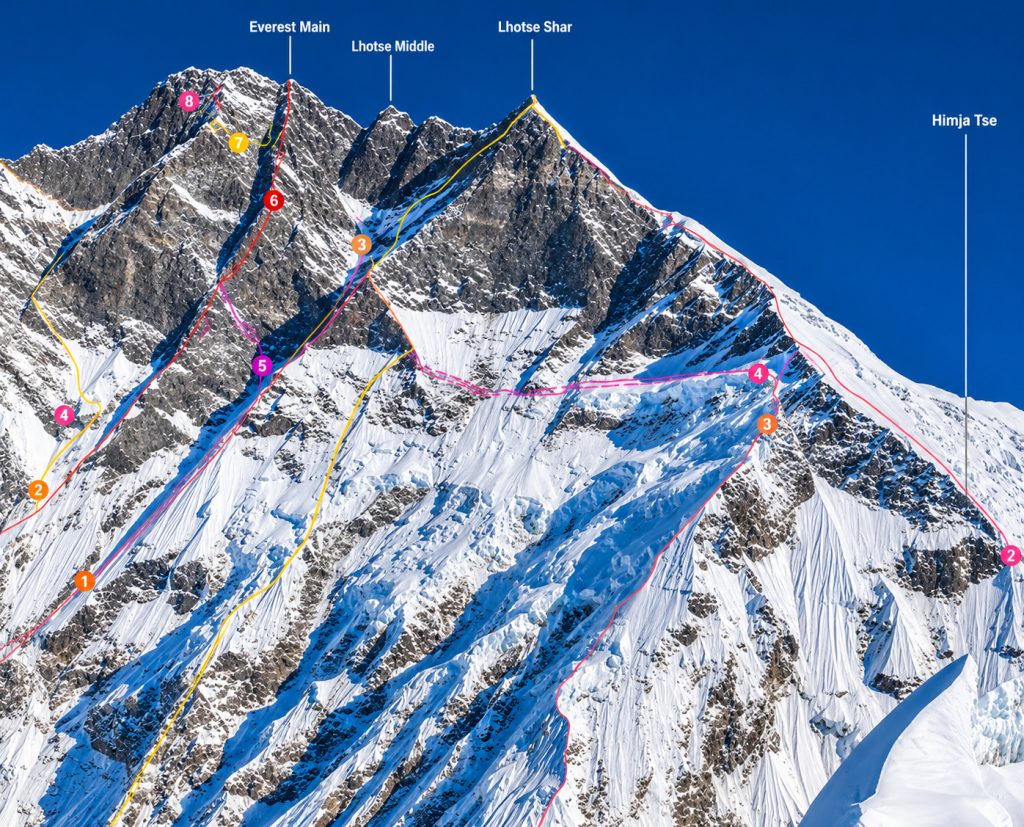
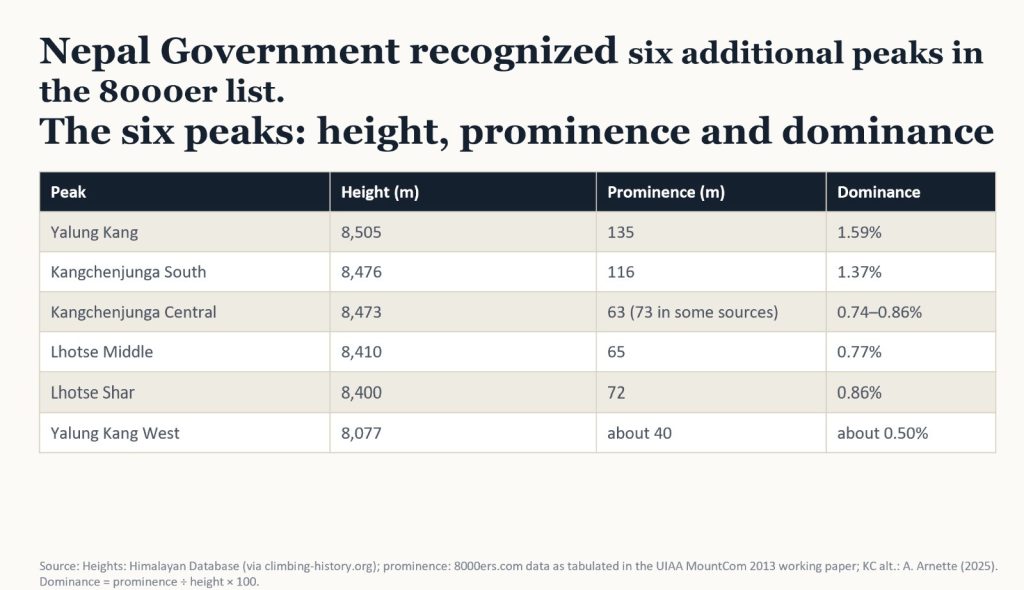
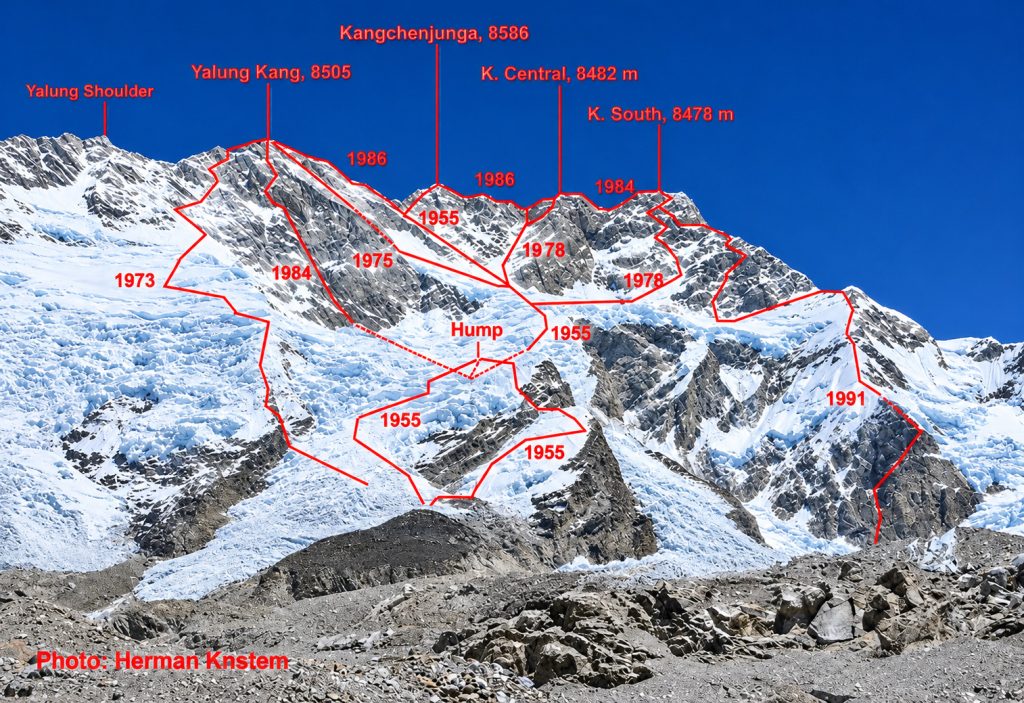
According to Fur Gelje Sherpa, president of the Nepal Mountaineering Association (NMA), Nepal has sought recognition for Yalung Kang (8,505 metres), Kanchenjunga South (8,476 metres), Kanchenjunga Central (8,473 metres), Lhotse Middle (8,410 metres), Lhotse Shar (8,400 metres) and Yalung Kang West (8,077 metres).
There are currently 14 internationally recognised mountains above 8,000 metres. Eight of them are in Nepal, including Mount Everest, the world’s highest peak, as well as Kanchenjunga, Lhotse, Makalu, Cho Oyu, Dhaulagiri, Manaslu and Annapurna.
The other six recognised peaks are Shishapangma in China (Tibet), and K2, Gasherbrum I, Broad Peak, Gasherbrum II and Nanga Parbat in Pakistan.
Pakistan also has Broad Peak East, which rises above 8,000 metres, but has not pursued its recognition as a separate summit, according to mountaineering experts.
The existing list of 14 peaks was first recognised by the UIAA in 1986, following the first ascent of all 14 by Reinhold Messner.
Nepal, however, already recognises the six additional peaks as separate mountains for administrative and mountaineering purposes. The government has been issuing climbing permits and certificates for 14 mountains above 8,000 metres in the country.
“We have recognised 14 mountains above 8,000 metres in Nepal and have been issuing climbing permits and certificates accordingly,” said Ram Krishna Lamichhane, director general of the Department of Tourism.
This is not the first time Nepal has sought international recognition for the six peaks. The proposal was first raised at the UIAA more than two decades ago.
Ang Tshering Sherpa, a former NMA president, recalled raising the issue at the UIAA General Assembly in Hong Kong in 2005.
In the first week of May 2013, the UIAA Management Committee discussed a proposal to recognise the six mountains as independent summits. The issue was also raised at the federation’s general assembly in Switzerland in October that year, but no decision was made.
Sherpa said Nepal’s attention at subsequent UIAA meetings was largely focused on the dispute among climbers on Everest in 2014 and the avalanches on Everest and Langtang following the 2015 Gorkha earthquake.
Despite repeated efforts by the NMA and other stakeholders, the UIAA has continued to maintain its position on the traditional list of 14 eight-thousanders.
However, the UIAA Mountaineering Commission stated in 2023 that the Nepal government had full authority to recognise additional peaks for administrative or other purposes.
The commission maintained that the UIAA’s position was to retain the traditional list of 14 mountains above 8,000 metres.
Following the latest general assembly in Kathmandu in the second week of Kartik, NMA president Sherpa said he was optimistic that UIAA officials would consider Nepal’s proposal positively.
“Previously, we had been raising this issue verbally with the UIAA. This time, we submitted our proposal in writing,” he said. “We presented the report prepared by our study committee at the general assembly. We are confident that the UIAA will consider the issue positively.”
Sherpa said UIAA officials had advised Nepal to submit the proposal to its Mountaineering Commission for consideration.
“They said that although the process would be lengthy and cumbersome, we would have to go through the bureaucratic procedure,” he said.
The next UIAA General Assembly is scheduled to take place in Chile in October 2027. Ang Tshering Sherpa, one of the federation’s seven expert members, said a breakthrough could be possible by then.
“We have submitted documents outlining the criteria for recognising the six additional peaks. The UIAA could make a decision by next year,” said Sherpa, who is also a former NMA president.
The UIAA Mountaineering Commission has acknowledged that recognising the six peaks, as proposed by Nepal and its government, could bring significant changes to mountaineering expeditions involving mountains above 8,000 metres.
However, despite more than two decades of debate within the mountaineering community, there is no single explanation for why the six peaks have not been granted separate recognition.
Experts say the absence of clear and universally accepted UIAA definitions of a mountain, summit, peak, top or point, combined with Nepal’s failure to follow up consistently, has hindered a decision that could benefit both Nepal and the international mountaineering community.
According to them, some climbers who have already completed all 14 traditional eight-thousanders have openly opposed recognising additional peaks.
Nepal’s position, however, is that the recognition of additional summits should move forward while preserving the historical record and achievement of climbing the classic 14 peaks.
At the recent general assembly, a report prepared by a committee led by former government secretary Madhusudan Adhikari was presented on behalf of Nepal.
The committee included Khimlal Gautam, deputy superintendent at the Department of Survey who led the team that measured Mount Everest’s height; Mahesh Thapa, president of the Nepal Geomatics Engineering Society; and mountaineering researchers Anish Dahal and Thaneshwar Guragain.
The UIAA considers several factors when classifying mountains, including topographical features, historical evidence, the interests of local communities, the concerns of the Nepal government, and the cultural and spiritual significance of the mountains. It also draws on previous experience in classifying Alpine mountains above 4,000 metres.
Mahesh Thapa said all six peaks proposed by Nepal met the criteria for separate recognition.
He said their prominence, geographical isolation and dominance in relation to neighbouring passes and summits provided sufficient grounds for recognising them independently.
In terms of climbing history, five of the six peaks have already been climbed. Yalung Kang West, at 8,077 metres, is the only one that has not yet been summited.
Edward Morgan, a British climber and writer based in Switzerland, has also argued in an article that all six peaks have sufficient geographical independence to be treated as separate mountaineering objectives.
Writing in the Nepali Times, Morgan noted that the six peaks have varying degrees of prominence and geographical isolation. He identified Yalung Kang, with a prominence of 135 metres, as having the strongest case for separate recognition.
Khimlal Gautam, who has climbed Everest twice and is the author of the book The Fifteenth Peak, said Nepal had been disadvantaged by the absence of a universally accepted definition of a mountain, summit or peak.
Lamichhane, the director general of the Department of Tourism, said Nepal needed to focus on three areas to strengthen its case for international recognition.
“Nepal needs to maintain consistent follow-up, accelerate scientific research and strengthen data verification,” he said.