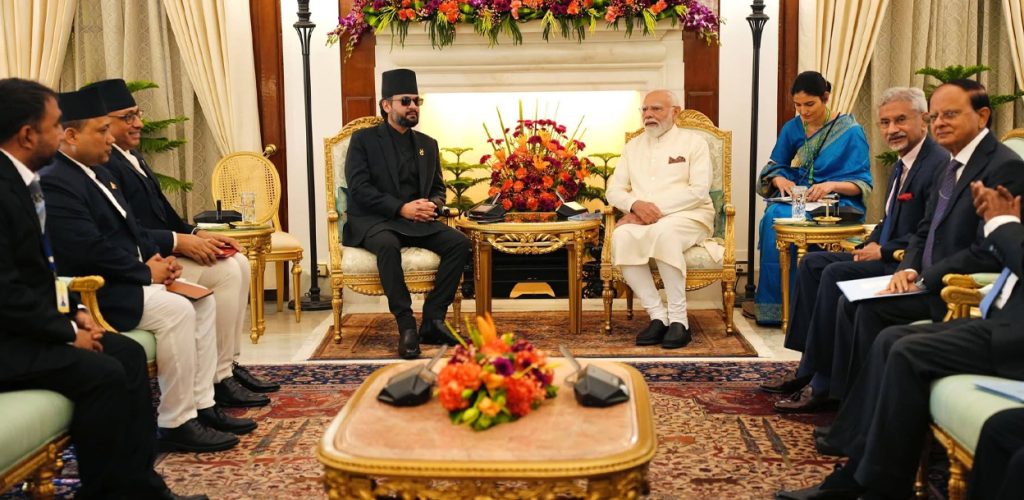
New Delhi, November 23
Nepal and India have agreed to activate a high-level monitoring mechanism to ensure the timely implementation of key agreements, understandings and projects reached during Prime Minister Balendra Shah’s state visit to India.
A clear framework for implementing the agreements has been outlined in the section on implementation mechanisms of the joint vision document titled Developed India and Prosperous Nepal: Reimagining the Partnership, issued during Shah’s visit.
Under the arrangement, the two prime ministers have decided to activate a high-level monitoring group led by Nepal’s foreign secretary and the Indian ambassador to Nepal.
According to Point 6 of the agreement, the group will meet at least once every six months. It will be responsible for ensuring the early implementation of projects, ideas and initiatives envisaged in the joint vision document, as well as facilitating the necessary government approvals and clearances.
Point 7 states that the monitoring group will submit progress reports to the India-Nepal Joint Commission, which is co-chaired by the foreign ministers of both countries.
The two prime ministers have also agreed to hold the next meeting of the Joint Commission in 2027 and directed officials from both sides to translate the shared vision into concrete outcomes.
During the visit, the two countries reached agreements on a development cooperation package worth Rs 240 billion, access to Kandla and Paradip ports, the Pancheshwar and Lower Arun hydropower projects, integrated check posts, expansion of railway networks, the establishment of an offshore campus of an Indian Institute of Technology in Nepal, and eight memorandums of understanding, among other initiatives.
The time-bound monitoring framework has been introduced to prevent a recurrence of a pattern in which agreements are signed but their implementation remains slow.
Why is high-level monitoring necessary?
Mahendra P. Lama, a Nepal-India relations expert and former Indian member of the Eminent Persons Group (EPG), says the failure to implement past agreements has been a major source of mistrust between the two countries, making an effective monitoring mechanism essential.
Speaking to Onlinekhabar, Lama stressed that there must be clarity about who is responsible for monitoring the implementation of agreements once they are signed.
“I think one of the main reasons trust has weakened in Nepal-India relations is the failure to implement agreements