Kathmandu, August 21
The government has held a high-level inter-agency discussion on the existing problems in waste management in the Kathmandu Valley and measures for their long-term resolution.
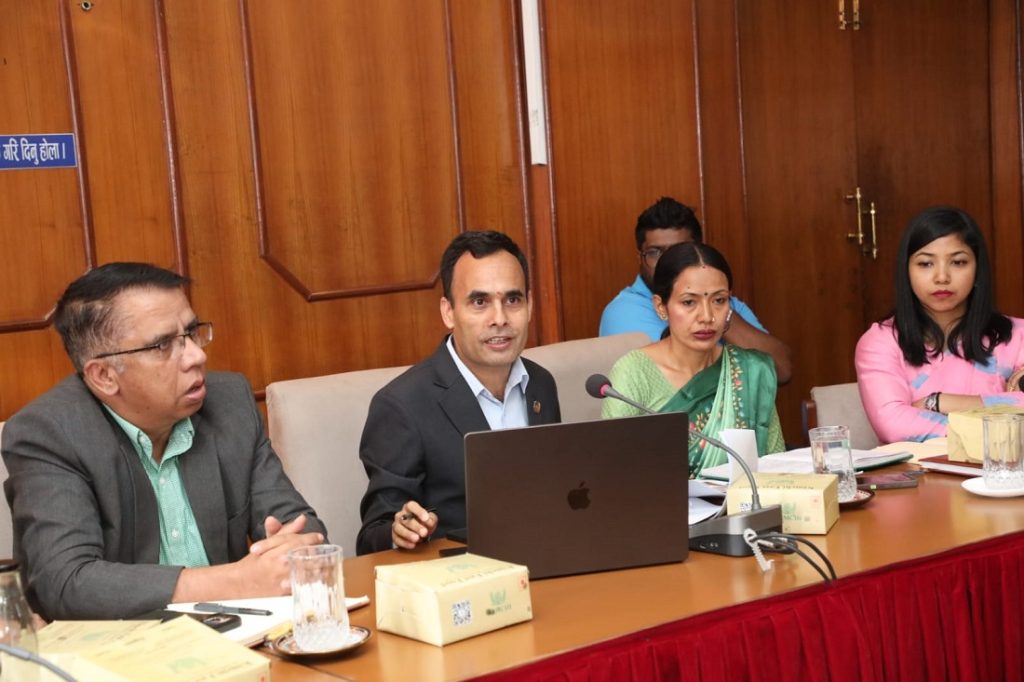
The discussion was held at the Ministry of Infrastructure Development on Friday under the chairmanship of Information and Communications Minister and Nuwakot-1 lawmaker Dr Bikram Timilsina.
Mayors and representatives of local governments in the Kathmandu Valley, officials from the Department of Environment, heads of agencies involved in waste management, waste management experts and representatives of communities affected by the Bancharedanda landfill site participated in the meeting.
According to the Ministry of Communications, the meeting concluded that although waste management is primarily the responsibility of local governments, coordination among the federal government, local governments and other concerned agencies is essential for a long-term solution.
Timilsina said the government had given high priority to the problems faced by residents affected by the Bancharedanda landfill and the broader issue of waste management.
He said the government was serious about resolving the problems that have persisted in waste management for years.
“The government is ready to make every possible effort to address policy and practical problems. The federal government is very serious about resolving the waste management problem,” Timilsina said. “All municipalities and agencies must also contribute from their respective sides.”
Timilsina said the Constitution and existing laws assign waste management responsibilities to local governments and that each municipality should move towards managing its own waste.
He pledged that the federal government would facilitate and support local governments in doing so.
The minister also said the federal government would work to resolve issues related to acquiring land needed for waste management.
He said the government would also consider legal amendments if necessary and was discussing ways to make land available to local governments, including through leasing.
“The government is committed to resolving the problems related to land acquisition. Similarly, we are committed to resolving the issues surrounding Nepwaste, which has been stuck in legal disputes for years after an agreement was signed for waste management,” Timilsina said.
“We are ready to identify where the responsibility lies, who needs to do what and where problems arise during implementation, and make a breakthrough.”
Local governments said an agreement with Nepwaste and subsequent legal disputes have made it difficult for them to develop independent waste management systems. Nepwaste is a joint venture between Nepal’s Organic Village and Finland-based company Komunikation Oy.
Timilsina stressed that efforts to solve the waste problem should not create additional complications and that the government should proceed with a clear division of responsibilities.
Local governments say they are ready to manage their own waste
Local government chiefs participating in the discussion pledged to manage waste generated within their respective municipalities and called for necessary facilitation from the federal government.
Kathmandu Metropolitan City acting mayor Sunita Dangol said waste management had previously been politicised, with different levels of government blaming one another.
She said that approach should end and that the government should address the problem at its source.
Dangol said Kathmandu Metropolitan City was working responsibly on waste management but needed short-, medium- and long-term plans.
She also said resolving the issues related to Nepwaste would make waste management easier.
Lalitpur Metropolitan City mayor Chiri Babu Maharjan said the agreement with Nepwaste was still in effect, preventing the metropolitan city from independently managing its waste.
He called for the agreement, which he said falls outside the metropolitan city’s jurisdiction, to be scrapped and said Friday’s meeting could become a starting point for resolving the issue.
Budhanilkantha Municipality mayor Mitharam Adhikari said the municipality wanted to manage its own waste but had been unable to move forward due to various legal disputes and court orders.
Tokha Municipality mayor Prakash Adhikari said waste management was a shared responsibility and that the municipality was ready to provide financial and other support.
He said different technologies could be used for waste treatment and called for an integrated plan and long-term mechanism.
Dhunibesi Municipality mayor Balkrishna Acharya said various agreements had been reached on waste management in the past but had failed to resolve the problem.
He called for those agreements to be reviewed so that local governments could create systems to manage their own waste.
Kirtipur Municipality mayor Krishnaman Dangol said the municipality planned to implement a system to manage its own waste within the next six months.
He also said other municipalities could learn from the practices Kirtipur has adopted in waste management.
Dakshinkali Municipality mayor Mohan Basnet said the municipality had started waste segregation three months ago, which had reduced the volume of waste.
He called on elected representatives of all municipalities to commit to managing waste within their own jurisdictions.
Infrastructure Development Ministry Secretary Gopal Prasad Sigdel said all levels of government must take responsibility for finding a long-term solution.
He said blaming one another would not resolve the problem and called for a joint effort by all local governments and concerned agencies.
Kathmandu sends nearly half of waste to Bancharedanda
During the meeting, Kathmandu Metropolitan City Environment Department chief Sarita Rai presented a report on the current condition of the Bancharedanda landfill site and plans for its future management.
According to the presentation, 1,792 ropanis of land have been acquired for the Bancharedanda site. However, although the site is around 24 kilometres from Balaju, Kathmandu Metropolitan City has yet to receive official documents specifying the boundaries of the acquired land.
Of the waste transported to Bancharedanda from 21 local governments, Kathmandu Metropolitan City accounts for 48.8 percent, Lalitpur Metropolitan City for 10 percent and Budhanilkantha Municipality for 5 percent, according to the presentation.
The meeting proposed moving towards a decentralised waste management model, establishing technology within individual municipalities for the reuse and recycling of dry waste, producing organic fertiliser and energy from biodegradable waste, and installing resource recovery technology at Bancharedanda.
Improving waste collection and transportation services and increasing citizen satisfaction were also identified as priorities.
The Waste Management Act requires local governments to manage their own waste, and the meeting emphasised the need for municipalities to develop plans accordingly.
875 households directly affected by landfill
The meeting was informed that Rs 1.04 billion has so far been spent on infrastructure at the Bancharedanda landfill site, while contracts worth an additional Rs 516.3 million are currently underway.
According to the information presented, 875 households across 539 hectares have been directly affected by the landfill site, while areas within three kilometres of the landfill boundary are indirectly affected.
Residents of affected areas called for the establishment of a Waste Management Development Authority to address the problem on a long-term basis.
They also called for past agreements and commitments to be implemented, problems faced by affected communities to be addressed, and dependence on Bancharedanda to be gradually reduced.
Participants also proposed developing a plan to ensure that waste from the Kathmandu Valley no longer needs to be transported to Bancharedanda within the next four years.
To achieve this, they stressed the need to reduce waste generation, segregate waste at source, increase reuse and recycling, and promote circular economy practices.
They also proposed incorporating waste management, segregation, reuse and environmental protection into school curricula to increase public awareness.