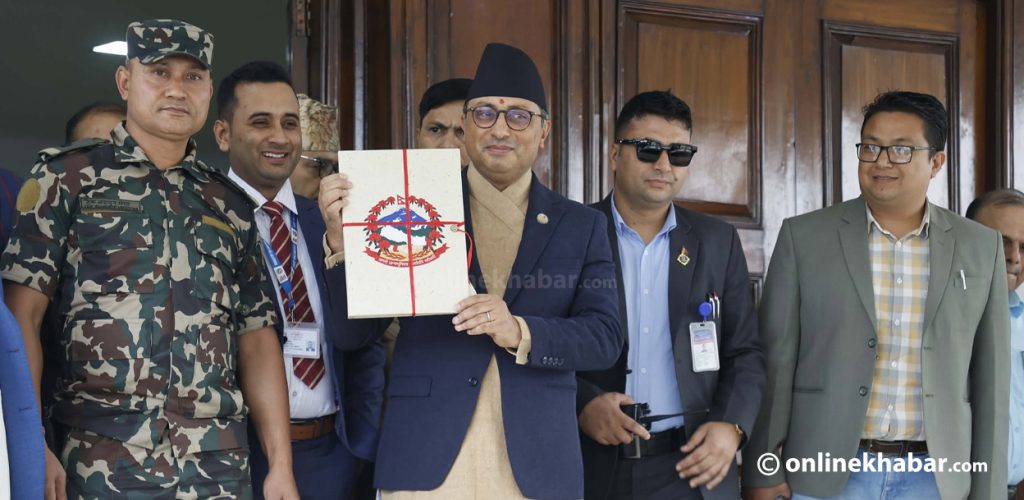
Kathmandu, May 29
Finance Minister Dr Swarnim Wagle on Thursday presented the national budget for the fiscal year 2026/27 in a joint meeting of the Federal Parliament, unveiling what the government described as a reform-oriented financial plan focused on good governance, economic transformation and industrial growth.
The budget speech was delivered after a Cabinet meeting held at the Office of the Prime Minister and Council of Ministers endorsed the annual estimates of government income and expenditure. The budget for the current fiscal year stands at around Rs 1.964 trillion.
Presenting the budget before the joint session of the House of Representatives and the National Assembly, Finance Minister Wagle said the new fiscal plan aims to end policy indecision, institutional capture and misuse of state resources while promoting result-oriented governance.
He stated that the country is at a decisive stage of comprehensive economic reform and said the budget prioritises a production-based economy, technology-friendly development and institutional good governance. According to him, the government seeks to transform governance culture and the structure of the economy through policy, legal and institutional reforms.
The government has also announced major changes in the tax system to expand the middle class and stimulate economic activity. The budget has set the income tax exemption threshold for individual taxpayers at Rs 1 million.
To encourage domestic industrial production, customs duties on 273 categories of industrial raw materials have been reduced by at least one level compared to finished goods. The existing 11-tier customs structure has also been revised and reduced to seven levels.
Similarly, excise duties on 360 items have been abolished, while taxes and fees collected at customs points, including infrastructure development tax and road maintenance charges, have been integrated under a new “green tax” system.
The government has further announced plans to fully automate the value-added tax refund system.
Minister Wagle said information technology, artificial intelligence, finance, trade, investment and the collective capacity of the Nepali diaspora would serve as key drivers of economic transformation. He added that the government aims to build a new framework for coordinated economic growth through the effective use of modern technology.