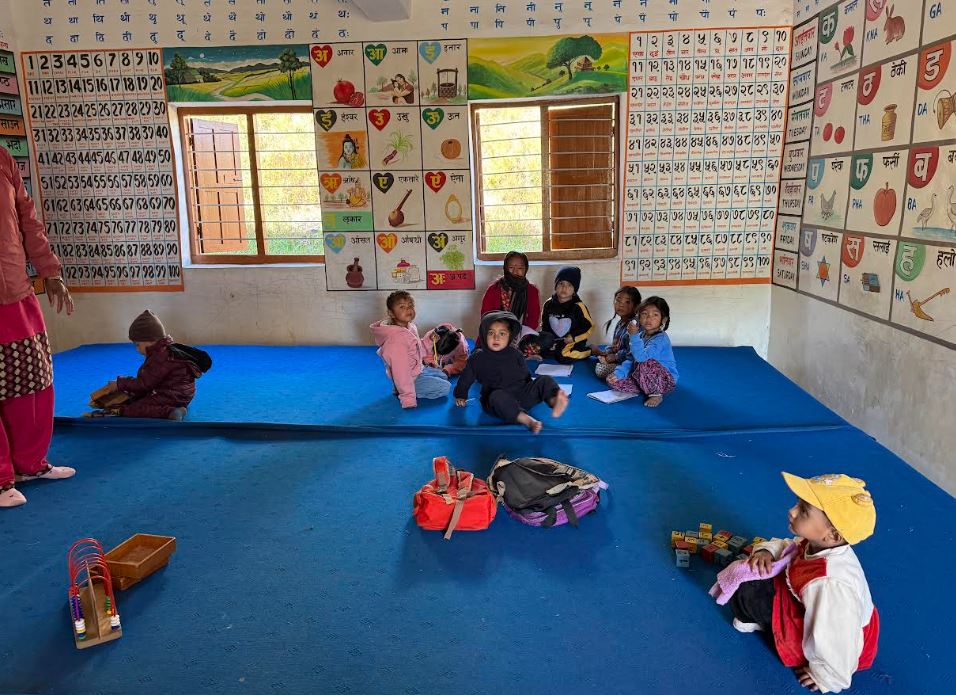
I recently visited Shree Sharada Higher Secondary School in Arun Rural Municipality, Bhojpur. What I witnessed there troubled me deeply. The Early Childhood Development classrooms sat nearly empty. A school that once buzzed with hundreds of students now struggles with alarmingly low enrollment at the ECD and primary levels.
The number of children has gone down due to migration to urban areas. Among those who remain in the village, most have moved to private schools, their parents choosing to pay fees rather than accept free government services.
Then my friend told me about Singh Jaleshwari Basic School in Khesang, another neighbouring primary school. The situation there is even more stark. The school has shrunk from Grade 7 down to Grade 5. Student numbers have dwindled to just 33.
This isn’t about two struggling schools. It’s the story of rural government schools across Nepal. And it reveals a crisis far deeper than empty classrooms.
The ECD paradox: Built but empty
I grew up in rural Nepal in the late 1975’s, a time when Early Childhood Education was not available in villages. I began Grade 1 without much preparation, finding it difficult to hold a pencil or follow instructions. Despite these early struggles, I was able to succeed in my education and career, even though ECD in Nepal did not begin until the 1950s.
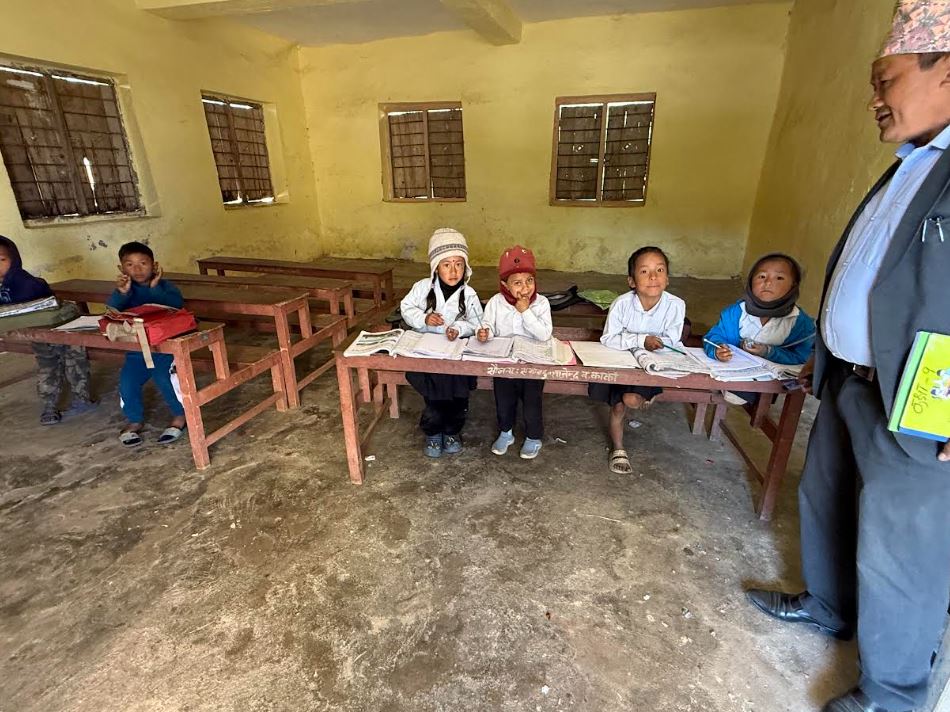
Today, the situation has changed dramatically. Nepal now has Early Childhood Development centres operating across the country. Government schools offer free education, free textbooks, and midday meals. Yet classrooms sit empty or nearly so. Schools that once served 200-300 students now struggle with 50-100 in ECD through Grade 5.
The pattern is clear and devastating: first, families migrate to cities, taking their children with them. Then, among the families who remain, parents increasingly choose private schools over free government services. This double exodus reveals something more troubling than empty classrooms: it reveals a complete collapse of trust.
The migration wound
Rural-to-urban migration is the most overlooked factor driving this crisis. Educated families and those with even modest means are leaving for cities, creating a devastating double blow.
First, these migrating families often provided leadership in School Management Committees. Without them, committees become inactive, meetings turn into formalities, and schools drift without accountability. Second, their children no longer attend these schools either.
This creates a brutal cycle. Government schools lose students to urban migration first, then lose more as remaining families choose private alternatives. What’s left is socioeconomic segregation: government schools increasingly serve only low-income families who have neither the means to migrate nor the money for private school fees.
Why private schools win (Even when they shouldn’t)
Here’s the uncomfortable truth: in Arun and similar areas, private schools with rented buildings, no playgrounds, and minimally trained teachers still attract parents. The reason? Children “speak English from day one,” and schools “project discipline.” Government ECD centres are seen as slow and uncertain.
This raises a critical question: why do municipalities license new private schools when government schools are losing students? Political pressure, demand for English-medium education, and belief in “healthy competition” drive these decisions. But dividing a shrinking student population ensures neither system can operate effectively.
The teacher’s credibility crisis
The most damaging reality of all: most teachers’ own children don’t attend the government schools where they teach. They’re enrolled in private schools in nearby towns.
Parents notice this. The unspoken message is devastating: “Even teachers don’t trust this system.” When teachers choose private schools for their children, it erodes their moral authority completely. How committed can teachers be when their own children study elsewhere?
The poverty trap
As migration and private enrollment draw away advantaged families, government schools serve increasingly marginalised communities. The parents who remain face unique challenges: working multiple jobs, migrating for seasonal labour, and struggling with basic survival. Limited education makes them hesitant to interact with teachers. Time poverty means no flexibility for school visits. Poverty creates psychological distance, a feeling that they “don’t belong” in school spaces.
This disengagement isn’t apathy. It’s exhaustion. Teachers see it as indifference and decrease their efforts. Parents see this decreased effort as neglect. The cycle reinforces itself.
When free isn’t enough
The government highlights free education, textbooks, and midday meals. These matters, especially important for low-income families. But parents are clear: “We’re not only feeding our children, but we’re shaping their future.”
Parents will pay for private schools if they believe their child will learn, gain confidence, and not fall behind. Free services without visible quality don’t build trust.
The investment problem
If government schools cannot maintain adequate enrollment at ECD and primary levels, all investments risk becoming wasteful. The infrastructure built for 200 students serves 50. Teachers teach classes of 5-8 children. Midday meal systems operate inefficiently. Training improves teachers, but they face tiny, disengaged classrooms.
The return on investment diminishes dramatically when schools operate far below capacity. Yet this is increasingly the reality across rural Nepal.
What must change
Revitalising rural government schools requires action on multiple fronts. Local governments must create incentives for educated families to stay and participate in School Management Committees. Regulate private school expansion based on actual village needs rather than allowing unlimited growth. Make government schools transparent through regular parent-teacher meetings and clear progress reports showing real learning outcomes.
Address the “English anxiety” by hiring teachers who can introduce basic oral English early while maintaining strong mother tongue foundations. Provide teachers with locality-based incentives to keep quality educators in rural postings.
Most transformatively, create locally-managed Child Development Funds. When household budgets are tight, the promise of free nutritious daily meals and quality learning materials becomes powerful. If government ECD centres can provide better facilities and consistent meals through transparently managed funds, they become the most attractive option.
The choice ahead
Standing at Shree Sharada School, seeing those empty ECD classrooms, and learning about Singh Jaleshwari Basic School in Khesang with just 33 remaining students, I understood that these aren’t isolated cases. They represent a systemic failure happening across rural Nepal.
Parents aren’t rejecting public education because it’s public. They’re rejecting it because they’re uncertain it will prepare their children for the future.
Without urgent reform, the migration-driven hollowing out of rural schools will accelerate, creating an educational landscape where public schools serve only low-income, least engaged families while wasting substantial investments.
The question isn’t whether rural communities want quality education. They desperately do. The question is whether Nepal’s educational system can evolve fast enough to meet expectations before public education in rural areas disappears entirely.
The future depends not only on free services but on trust restored, communities stabilised, and investments protected through sustained enrollment. Those 33 children at Singh Jaleshwari deserve more. The nearly empty classrooms at Shree Sharada deserve to be filled again. But that will only happen when we address the fundamental crisis of trust that has driven families away.