

Nuwakot, September 6
“It’s coming… it’s coming… the river is going to sweep everything away!”
People began shouting outside as residents of the old Trishuli Bazaar in Ward No. 1 ran for safety.
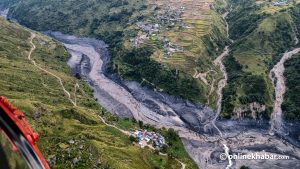
The Trishuli River was rising rapidly before their eyes. Water surged beyond its banks and towards the homes and streets where people had lived for generations.
“It came dancing,” 70-year-old Kanchi Shrestha recalls.
That day, Kanchi was at home with her 88-year-old husband, Siddhibahadur Shrestha, their son Shyam and grandson.
Before the flood reached their home, Shyam had urged his elderly parents to leave. He even tried to put them in a tempo and take them somewhere safe. But they refused.
This was where they had spent their lives. Their home held years of work, memories and the property they had managed to build.
“We will die if we have to. We will die here,” they told Shyam..
“My brother kept telling them to leave, but they would not listen,” their daughter, Sangita Tamang, recalls.
No one imagined that decision would soon become a matter of life and death.
She would not leave him behind
As the water surged closer, Kanchi realised they could no longer stay. But there was one problem. Siddhibahadur was frail and could not walk properly even under normal circumstances. His eyesight was also poor.
There was no time to think. Kanchi grabbed her husband and pulled him along.
“She somehow pulled him and brought him along. He still has injuries on his body from being dragged,” Sangita said.
Other villagers also came to their aid.
For Kanchi, surviving the flood meant refusing to leave behind the man with whom she had spent decades of her life.
‘I thought my parents were dead’
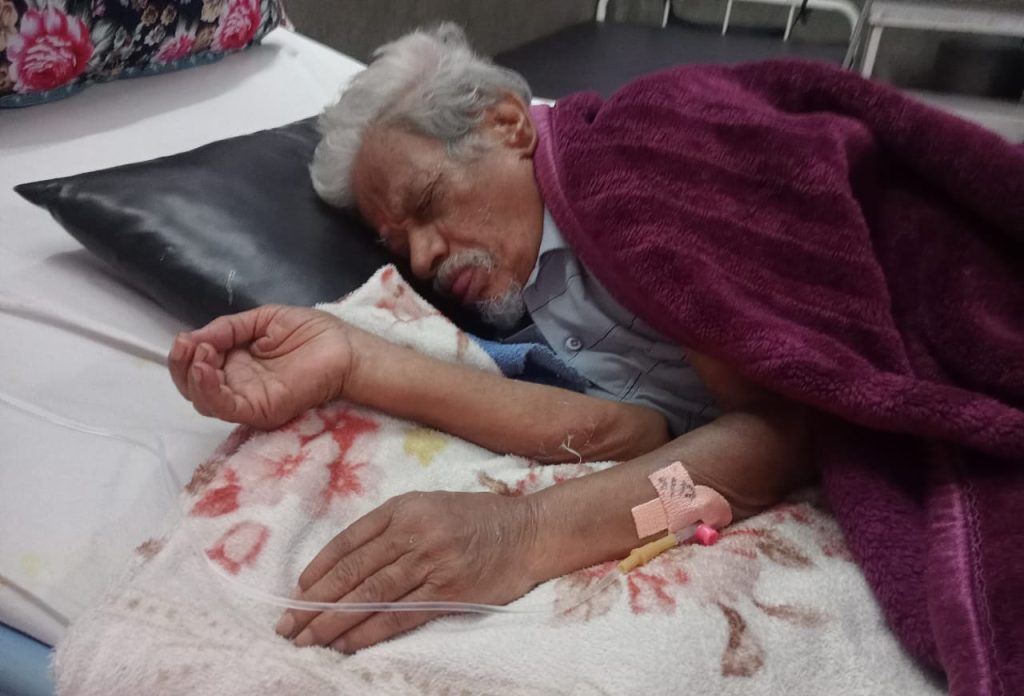
Shyam had already fled uphill with his son. He had tried repeatedly to convince his parents to leave.
“My parents said they would rather die there. I told them many times, but they insisted,” Shyam said over the phone.
Then another warning came: leave immediately.
His son had been sitting down to eat when news spread that the flood was approaching. They left without finishing their meal.
“We were about to eat rice, but we could not. We ran uphill, and as soon as we got a little higher, the river came,” Shyam recalled.
Within minutes, the flood reached the area they had just left. Water rushed along the road and towards the houses.
Shyam’s thoughts turned to his parents, but he could not return. He had reached higher ground with his son, while communication was intermittent.
In the confusion, he assumed the worst.
“I had already reached higher ground. I thought my parents must have been swept away. I felt guilty,” he said.
For some time, there was no word about his parents.
Then, several hours later, a relative brought news: someone had seen the elderly couple while fleeing the flood.
“As soon as I heard, ‘Your parents are over there,’ I ran to find them,” Shyam said.
By then, he had almost forgotten about his house and property.
He had only one question: Were his parents alive?
They were.
But Siddhibahadur was in poor condition. He could barely walk and had to be carried even to the toilet. He repeatedly became frightened, saying the flood was coming again.
Shyam kept his parents at a place of refuge for two days before arranging a helicopter to evacuate his father to Kathmandu.
The phone call at 6 am
Sangita lives in Kathmandu.
When the flood struck, she heard from her brother that there had been no word from their parents. She had begun to fear that they were dead.
Then, two days later, at around 6 am, her phone rang.
It was her brother.
“Didi, we are safe. Father is in a very difficult condition. We are arranging to take him to Kathmandu for treatment,” he told her.
Sangita travelled to the area. When she arrived around 10 or 11 in the morning, army personnel were carrying her father from a helicopter.
“The army personnel were carrying my father,” she recalled.
Seeing him alive brought relief, but another thought struck her.
How had her 88-year-old father survived?
And how had her elderly mother managed to save him?
“I was shaking when I heard about the flood. My elderly mother herself saved my father. Even now, when I think about it, I am amazed,” Sangita said.
Siddhibahadur was eventually brought to Kathmandu and admitted to Bir Hospital.
The struggle, however, had only changed form.
The flood is still with Kanchi
Kanchi survived, but the fear has not left her. Her daughter says she has become withdrawn and easily frightened. She trembles, cries and struggles to sleep.
“For two or three days after remembering what happened, my mother’s legs kept shaking. She could not sleep. She did not want to eat,” Sangita said.
Kanchi keeps asking the same questions: What if the flood comes again? What if the water rises again? What if everything is swept away again?
The family gave her a mobile phone to distract her.
But even that can trigger memories.
“When she sees videos of the flood on someone else’s phone, she starts crying,” Sangita said.
For others, those videos are images of a disaster.
For Kanchi, they are memories of the moment her world almost disappeared.
‘Where do we start again?’
The flood took much more than the couple’s sense of security.
Shyam had worked in Malaysia and used his savings to build a home for his family. He had gradually accumulated property, hoping life would become easier.
In a matter of minutes, much of it was gone.
“A flood I had never seen in my life destroyed everything. I built that house after years of hardship, going without things. Now that house is gone. What do I do?” Shyam said.
He had also been preparing to move into a new house in Trishuli’s old market area, in Ward No. 9.
“If we had been there, we would not even have had time to run. Even if we had gone to the roof, we might not have survived. At least our lives were saved,” he said.
His livelihood has also disappeared.
After returning from foreign employment, Shyam did not want to leave the country again. He borrowed money to buy a tempo, hoping to earn a living by driving it and repay the loan.
“I bought the tempo on loan because I wanted to do something here instead of going abroad. Now that is gone too,” he said. “The house is gone, the tempo is gone. I don’t know what to do now. Where do we start again?”
His wife is currently working in Kuwait, but Shyam says her income is not what they had hoped for.
He is now staying at a nearby relief camp while his father remains in Bir Hospital.
At 88, Siddhibahadur has other health problems as well. His family says he has kidney-related problems and gallstones and also needs dental treatment.
Beside his hospital bed, Sangita is struggling with the financial burden.
“The hospital may not charge for treating the external injuries, but how will we pay for treatment of his chronic illnesses?” she asked. “What do I have? I am also living in someone else’s house and barely managing. My parents are in such a difficult situation. I cannot afford to support them, but I also cannot bear to see them suffer.”