Kathmandu, September 1
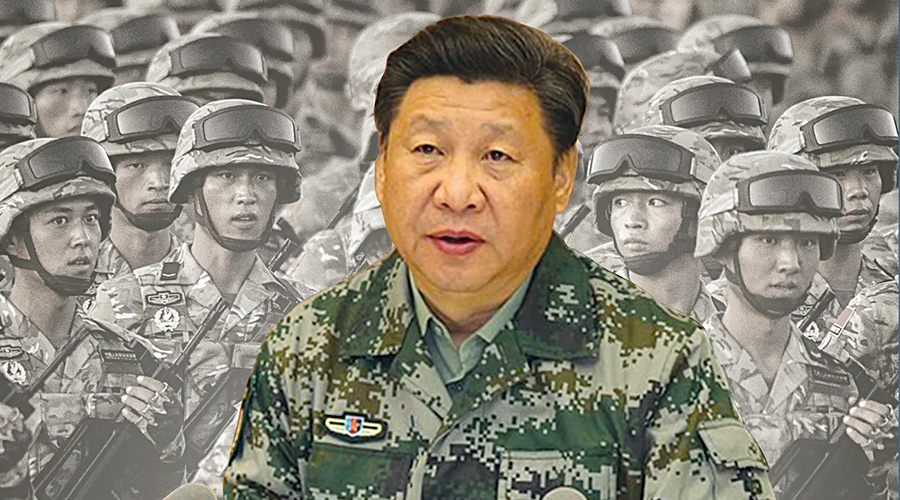
China has made major changes to its national defence legislation, allowing the government to mobilise not only the military but also civilians, private companies and other national resources during war or a major crisis.
China’s parliament, the National People’s Congress, approved amendments to the National Defence Mobilisation Law on August 28. The revised law will come into force on October 1.
The new law provides not only for the requisition of resources but also for placing them under government control. Those who refuse to comply with orders or deliberately cause delays could face penalties and fines.
Major overhaul after 16 years
China’s National Defence Mobilisation Law was enacted in 2010 and has now undergone its first major overhaul. The revised law contains 14 chapters and 82 articles.
According to China, its main objective is to enable the country to rapidly shift from a peacetime footing to a wartime state in the event of any threat. Economic and social resources can also be mobilised for defence purposes.
The revised law covers the protection of China’s sovereignty, unity, territorial integrity and security, as well as its “development interests.”
Military-civilian mobilisation mechanism under party leadership
According to Samantha Hoffman, an expert at the Jamestown Foundation, the new law introduces changes related to party leadership, organisational structures, reserve forces, recruitment, stockpiling of essential supplies and defence-related education.
Articles 3 and 17 place the national defence mobilisation system under the leadership of the Central Committee of the Chinese Communist Party. Previously, the State Council and the Central Military Commission played the leading roles.
According to Hoffman, the party will be able to bring together military, civilian, economic and social resources to pursue its strategic objectives when necessary.
Hospitals, internet and transport services must also be prepared
Under the new law, sectors including transportation, postal services, telecommunications, cybersecurity, medical and pharmaceutical supplies, food supply and engineering must be prepared to fulfil national defence-related responsibilities.
Organisations in these sectors will be required to form specialised teams and provide them with training so they can be deployed immediately when needed.
Cybersecurity has been given particular emphasis. The law also calls for strengthening defence capabilities through the use of new and advanced technologies.
It also includes provisions for developing reserve forces, strengthening recruitment systems and increasing stockpiles of strategically important supplies.
Development now also a national security issue
Under the 2010 law, defence mobilisation could be activated when China’s sovereignty, unity, territorial integrity or security faced threats. The revised law now also includes the protection of “development interests.”
This means that threats to China may no longer be viewed only in terms of its borders or territorial security. Economic interests, access to essential resources, Chinese assets overseas and interests related to technological development could also be considered part of national security.
According to Hoffman, this change is also linked to China’s National Defence Law, which was revised in 2020 and included provisions for initiating defense mobilisation when the country’s development interests are threatened.
Is China preparing for war?
The new law has raised questions about whether China is preparing for war, although experts have differing views.
Theresa Fallon, director of the Centre for Russia Europe Asia Studies in Brussels, has expressed concern over the new law. In a post on X, she said the growing risk of war around the world was difficult to ignore.
She questioned whether factors such as declining US military stockpiles, the Russia-Ukraine war and the Israel-US conflict involving Iran could be leading Chinese President Xi Jinping to believe that a time of war is approaching.
Lyle Morris of the Asia Society Policy Institute, however, takes a different view. He said the law should not be interpreted as evidence that China has suddenly begun preparing for war, arguing that the country has been making such preparations for more than a decade.
Nevertheless, the new law indicates that China is not preparing only its military for a potential major crisis. It is also incorporating civilians, companies, essential services, technology and data into its broader national defence preparations.
According to experts, Taiwan and the United States could emerge as China’s principal potential military rivals in the future.
—With the assistance of agencies.