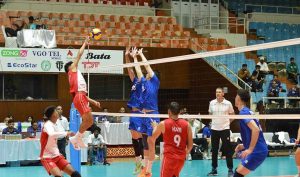

When Nepal departed for Islamabad, Pakistan, to play the CAVA Men’s Volleyball Championship, its goals were clear: enter the FIVB world rankings and win a medal for the senior men’s team for the first time in nearly a decade.
Since the tournament carries world-ranking recognition, Nepal entered the world rankings as soon as it played its first match. But the second goal went unfulfilled.
Despite competitive performances, Nepal lost all five of its league-stage matches and failed to reach the semifinals. With the semifinal berth out of reach, the medal target also remained incomplete.
Nepal last won a medal, bronze in the Central Zone back in 2017, and has not won one since at the senior level, though it did win a medal at the CAVA U-20 age-group level.
This time, apart from host Pakistan, the other four teams were considered roughly on par with Nepal, so the goal was to reach the semifinals and at least “touch” a medal. But despite performing well in every match, Nepal fell short on results, losing all its league-stage games and missing out on the semifinals.
Having lost all five consecutive matches, Nepal was defeated in three of them after going the full five sets. Because those matches went to five sets, Nepal earned 1 point per match from them, ending with 3 points overall.
Nepal also lost against Kazakhstan for fifth place by 3-0.
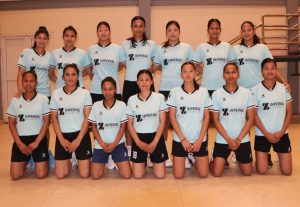
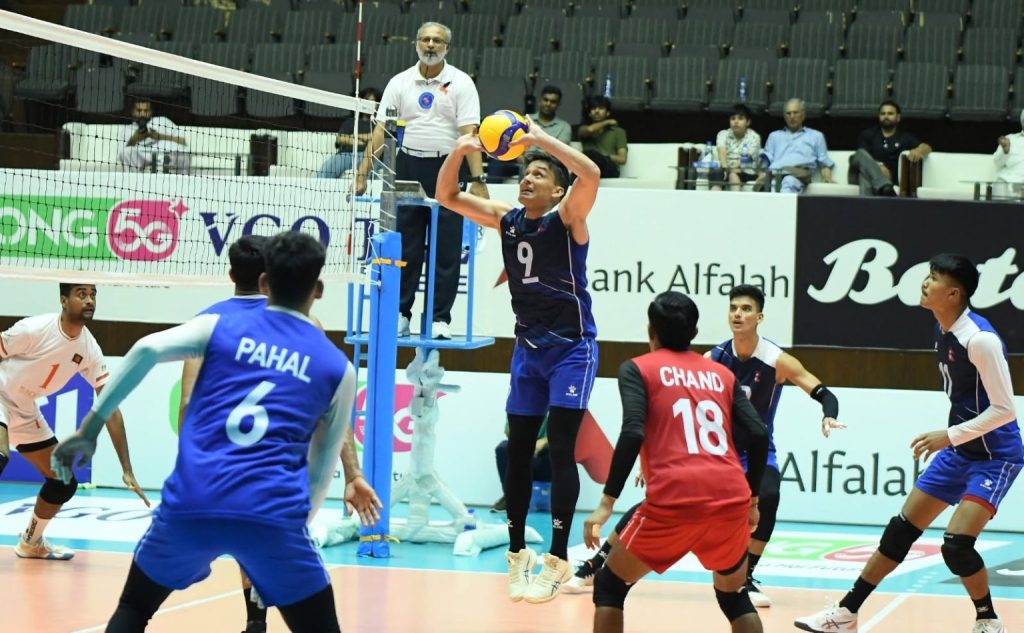
This time, under the captaincy of setter Hari Hajur Thapa, the Nepali squad was dominated by young and new players. Six of the twelve players were representing the national team for the first time. Four players had only played one previous international tournament, last year’s CAVA Nations League. Only setter Harihazur and libero Binod Chand had somewhat more international experience.
However, the spirited performances of the new players could not be sustained throughout the matches. Despite playing well overall, Nepal lost due to a lack of international experience, an inability to hold up under pressure in decisive moments, and the greater experience of opposing teams.
Nepal’s Performance
Against a strong Kazakhstan side, Nepal put in an outstanding performance in its very first match. Although it lost a competitive contest, Nepal’s comeback drew widespread praise. After losing the first two sets, Nepal fought back to win the next two and level the match 2-2.
But Nepal could not maintain that momentum in the fifth and decisive set, losing 3-2 overall. Kazakhstan defeated Nepal 25-19, 25-21, 32-34, 19-25, 15-9.
In the second match against Sri Lanka, Nepal again went the distance to a fifth set before losing. After dropping the opening set, Nepal fought back to take a 2-1 lead by winning two sets in a row, but again could not hold the momentum.
Having lost the first set 25-18, Nepal took control by winning the second 25-21 and third 25-19. But losing the fourth set 25-21 sent the match to a decider, where the same pattern from the first match repeated. Unable to hold a 9-8 lead, Nepal saw Sri Lanka take the set 15-10 to win the match.
In the third match, against tournament favourites Pakistan, Nepal could not offer the expected challenge and lost comfortably, 25-14, 25-18, 25-10. For a Pakistani side featuring players who had come to play in Nepal, the match against Nepal posed little challenge.
After three straight losses, Nepal needed to win both remaining matches to reach the semifinals. But the fourth match, against Bangladesh, followed a similar pattern.
Nepal made an excellent start, taking the first set 25-18. But Bangladesh fought back to win the second 25-19, levelling the match 1-1.
In the third set, Nepal again started strong, winning 25-21 to take a 2-1 lead — needing just one more set to win the match. But Nepal could not maintain control and ultimately lost in the fifth set.
Bangladesh won a competitive fourth set 25-23 to force a decider, then took the fifth and final set 15-11 to win the match.
In the fifth league match, against Uzbekistan, Nepal again played competitively but lost in straight sets. Nepal had previously beaten Uzbekistan, but that result did not repeat on Monday.
In a competitive first set, Nepal led 24-23, just one point from winning the set, but fell short — Uzbekistan scored three points in a row to win the set in a tiebreak, 26-24.
Uzbekistan then led from the start of the second set to win it 25-20, and again led throughout the third set to take it 25-22.
Weaknesses and areas for improvement
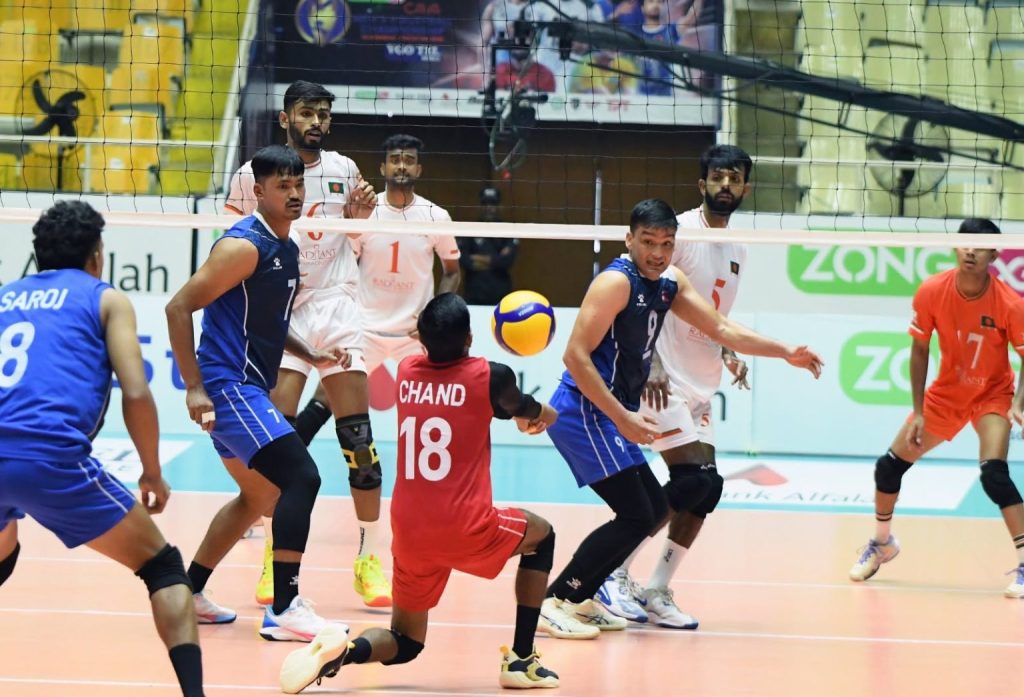
Across all six matches, apart from the game against Pakistan and Uzbekistan, Nepal lost matches even while in strong positions.
Nepal played competitively in four of its six matches but could not convert that into results, including two matches where it held a lead but failed to turn it into a win. Weaknesses in blocking, reception, and experience were evident in decisive moments. While opposing teams made fewer errors under pressure, Nepal lost crucial points at key moments and struggled to handle pressure in decisive sets.
With a squad heavy on new players lacking international experience, and with blocking and reception, both essential in volleyball, being relatively weak, Nepal came close to victory several times but could not close it out.
For Nepali men’s volleyball, the CAVA tournament served as a means to enter the world rankings, identify weaknesses, and prepare well for future international competitions.
Through this tournament, Nepal entered the FIVB world rankings. After its first match, Nepal reached the 83rd rank, and after six matches settled at 109th.
Six new faces were included in the Nepali squad for this tournament — Himal Sunar, Rajendra Dhami, Suraj Chunara, Dipesh Kunwar, Santosh Bik, and Saroj Bardewa, all of whom made their debut in the very first match, against Kazakhstan.
These six new players were given their first opportunity with the senior national team and showed they are capable of competing at the international level, raising hope for the future of Nepali men’s volleyball.
It has shown that investment in Nepali volleyball, along with continuous training and international matches, could lead to much better performances.
According to head coach Jagdish Bhatta, if Nepal receives long-term planning, regular training, and international competition, it could establish itself as the fourth-strongest team among the 14 nations of Central Asia.
“If we plan and prepare well and play international competitions, we will be right behind Iran, India, and Pakistan,” he says.
Iran is a strong team not just in Asia but globally, ranked in the top 20. In South Asia, India and Pakistan are strong teams that play international competitions regularly and are also investing in age-group categories.
Coach Bhatta said that if Nepal also builds a good plan from the grassroots to the age-group levels and moves forward, the national team could improve significantly in the coming years.
“A franchise league is also starting now. If we keep identifying good talent from age-group and grassroots levels and provide continuous training, Nepal’s team can become much better,” Bhatta says.
The results at the CAVA men’s volleyball championship exposed Nepal’s weaknesses, but the performances also revealed potential. Going the distance to five sets in three of five matches, an outstanding comeback in one match, holding leads in two matches, and six new players debuting with confidence are all positive signs for Nepali men’s volleyball.
If these experiences can now be paired with organised preparation, domestic competitions, and regular international exposure, there is a foundation for Nepal to turn its medal ambitions into reality in the future.