
London, February 13
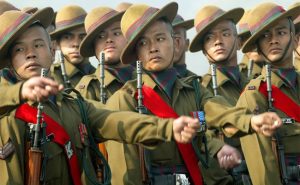
The United Kingdom’s Ministry of Defence has urged former Gurkha soldiers not to begin a hunger strike, saying discussions are ongoing to address their longstanding demands.
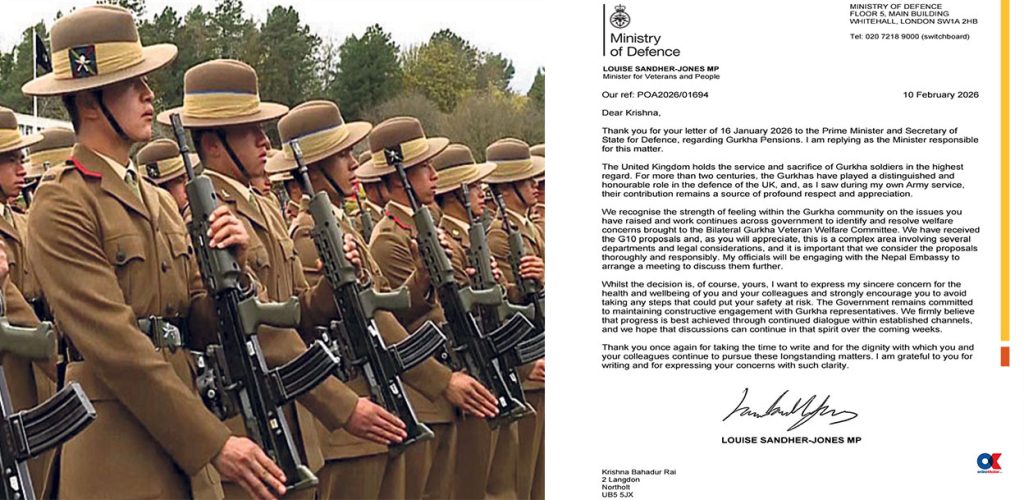
The appeal was made in response to an ultimatum letter sent by the British Gurkha Joint Struggle Committee UK–Nepal to Prime Minister Keir Starmer and to Veterans Minister Louise Sandher at the Ministry of Defence. In her reply, the minister said the government remains engaged on the issues raised.
Addressing demands including equal pensions, the minister noted that the proposals involve multiple government departments and legal complexities, making it essential that they be considered “carefully and responsibly.”
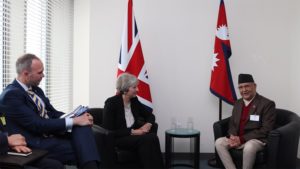
She added that officials from her ministry would coordinate with the Embassy of Nepal in London to arrange further meetings for continued discussions.
On January 16, 2026, the British Gurkha Joint Struggle Committee UK–Nepal issued an ultimatum warning that, unless their demands based on the 2018 technical report are addressed by March 31, 2026, they would resume protests, demonstrations and hunger strikes in both Britain and Nepal. The committee said there had been insufficient political and diplomatic progress between the governments of Nepal and the United Kingdom on Gurkha-related grievances.
In its letter, the committee argued that the treatment of former Gurkhas recruited into the British Army has been inconsistent with the spirit of the 1947 Tripartite Agreement. It maintained that Gurkhas should be treated on the same basis as other units of the British Army.
In her response, the minister said the United Kingdom holds the service and sacrifice of Gurkha soldiers in the highest regard, praising their “distinguished and honourable role” in defending the country for more than two centuries.
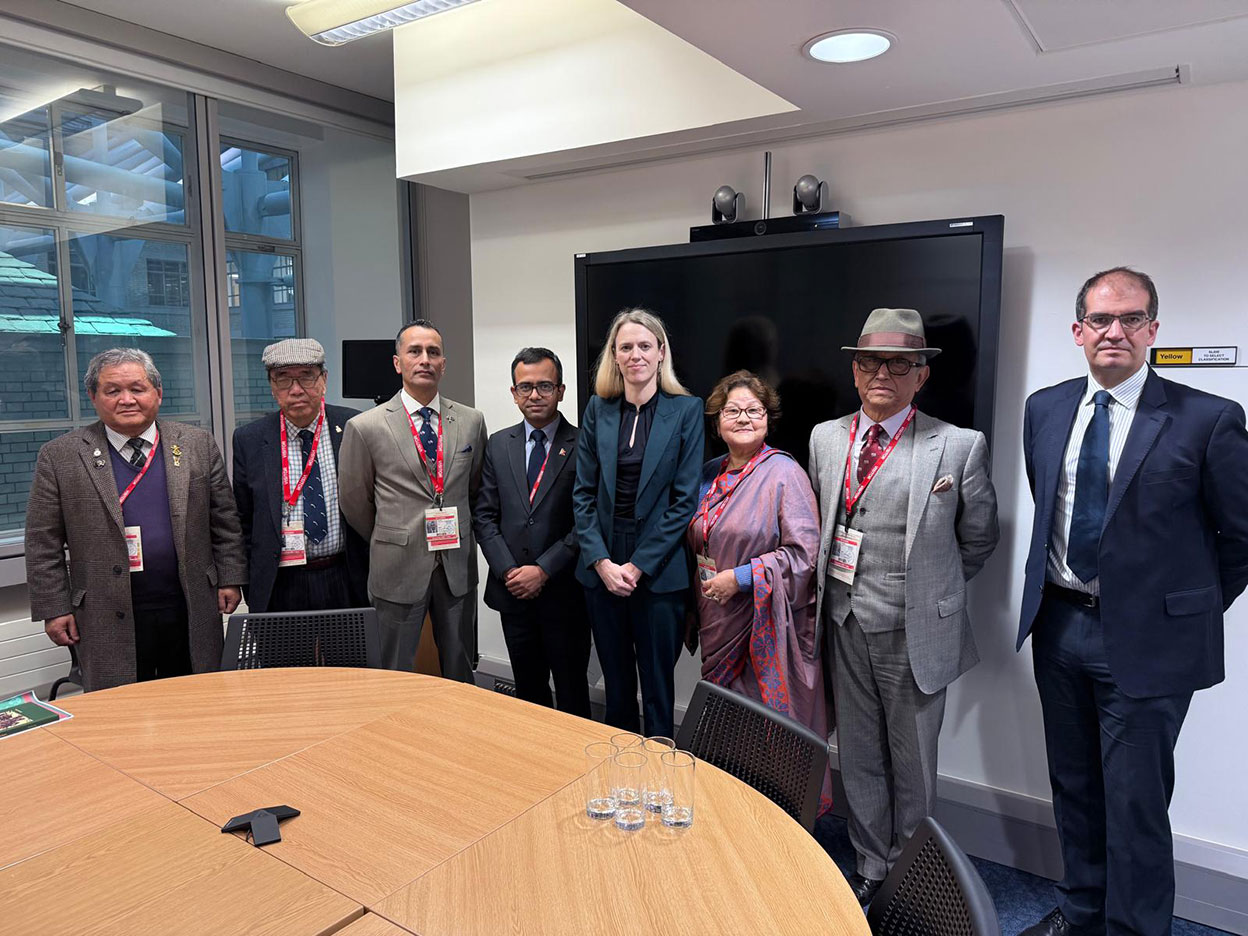
She also expressed serious concern for the health and well-being of Krishna Bahadur Rai, the committee’s chief coordinator, and his colleagues, urging them “to refrain from any action that could put their safety at risk.”
The letter said the government remains committed to maintaining constructive dialogue with Gurkha representatives.
“We firmly believe that the best progress is achieved through continued dialogue, and we hope discussions will proceed in that spirit in the coming weeks,” she wrote.
A contradictory response
However, a separate written response by the veterans minister on February 5 to a question from Liberal Democrat Member of Parliament Will Forster appeared to strike a different tone.
According to the U.K. Defence Journal, the minister told Forster that the current pension arrangements have already been applied equally to most service personnel.
She reiterated that the British government greatly values the contribution of Gurkha soldiers and pointed to pension reforms introduced nearly two decades ago.
Since 2007, she said, Gurkhas have received pensions under the Armed Forces Pension Scheme on the same basis as other members of the British Army.
For those who served before 2007, she said the 1948 Gurkha Pension Scheme, which applies to most former Gurkhas of that period, is at least comparable to, and in many cases more generous than, the pensions of British soldiers with equivalent lengths of service.
She reaffirmed the British government’s commitment to treating former Gurkha soldiers with fairness and respect.
Tripartite talks among Britain, Nepal and representatives of former Gurkhas have largely centred on the pension issue. Although the British government had previously taken the position that pensions were not open for discussion, it has recently indicated a willingness to explore further talks aimed at finding what it described as an “affordable solution.”