

Kathmandu, November 22
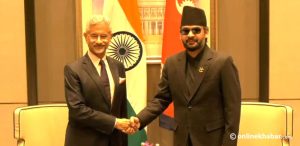
Prime Minister Balen Shah and his Indian counterpart Narendra Modi are scheduled to hold a 30-minute one-on-one meeting on Monday in New Delhi, with discussions expected to cover 10 key areas of bilateral cooperation, according to a document obtained by Onlinekhabar titled Developed India and Prosperous Nepal – Reimagining the Partnership.
The document outlines a proposed agenda for the meeting, covering bilateral friendship, people-to-people ties, civilisational links, disaster cooperation, a review of the 1950 treaty and a broader framework for cooperation across 10 pillars.
Shah arrived in New Delhi on Sunday for a two-day visit to India. The one-on-one meeting with Modi is scheduled for the second day of the visit.
The meeting is expected to begin with discussions on the longstanding friendship between Nepal and India, close ties between their citizens and shared civilisational heritage. The two leaders are also expected to exchange views on assistance in search and rescue efforts following the Rasuwa floods.
The agenda also includes discussions on reviewing the 1950 Treaty of Peace and Friendship through mutual understanding.
The two prime ministers are then expected to discuss a joint vision for the younger generations of both countries under 10 pillars of cooperation. Some proposals have reportedly received preliminary agreement from the Indian side, while others involve commitments to cooperation and joint initiatives.
However, longstanding issues such as the border dispute and air routes do not appear in the document obtained by Onlinekhabar. Government sources say the agenda could still change at the last minute. Although the air route issue may come up during discussions, India has yet to agree to Nepal’s demand.
The document also proposes the formation of a high-level monitoring group led by Nepal’s foreign secretary and India’s ambassador to Nepal to oversee implementation of agreements. The group would brief the two governments on progress every six months.
The 10 pillars of the proposed partnership
1. Comprehensive economic and development partnership
The two prime ministers are expected to review existing agreements on trade and investment and discuss ways to expand Nepal’s access to additional air routes from India, including preparations for their effective operation.
The agenda also proposes cooperation in developing special economic zones to boost supply and production, while encouraging Indian investment in Nepal.
The two countries are expected to explore cross-border special economic zones and industrial parks along the Nepal-India border to promote export-oriented manufacturing and strengthen supply chains for production and processing industries. Cooperation in developing information technology parks is also proposed.
India is also expected to encourage investment in Nepal’s priority sectors and provide financial assistance packages.
2. Physical and digital connectivity
The second pillar proposes improving connectivity between the two countries through direct express rail services, with the Ayodhya-Janakpur route reportedly finalised.
The document also proposes constructing a motorable bridge connecting Dharchula in India with Darchula in Nepal.
Work on the integrated checkpost at Bhairahawa-Sunauli and the proposed checkposts at Banbasa and Dodhara-Chandani is expected to be expedited.
The two sides are also expected to accelerate the remaining sections of the Jayanagar-Bardibas and Jogbani-Biratnagar railway lines. Final surveys for the Raxaul-Kathmandu railway and the East-West Railway are proposed to be advanced, with the Bardibas-Nijgadh and Birgunj-Nijgadh sections receiving special priority.
The agenda also includes upgrading other roads, studying the feasibility of gas pipelines and strengthening cooperation to prevent illegal and criminal activities across the border.
3. Energy, water resources and climate resilience
The third pillar focuses on attracting investment in energy, water resources and climate resilience, with India expressing the need for cooperation from Nepal.
The two countries are expected to advance the Pancheshwar and Saptakoshi-Sunkoshi multipurpose projects in a manner beneficial to both sides and work towards reducing flood risks.
The document also proposes mutual flood early-warning systems, post-flood assistance and periodic monitoring of glaciers.
4. Governance
The document notes similarities between Nepal’s governance priorities and India’s approach, particularly in adopting digital technologies and making interactions between citizens and governments more transparent, accessible and efficient.
India is expected to share technical expertise and best practices to support implementation of Nepal’s Digital Nepal Framework, particularly in digital identity, payment systems and e-governance, in line with internationally recognised principles of digital sovereignty and data protection.
The agenda also proposes training Nepali civil servants through India’s National Centre for Good Governance.
Both sides are expected to exchange experiences and best practices between federal and provincial legislatures and strengthen cooperation in local governance through visits and training programmes involving relevant Indian institutions.
5. Technology, space and innovation
The fifth pillar proposes Indian support for Nepal’s efforts to promote technology adoption and develop itself as a technology hub.
The document proposes expanding the India-Nepal startup partnership network, providing training and mentorship to Nepali startups in India, establishing a Startup Centre of Excellence in Kathmandu and a Digital Nomads and Innovation Centre in Pokhara.
It also proposes facilitating private investment in the development of digital parks and data centres in Nepal.
Bilateral cooperation in artificial intelligence is expected to be strengthened, including the development of a large language model for the Nepali language.
Cooperation in the space sector is also proposed, involving Nepal’s relevant institutions, including the Nepal Academy of Science and Technology, and India’s Indian Space Research Organisation (ISRO) and IN-SPACe. The proposed areas of cooperation include satellite development, earth observation, remote sensing for disaster management and capacity building.
6. Education and skill development
The sixth pillar focuses on strengthening skills development and capacity building through training, human resource development and academic exchanges.
The two sides are expected to study the possibility of establishing campuses and branches of reputed Indian higher education institutions in Nepal, beginning with Indian Institutes of Technology (IITs).
Existing scholarship programmes are also proposed to be expanded, with additional scholarship and training opportunities for Nepali students in emerging fields such as law, technology and artificial intelligence.
The agenda further proposes stronger institutional cooperation between educational and training institutions, including exchanges of professors, teachers and experts.
India is also expected to support the establishment of a vocational training institute in Nepal to equip young people with skills related to manufacturing, services and entrepreneurship.
7. Sports
Under the sports pillar, India is expected to support Nepal in establishing a national cricket coaching and training academy and developing cricket infrastructure at both national and provincial levels.
Nepali provincial cricket players are proposed to be given opportunities to train at India’s national training academies.
The two countries are also expected to explore similar opportunities in badminton, tennis, shooting and athletics, alongside cooperation in developing modern multisport centres in Nepal.
Cooperation in mountain sports, including joint mountaineering expeditions, is also proposed.
The document further proposes encouraging relevant sports organisations in both countries to explore opportunities for Nepali and Indian players to participate in each other’s sporting leagues, including cricket and football.
8. Culture and tourism
The eighth pillar proposes joint development of religious tourism routes and new destinations to strengthen cultural ties and bilateral relations.
The proposed initiatives include developing Ramayana-related sites, a Ramayana Circuit connecting Janakpur and Ayodhya, a Buddhist Circuit linking Lumbini, Bodh Gaya, Sarnath and Kushinagar, and a Shiva-Shakti Circuit connecting Kathmandu’s Pashupatinath with Varanasi.
Cooperation through sister-city agreements is also proposed.
The two countries are expected to organise an annual youth cultural festival alternately in Nepal and India and expand training and exchange opportunities for artists in filmmaking, theatre and fine arts.
The agenda also proposes establishing a Nalanda Centre at Lumbini Buddhist University to strengthen cooperation between Nalanda University and Lumbini Buddhist University.
Cooperation between young entrepreneurs in tourism and hospitality is also expected to be encouraged to promote tourism in both countries.
9. Health
The ninth pillar focuses on strengthening health infrastructure and cooperation in medical research, training and healthcare services.
The document proposes continuing projects under India’s High Impact Community Development Projects programme, including construction of health posts, maternity centres and hospitals based on Nepal’s requirements.
Cooperation to upgrade Nepal’s National Medical Laboratory is also proposed, alongside the establishment of India-Nepal Jan Aushadhi centres to improve access to quality medicines at affordable prices.
India is expected to provide specialised training in various healthcare fields under the Indian Technical and Economic Cooperation programme to strengthen the capacity of Nepal’s health workforce.
The two countries are also expected to strengthen partnerships between leading medical institutions, promote academic exchanges between students and professors, and enhance research cooperation between the Indian Council of Medical Research and the Nepal Health Research Council.
10. Agriculture
The tenth pillar proposes expanding cooperation in agriculture through experience-sharing, training, exchange of framework documents and greater interaction between institutions in both countries.
India is expected to provide grant assistance for the establishment of an agro-industrial park in Chitwan to add value to Nepali agricultural products.
The two sides are also expected to accelerate implementation of the 2026-2030 action plan agreed between the Indian Council of Agricultural Research and the Nepal Agricultural Research Council.
Specialised training programmes are proposed for government officials, farmers and professionals working in Nepal’s agriculture and livestock sectors.
The document also proposes establishing a Centre of Excellence of the Indian Council of Agricultural Research in Nepal, with leading agricultural universities affiliated to it, to provide specialised training to government officials, farmers and entrepreneurs in agriculture and livestock.