


Kathmandu, November 6
Nearly two decades have passed since the Comprehensive Peace Accord formally ended Nepal’s armed conflict, but the transitional justice process remains unfinished.
A parliamentary subcommittee has now identified several obstacles to implementing the law governing transitional justice, ranging from a lack of political consensus to weak institutional autonomy and unmotivated staff at the commissions responsible for the process.
The Legislative Management Committee under the National Assembly had formed a subcommittee led by Dr Anjan Shakya to study and assess the implementation of selected laws.
Formed on July 20, the subcommittee selected six laws for review and submitted its report to the parent committee on October 30.
The laws include the Enforced Disappearances Enquiry, Truth and Reconciliation Commission Act, 2014, which governs the transitional justice process, as well as the Federation, Province and Local Level (Coordination and Interrelations) Act, 2020; the Commission for the Investigation of Abuse of Authority Act, 1991; the Electronic Transactions Act, 2006; the Legal Aid Act, 1997; and the Human Body Organ Transplantation (Regulation and Prohibition) Act, 1998.
The report includes an assessment of the implementation of the transitional justice law and an indicator-based analysis. It identifies five major problems.
First, transitional justice continues to be viewed primarily through the lens of conventional criminal justice. Second, the process requires political initiative and consensus, which remain inadequate. Third, victims have the right to appeal if they are dissatisfied with the commissions’ recommendations on reparation. Fourth, staff working in the commissions lack motivation. And fifth, the commissions do not appear to enjoy financial and administrative autonomy.
The Comprehensive Peace Accord was signed between the then government and the rebel Communist Party of Nepal (Maoist) on November 21, 2006, formally ending the decade-long armed conflict. However, conflict victims have yet to receive full justice.
In its assessment, the subcommittee notes that a separate trust or fund has been established for transitional justice. The fund receives contributions from the international community, the Nepal government and other sources. However, it says political commitment and consistency are necessary to mobilise the fund to provide reparation and justice to conflict victims.
The report also recalls the background of the peace agreement and provisions of the Interim Constitution, noting that the transitional justice process did not advance as envisaged.
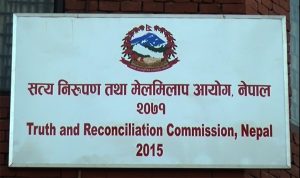
It states that the Enforced Disappearances Enquiry, Truth and Reconciliation Commission Act, 2014, was introduced following the Comprehensive Peace Accord to establish the truth and create conditions for reconciliation in society. The Act also provided the legal basis for establishing the commissions.
Yet the peace agreement, signed on November 21, 2006, had already stipulated that a Truth and Reconciliation Commission would be formed within six months.
Clause 5 of the agreement called for the formation of the commission within that period to investigate the truth about serious human rights violations and crimes against humanity committed during the conflict and promote reconciliation. Political disagreements and legal ambiguities, however, delayed the process for years.
While several other aspects of the peace process have been addressed, transitional justice remains unresolved.
The formal end of the decade-long conflict, the management of weapons held by Maoist combatants and their integration into the Nepal Army were among the major tasks completed under the peace process. But justice for conflict victims remains outstanding.
Against this backdrop, the parliamentary subcommittee has sought to identify why implementation of the transitional justice law has been delayed. Its findings point to the absence of political consensus, a lack of autonomy in the commissions and shortcomings in their institutional capacity and staffing.
The study says the approach to transitional justice remains constrained by the mindset that treats it solely as a conventional criminal justice process.
In other words, the problem lies partly in how transitional justice itself is understood.
Transitional justice is not simply a criminal justice procedure. It is intended to establish the truth about events during the conflict, provide justice and reparation to victims, and create an environment for reconciliation in society. Political commitment and consensus are equally important to achieving these objectives.
The subcommittee therefore stresses the need for a common understanding and consistent commitment among political parties. It says a shared political position is essential to move the process forward.
The report also identifies three broad challenges and possible measures for the coming days.
It notes a lack of political unity, commitment and priority in completing the remaining tasks of the peace process. It further says that the obstacles to implementing the law can be addressed only if the commissions are granted financial and administrative autonomy. At present, however, they lack such independence.
The subcommittee has also called for coordination and cooperation with donor countries and urged local, provincial and federal governments to focus on providing technical and administrative support and creating employment opportunities to protect and support victims.
The report highlights a lack of motivation among employees working in the commissions. It says the absence of institutional capacity and staff motivation has affected the work of bodies responsible for investigating, examining and establishing the truth about highly sensitive conflict-era cases.
The subcommittee concludes that providing the commissions with the independence, resources and administrative authority needed to function effectively would help advance the process of delivering justice to conflict victims, establishing the whereabouts of disappeared people and determining the truth about serious human rights violations.
The study also notes that victims can appeal against recommendations made by the commissions if they are dissatisfied. This provision is intended to ensure that the commissions’ recommendations are not treated as final without considering victims’ objections.
By emphasising victims’ participation and satisfaction, the report points to the importance of keeping avenues for judicial remedy open when the commissions’ recommendations fail to meet victims’ expectations of justice.
According to the parliamentary study, 17 regulations, directives and procedures have been introduced to support implementation of the Act.
The subcommittee examined these supporting legal and procedural instruments as part of its assessment. Although the legal and technical foundations for implementing the law have been established, effective implementation remains lacking. The report identifies political commitment, the commissions’ autonomy and the delivery of justice to victims as major challenges.
Khamm Khati, a member of the parliamentary subcommittee, says the central purpose of transitional justice goes beyond documenting conflict-era incidents and investigating complaints.
Its core objectives are to ensure that victims receive justice and reparation, establish the truth and create lasting conditions for reconciliation in society.
“Along with making laws and procedures, the task now is to ensure political consensus, strengthen the institutional capacity of the commissions and guarantee justice for victims,” he said. “But once again, the government does not appear to have given this issue priority.”
Khati said the law minister had expressed a commitment to implementing provisions related to the transitional justice law, but the government’s actions had not reflected that commitment.
“The commissions are without office-bearers. Work needs to begin there first,” he said. “The commissions need to be formed, and the complaints they have received need to be examined and taken forward.”
On May 5, 2026, the government issued the Special Ordinance on the Removal of Public Office-holders, 2026. Under the ordinance, the then office-bearers of the Truth and Reconciliation Commission and the Commission of Investigation on Enforced Disappeared Persons were removed from their positions.
The vacant positions have not been filled since then.
With the office-bearers removed through the ordinance and no new appointments made, the commissions have been unable to carry out their work.
The Truth and Reconciliation Commission initially received 63,718 complaints. However, following amendments to the Act in 2024, the deadline for filing complaints was extended, particularly to allow conflict victims who had previously been unable to register complaints to come forward. These included women who had suffered sexual violence and rape during the conflict.
More than 15,000 additional complaints were registered during the extended period. The commission now has a total of 78,909 complaints.