

Kathmandu, September 17
The Supreme Court has issued an interim order preventing the implementation of two provisions of the House of Representatives Regulations 2026 that it found inconsistent with the Constitution.
The order means that a constitutional amendment bill must be approved separately by a two-thirds majority in both the House of Representatives and the National Assembly before the amendment process can move forward.
The House had adopted the Regulations 2026 with provisions governing the procedure for constitutional amendments. The provisions had faced objections from opposition lawmakers, who argued that they undermined Nepal’s bicameral parliamentary system.
Nepali Congress National Assembly parliamentary party leader Kamala Pant and others filed a petition at the Supreme Court’s Constitutional Bench, arguing that certain provisions of the regulations were inconsistent with constitutional provisions governing the two chambers.
What was the dispute?
Article 274 of the Constitution sets out the procedure for constitutional amendments. Article 274(8) requires a constitutional amendment bill to be passed by at least a two-thirds majority of the total number of members currently in office in both houses of the Federal Parliament.
Under the constitutional arrangement, the amendment bill therefore has to secure the required majority separately in the House of Representatives and the National Assembly.
However, Rule 140 of the House Regulations 2083 included provisions on the procedure for constitutional amendment bills.
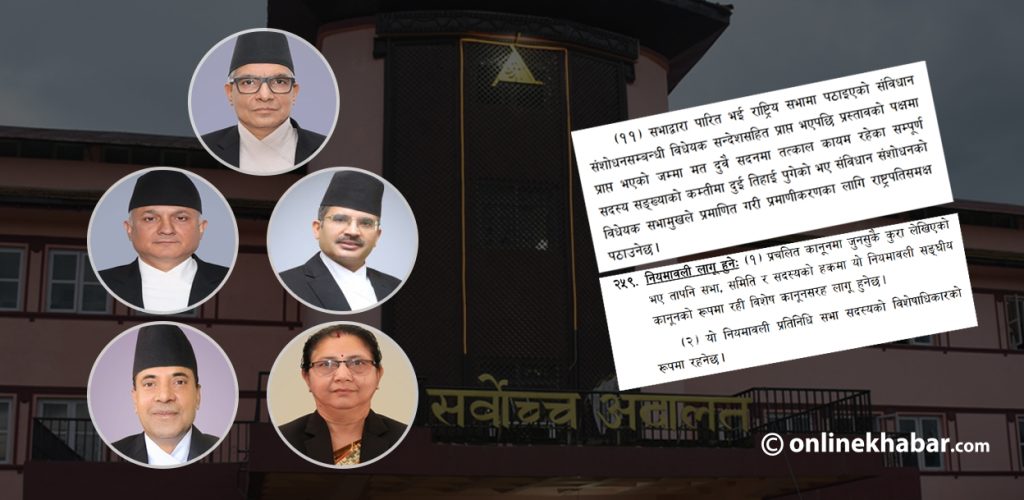
Rule 140(11) stated that when a constitutional amendment bill returned from the National Assembly with a message received the required two-thirds support based on the total membership of both houses, the Speaker could proceed with certification and send it to the President.
Opposition lawmakers argued that this effectively allowed the votes of the two chambers to be combined, contrary to the constitutional requirement that each house approve a constitutional amendment separately.
What did the Supreme Court order?
A five-member Constitutional Bench headed by Chief Justice Dr Manoj Kumar Sharma and comprising Justices Kumar Regmi, Dr Nahakul Subedi, Binod Sharma and Saranga Subedi ordered that Rule 140(11) and Rule 259 of the House Regulations 2026 not be implemented for now.
Rule 259 stated that, notwithstanding anything contained in prevailing law, the House regulations would apply as federal law and as a special law in matters concerning the House, its committees and its members.
The court’s interim order has placed both provisions in their existing state pending further proceedings.
The Constitutional Bench also considered constitutional provisions concerning Nepal’s bicameral Federal Parliament and the procedures governing the two chambers.
Article 83 provides for a Federal Parliament consisting of two houses, while Article 104 deals with the procedures for conducting the business of each house. Article 111(9) provides for circumstances in which a joint sitting of the Federal Parliament may be held.
The court noted that the constitutional provisions on joint sittings do not envisage consideration of constitutional amendment bills through a joint sitting.
Implications of the order
The Supreme Court’s order prevents the disputed provision from being used to treat the combined strength of the two houses as the basis for approving a constitutional amendment.
As a result, the constitutional requirement for a constitutional amendment bill to obtain a two-thirds majority separately in each chamber remains applicable.
The petitioners had also challenged provisions giving the House regulations the status of federal law, arguing that such a provision could conflict with the constitutional supremacy established under Article 1.
The court has not issued a final ruling on the underlying dispute. Its latest decision is an interim order preventing the two provisions from being implemented while the case proceeds.