
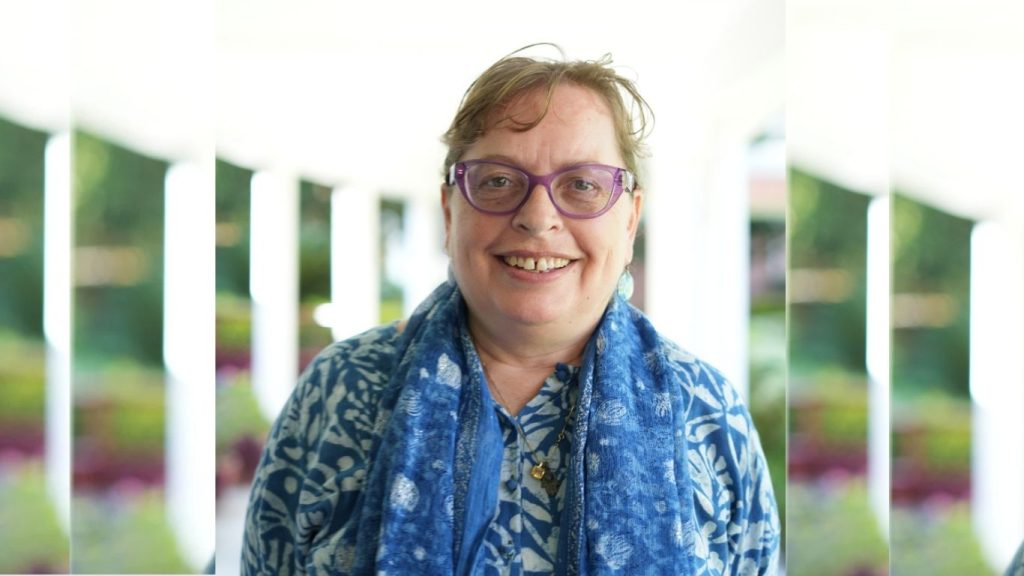
American writer, visual artist, and literary translator Daisy Rockwell is best known globally for bringing South Asian masterpieces to a wider audience, most notably through her English translation of Geetanjali Shree’s Tomb of Sand, which won the International Booker Prize in 2022.
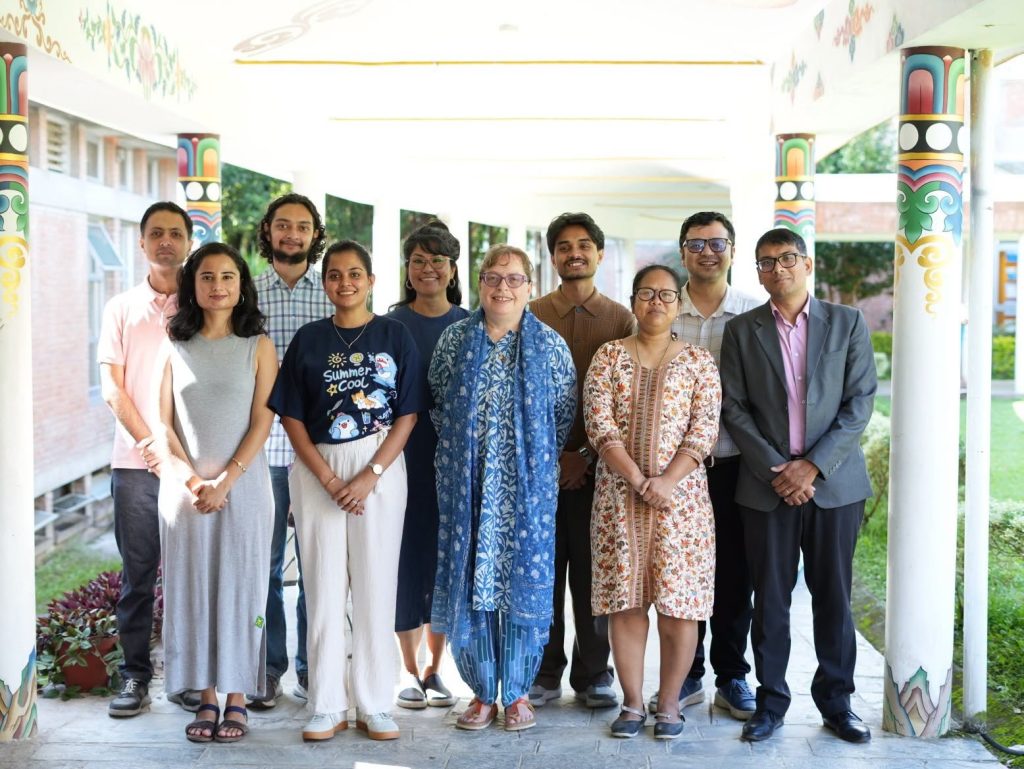
Working primarily with Hindi and Urdu literature, Rockwell recently visited Nepal as a mentor for a literary translation workshop organised by the Department of Language and Mass Communication at Kathmandu University in collaboration with South Asian Literature in Translation (SALT) at the University of Chicago.
During her visit, Rockwell sat down with Onlinekhabar to discuss the impact of artificial intelligence on translation, her upcoming projects, and the nuances of preserving cultural voice across languages.
Excerpts
You have spent years translating Hindi and Urdu literature into English. What first drew you to South Asian literature?
I started learning Hindi in college simply because I liked learning languages and wanted to study one I knew nothing about. Having previously studied French, German and Greek, Hindi felt entirely different, even if it is distantly related as an Indo-European language. In the U.S. university system, you can explore freely, so I thought I would just try Hindi out. I didn’t imagine I would get so deeply into it and spend the rest of my life working on it.
You conducted a literary translation workshop in Nepal. What potential do you see in Nepali literature reaching international readers through translation?
It is difficult to get international publishers interested in South Asian literature in translation, but initiatives like the International Booker Prize are helping to make headway. Organisations like South Asian Literature in Translation (SALT) are doing a great job training translators and bringing Western publishers to South Asia to spark interest.
Nepali literature has a rich tradition spanning centuries that deserves to be known globally, not just in the UK or US, but across English-reading regions like Singapore and Nigeria. Beyond SALT’s efforts, prizes like the Armory Square Ventures (ASV) Prize, recently won by Rohan Chhetri for a Nepali translation project, Flowers of the Siris Tree, a translation of Shirishko Phool by Parijat, are creating direct pathways by guaranteeing publication with U.S. presses like Open Letter Books.
A translator is often described as a bridge between cultures. What do you think gets lost when literature travels from one language and culture to another?
Translators don’t usually think in terms of what is lost; we focus on what is being gained. If you really want to know what gets lost: everything. The original language, culture, and script are all gone. The translator’s job is to build something new that allows readers to feel as though they are experiencing the original work. In that sense, every translation is a kind of illusion.
What are some common mistakes that young or emerging translators make?
Out of a fear of losing something, new translators often cling too tightly to literalism. But accuracy isn’t just about matching dictionary definitions word-for-word. Words together create a feeling and a world; true accuracy lies in recreating that feeling. In South Asia, emerging translators sometimes carry a fear rooted in colonial history, a worry of doing violence to the text by bringing it into English. I remind them that the original text remains untouched and intact; translation is simply an attempt to recreate its life in a new medium.
AI tools are rapidly changing the translation industry. How do you see AI changing literary translation in particular?
AI is consistently wrong about 30 percent of the time, regardless of the task, whether it is solving a math problem, summarising history, or translating text.
The issue is that people now realise these outputs contain errors, so they hire human translators to fix them. Editing an AI-generated draft actually creates more work than starting from scratch. When a human translator makes a mistake, you can usually spot it immediately because the language feels awkward. AI, however, produces text that appears completely smooth and plausible on the surface, forcing an editor to meticulously compare every line against the original text to catch hidden mistakes.
For languages with smaller digital footprints—such as Nepali, Urdu, or Tamil—far less training material has been fed into these systems, making their outputs significantly worse. When AI encounters a word or concept it does not understand, it won’t flag the difficulty like a human translator would; it simply hallucinates and makes things up to maintain the illusion of a flawless translation.
What can a human translator understand that AI cannot?
Feelings, culture, history, and vibes. AI can’t do a vibe check!
How much communication do you prefer to have with the author while translating their work?
It depends on whether they are alive and whether they speak English. When working with Geetanjali Shree, who speaks English fluently, she had strong opinions and reviewed the translation closely. Her writing style is so idiosyncratic that her input was invaluable. However, it can occasionally be tricky when authors attempt to rewrite sentences in English that were already fine in translation.
Where does a translator need to draw the line and maintain independence from the author?
At a certain point, you have to finalise the work for the publisher. Translator Maureen Freely, who translated several books by Orhan Pamuk, once told Pamuk directly: “I don’t work for you; I work for the publisher.”
Ultimately, the translator’s primary responsibility is to the reader and the text in the target language.
How do you balance staying faithful to an author’s intentions with making creative decisions that you feel are necessary in the target language?
Translators are almost like mediums, channelling an author’s voice. You have to ask yourself: “If this author were writing directly in English, how would they express this?”
You also have to ensure the text sounds compelling. If it doesn’t read well in the target language, the translation hasn’t succeeded, regardless of how literally accurate it might be.
What keeps you excited about translation after all these years, and what still surprises you about the process?
Every book and author teaches you something new about writing. Translation involves immense drudgery, but there is a magical moment at the end when everything is polished and comes together, creating a finished piece of art in a new language.
Lastly, what are you up to lately?
I am currently working on a collection of Urdu horror stories from the 1930s by Hijab Imtiaz Ali. Her work blends horror with romance.
Next, I am about to start translating Geetanjali Shree’s latest novel, which, as expected with her work, is a brilliantly wild piece of writing.
Finally, I am thrilled to share that I have secured the translation rights for Aag Ka Darya (River of Fire) by Qurratulain Hyder. Tracking down rights holders is a massive, behind-the-scenes effort that non-translators rarely see, so obtaining permission for this has been a long-time dream of mine.
River of Fire is considered the great Partition novel in Urdu, sweeping across 2,000 years of history. Hyder previously published her own English version, but she altered it significantly and cut nearly 200 pages from the original. I plan to produce a complete retranslation of the original text.