

Trishuli, September 4
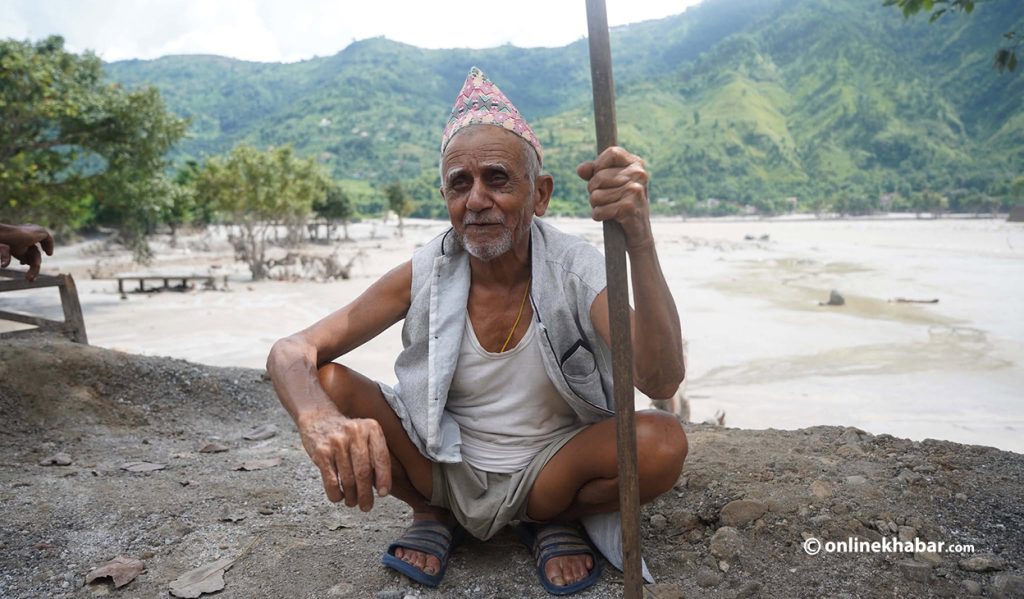
At the banks of the Trishuli, 86-year-old Bhuwan Prasad Ghimire leaned on his walking stick and stared across the river.
He has spent his entire life beside the Trishuli. He has watched it rise and fall through the seasons, lived through its quieter days and its angry ones. But what he saw now was beyond anything he had known.
The concrete bridge and the old suspension bridge that once connected the two sides had both been swept away.
“I have spent my whole life on the banks of the Trishuli,” Ghimire said. “I had never seen the river like this, nor even imagined it in my dreams. I had never heard my forefathers speak of such destruction.”
Then he fell silent.
For communities living along the river, the flood has destroyed much more than houses and bridges. It has broken the physical connections that allowed people to cross from one bank to another in minutes, to visit relatives, trade goods, attend school or reach a hospital.
It has also created something less visible but increasingly frightening: an information vacuum.
Without electricity, mobile connectivity or internet access, people cannot easily find out what has happened, what is happening or what might happen next. In that vacuum, rumours have begun to travel faster than reliable information.
And for people already traumatised by a catastrophic flood, some of those rumours are terrifying.
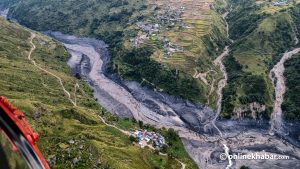
The Trishuli floods of August 26 destroyed or swept away 35 bridges between Miteri Bridge at the Nepal-China border and Muglin, cutting off movement between communities on either side of the river. More than 200 homes from settlements between Devighat and Betrawati were swept away, while more than 100 people remain missing or out of contact.
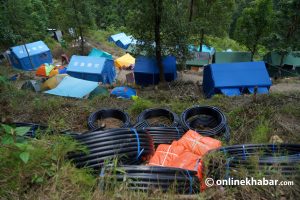
Flood victims, pregnant women and children are sheltering in cold classrooms at a holding centre in Bhairum Secondary School in Trishuli Bazaar.
The destruction is widespread, but the experience of it is not the same on both sides of the river.
The other side
Most ministers and lawmakers who have visited the flood-affected area have remained on the more accessible side of the river. From Kathmandu, the route through Tokha–Chhahare, or Kakani to Battar, Bidur and Betravati, is comparatively straightforward.
Crossing to the other side is another matter.
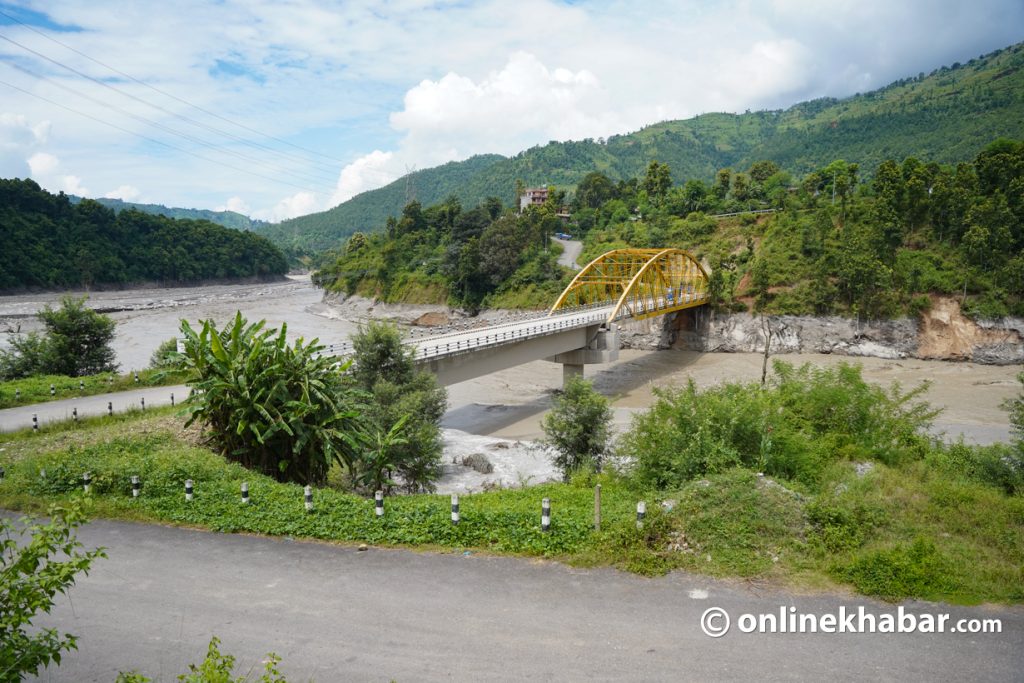
Almost every small and large bridge along the 82-kilometre stretch from Rasuwagadhi to Galchhi has disappeared.
Galchhi now has the only surviving bridge. On one side, the bridge does not rest on a conventional concrete span but directly on rock. Its engineering may explain why it survived the force of the flood.
Beyond Galchhi, however, there are few remnants of bridges at all. Some suspension bridges remain hanging limp and damaged. Others have vanished completely.
We crossed the only remaining bridge connecting the geography and lives of communities on both banks along this stretch, then travelled towards Uttargaya, following the stories of people living through the aftermath.
The affected settlements came one after another: Darshantar, Piplatar, Pipladanda, Sirkhali, Gauribesi, Kalikhola, Devighat, Trishuli Bazaar and Sole Bazaar.
The flood has brought down not only houses but people’s spirits.
Communities that once crossed the river in three minutes, sharing their celebrations, grief and everyday lives, have suddenly become strangers to one another. The river has swallowed the bridges, and with them the easy communication that once connected the two banks.
At Darshantar, Ghimire stood watching the settlement opposite him. For someone who has lived beside the river for 86 years, there was little left to say.
A project swept away
Directly opposite Darshantar is Ratmate, where the much-discussed MCC project substation was under construction.
The 400-kilovolt substation was designed to transmit about 3,200 megawatts generated by various hydropower projects. The project has an investment of USD 51.6 million, roughly Rs 7.25 billion.
Construction had only just begun in June 2026. It was scheduled for completion in 39 months. The flood swept away the project site.
Even after seven days, the Trishuli remains thick with mud and debris. The banks continue to erode, and residents fear that the river could reach homes that have survived so far.
The physical destruction is visible everywhere. But reaching the places where people are living through it is itself becoming a challenge.
The road on the far side of the river was never a major route. Vehicles generally travelled on the other bank, while people living on this side crossed the bridges. There had been little reason to prioritise paving an alternative road.
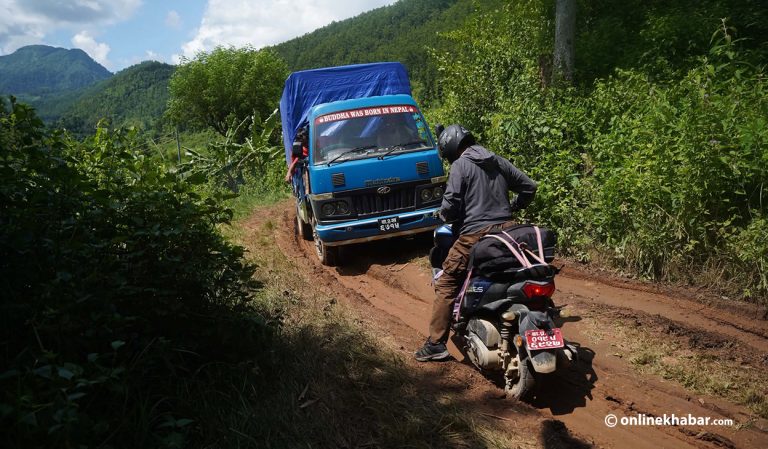
Now that dirt road is the lifeline of the entire side of the river.
It is narrow and covered in red mud. Rain and water make the journey slow and treacherous. Vehicles queue along the route. Sometimes passengers sit inside; sometimes they get out and push.
On August 13, it took us four hours to travel roughly 20 kilometres from Galchhi to Devighat.
Relief volunteers said that in the days that followed, the same journey could take nine or 10 hours because of the traffic.
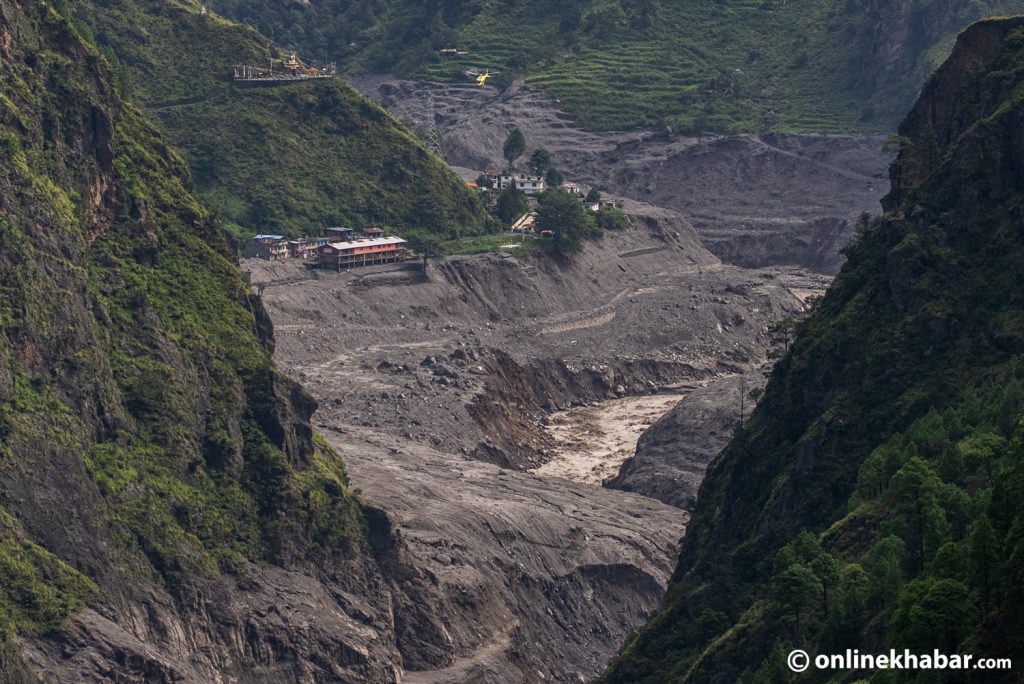
At Devighat, it was difficult at first to tell whether one was looking at a market or a riverbed. The landscape was desolate.
Locals had gathered at chautaris — traditional communal resting and meeting places. In settlement after settlement, people were doing the same. There was no electricity. No internet. No Facebook or TikTok. There was little news and little entertainment. So people had returned to the chautari.
“It has been laid waste,” said 55-year-old Purna Bahadur Bhujel. “It feels like the Stone Age; we know nothing.”
When the government message arrived too late

Near Devighat stands a statue of Prithvi Narayan Shah, where the king died. The statue survived because it stands on higher ground. The bridge, however, did not. Neither did the settlements around it.
The Tadi River joins the Trishuli at Devighat. There were separate bridges over the Trishuli and Tadi at their confluence. Neither remains.
Images of an iron bridge being swept away by floodwaters travelled around the world. It was the bridge over the Tadi.
Below the chautari, a house stood with only its pillars remaining across two floors.
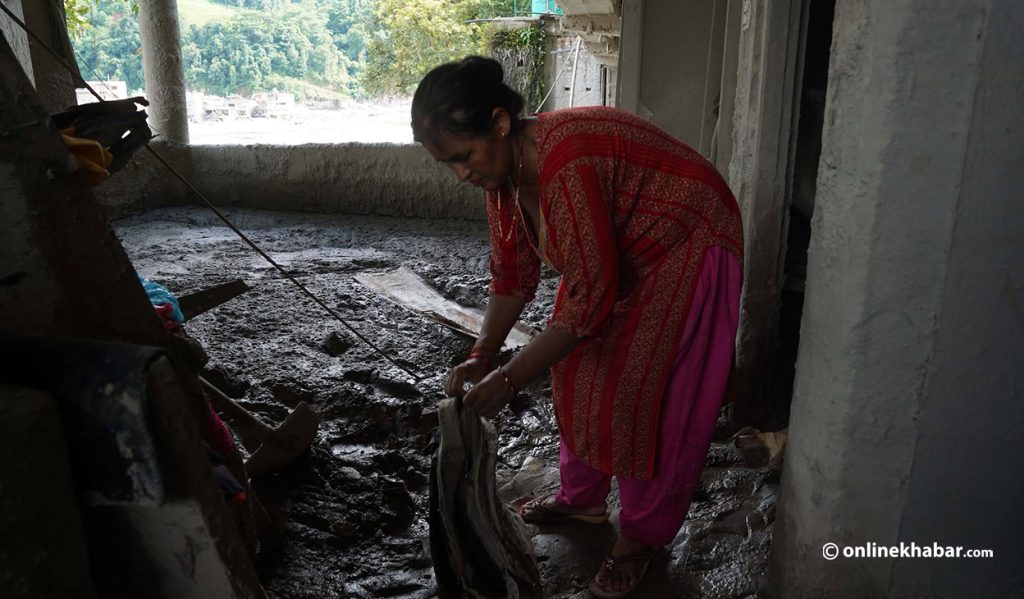
Lok Bahadur Pudasaini and his wife, Durga, were cleaning what remained.
The house belonged to journalist Shyam Sundar Pudasaini, an energetic journalist who died suddenly last year. Lok Bahadur lost his brother last year. This year, Durga’s brother is missing. He worked at Trishuli 3B and has been out of contact since the flood.
“Was he trapped by the flood inside the tunnel, or was he swept away while trying to escape?” Durga asked.
Her own maternal family is across the Trishuli. She has not even been able to sit with them and grieve. We suggested that she follow official information. She then showed us her phone, with barely any battery remaining.
“We sat on the hillside for two hours until the flood subsided, then came home and were doing household chores,” she said. “Then a message came: ‘A flood is coming in the Trishuli, please stay safe.’”
The message, rather than reassuring her, had only deepened her distress. “The government’s message came too late,” she said.
The warning had arrived after the danger had already passed.
The price of survival
More than 200 homes across both banks at Devighat were swept away. More than 100 people were swept away or remain missing. Some families, having found no bodies, made symbolic bodies from kusha grass and performed funerals. Others are still waiting and hoping.
Even people whose homes survived are struggling.
Cooking gas was already scarce. The market had been swept away. With the road damaged and goods unable to move easily, prices soared.
Petrol was reportedly selling for Rs 550 a litre in Trishuli.
At first, the price itself seemed like a story. But after travelling the road, the problem became clearer.
The road is so narrow that even ambulances struggle to pass. How, then, are oil tankers supposed to reach the area and keep fuel prices at a reasonable level?
There is a question for the government here, too. If helicopters are flying in to carry relief, could they not also transport fuel from the Nepal Oil Corporation so that people can obtain petrol at a reasonable price?
At the chautari, 77-year-old Krishna Prasad Aryal summed up the feeling of abandonment.
“Across the river, there is no state. We are alone,” he said. “Every resource has been spent there. It feels like everyone has abandoned us.”
A home, a shop and 30 years of work

A week after the flood, electricity had begun returning intermittently. Internet access, too, might gradually return. But that does not answer the bigger questions.
When will the roads reconnect these communities? When will the bridges be rebuilt? When will housing grants arrive? And even if the money arrives, where will people be allowed to build?
The disaster has raised a problem different from that faced after an earthquake.
After an earthquake, people could rebuild on the same foundations if the site and construction meet safety standards. But after a flood of this scale, where can the foundations be laid?
On the same riverbank, vulnerable to the next flood?
On the far side of the Trishuli is Bidur–Dhunge Bazaar. A journey that once took two minutes now requires a route from the Trishuli to Galchhi, then to Kathmandu and back towards Bidur. What once took minutes can now take as long as two days.
Helicopters can rescue people caught in a disaster. But how does an ordinary sick person reach a hospital in the city?
“It is even harder when someone falls ill,” one resident said. “If a patient is serious, taking them to Kathmandu is almost impossible.”
In Trishuli Bazaar, 62-year-old Beg Bahadur Bogati stood among the ruins of his six-storey house. For 30 years, he had run a television shop. On August 26, the flood swept away his home and the wealth he had accumulated over three decades.
“The damage is around Rs 50 million,” he said. “The house and business were financed with bank loans. I don’t know whether the bank will accept what has happened. I don’t know what to do.”
Many displaced residents stood along the embankment looking towards what remained of their homes. For many, there was little left to return to.
Four missing
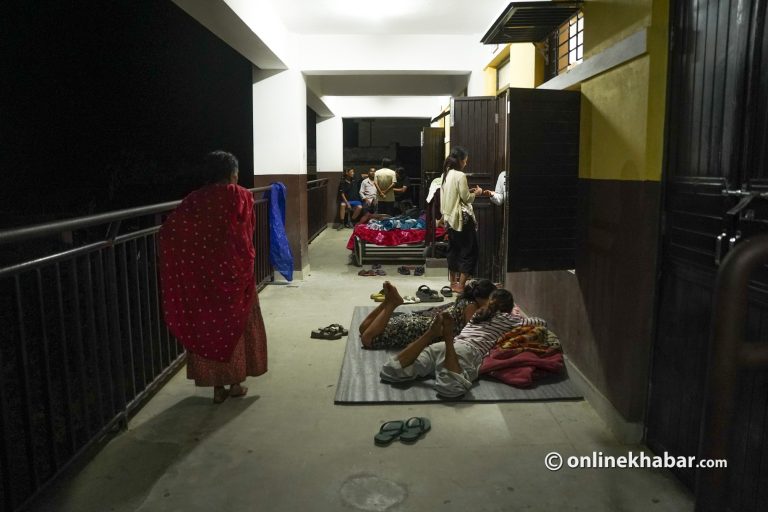
At 9.30 pm on August 31, Bhairum Secondary School in Trishuli Bazaar had become a holding centre.
Heavy rain was falling.
Women, children, adults and elderly people lay on desks and benches inside the classrooms. Others sat or lay in rows along the verandah, using umbrellas to shield themselves from the rain.
Some had mats. Others lay directly on the cold floor.
Among those sheltering there was Suchit Joshi, from Bidur Municipality-1, who works at Tribhuvan Trishuli Multiple Campus.
He survived. Four of the eight members of his family are missing: his wife, Manju Shrestha; his seven-year-old daughter, Sumansi Joshi; his brother’s wife; and his brother’s son.
“I tried very hard to find them,” he said. “I repeatedly rode my motorcycle around the areas the flood had reached. I couldn’t find any trace.”
He kept searching.
“I have wandered around from morning until late at night. I shouted and called out, hoping they might hear me. I called their names in case they responded. I even walked around blowing a whistle, hoping the children would hear. But every attempt failed.”
Sumansi was a Grade 1 student at Gyankunj School. Her father remembered how she reacted whenever a helicopter passed overhead.
“When a helicopter came overhead, she would run out shouting, ‘Dad, a helicopter!’” he said. “Today the sky is full of helicopters. But my daughter is not here to watch them.”
During his search, Suchit found his nephew and uncle and helped get them rescued. He also found an elderly woman trapped by the flood and helped rescue her.
He also found three bodies, but they could not be identified. Around him, other families were waiting for answers.
Seven months pregnant
Srijana Nagarkoti, 27, is seven months pregnant. She was staying in a room at Bhairum Secondary School in Bidur Municipality-8. She had a house in Trishuli Bazaar.
“Our home in Trishuli Bazaar was swept away by the flood,” she said. “We have nothing left. I am staying in a cold classroom. I worry the cold in the room will affect the baby in my womb.”
She and her husband had run a meat shop in Trishuli. They also had a farm with 200 pigs. The flood has taken everything from them. Their home and their livelihood.
For people like Srijana, the disaster is not only about what has already been lost. It is about trying to imagine a life after the water has gone.
Rumours become another disaster
One week after the flood, electricity had started returning in some places, but not reliably. We brought battery backup equipment to charge their cameras. Locals were not so fortunate.
Even when electricity returned, it was sometimes only enough to provide what residents described as “half voltage”, insufficient to charge their phones. And even when a phone could be charged, there was still no internet. No internet meant no news.
Around the world, there is growing concern about misinformation and deepfakes circulating on social media. But in the villages along the Trishuli, something more basic — and in some ways more frightening — was happening.
Rumours were spreading without social media at all.
“More than the flood, the rumours have troubled us,” said Bhagwati Aryal of Tupche.
“They say China is going to open all the dams and lakes upstream. Sometimes they say Gosainkunda is about to burst. Yesterday there was a rumour that Manasarovar had tipped over and was coming this way. I haven’t been able to look at my mobile. How do we know which rumour is true and which is not? We have been terrified around the clock.”
For people already living through a catastrophe, uncertainty itself has become a source of trauma.
A fellow journalist took his father to Kathmandu overnight through Galchhi. But the rumours had so unsettled him that he continued to believe the flood was coming.
Even after reaching Kathmandu, he would wake everyone in the middle of the night, saying: “The flood has come.”
The problem is that people cannot simply dismiss the rumours. Last Sunday morning, another surge came.
“The river rose with a frightening sound,” one resident recalled. “I ran out of the house, and the whole village had already reached the higher slopes. The flood only became moderate at 6am.”
Once again, people fled uphill. And once again, the official warning came later.
They had spent two hours on the hillside before returning home. Only then did the government message arrive saying a flood was coming.
In an information vacuum, even a genuine warning can arrive looking like another rumour.
The rescue effort
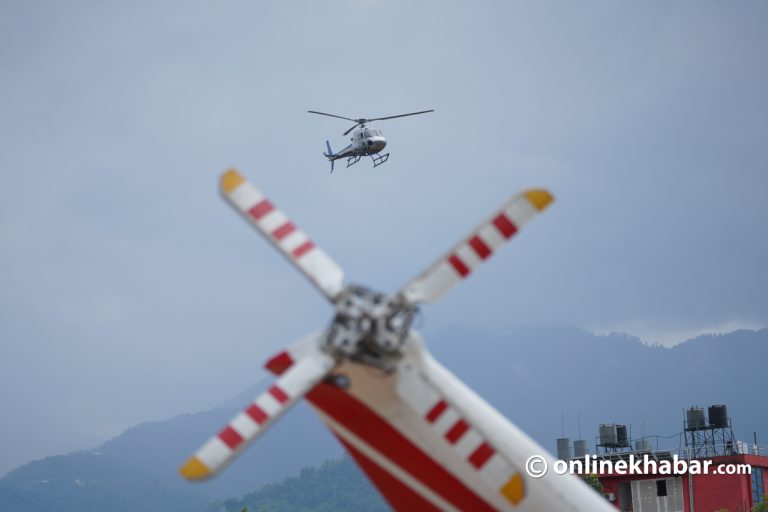
The deployment of security personnel has been one of the more visible parts of the response.
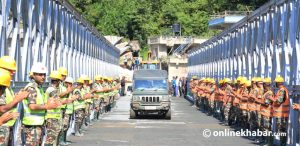
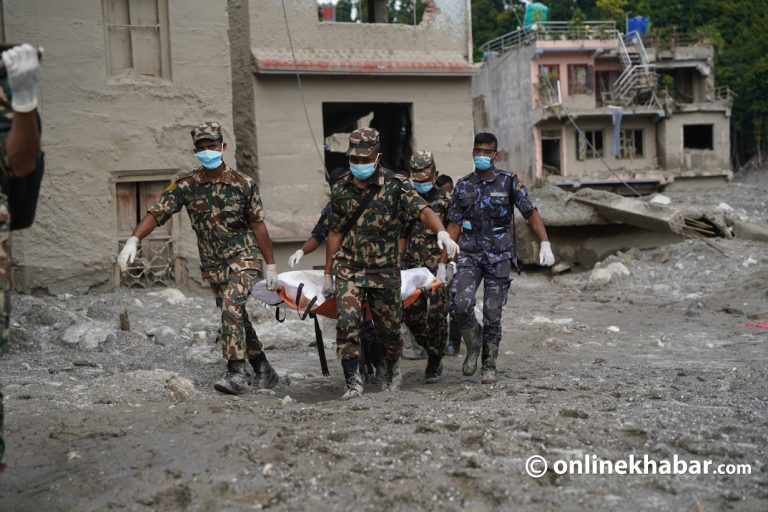
Nepal Army, Nepal Police and Armed Police Force personnel have remained continuously in the field, moving almost constantly.
They carry relief supplies, bodies, generators and equipment. Excavators move through the damaged areas. Personnel travel back and forth along roads that are themselves barely passable.
We ate chowmein and instant noodles on the road for two days before returning home. Rescue workers have spent many days in the field, eating beaten rice and plain instant noodles. It is unclear how many more days they will have to continue.
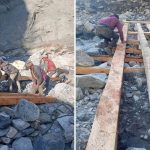
From Tuesday, the government began installing a tuin — a cable crossing — to improve movement between the banks. When word spread that it was being installed, we rushed from the market towards the riverbank. Hundreds of people had gathered.
One end of the cable was tied to a pillar of a ruined house. The other was attached to a tree on the opposite bank. The first crossing carried three cartons of essential medicines for the District Public Health Office.
Then a woman who had been rescued on the near bank needed to be transported across. She was placed in the carriage. It moved rapidly over the river and then stopped suddenly in the middle.
Security personnel were waiting on the far bank, but there was no rope with which to pull the carriage across. The technical coordination had failed. An elderly man watching the scene became agitated.
“Is this how you play with people’s lives?” he said. “Is this a spectacle in the name of rescue and relief? Is this really a tuin? A tuin is supposed to be operated by the people themselves to cross from one side to the other. Is it possible to keep 15 people stationed here every time one person needs to be pulled across?”
Yet even amid such frustration, something striking remained: faith in the government had not disappeared. The same man continued to defend it through political reasoning.
“Would Sudan Gurung build such a tuin? Would Balen build such a tuin?”
When asked who had built it, he answered: “This must surely be the opposition party’s doing; they have done all sorts of things to defame the government.”

The exchange revealed another fracture running through the disaster zone. Thousands of people are directly affected — drowned, missing, homeless, injured or grieving. Yet beyond those immediate victims, people appear to have divided themselves according to whom they supported in the last election, rather than according to what the government has or has not done.
At a chautari in Devighat, the reporters asked residents about the state’s response.
One person said: “The state is nowhere here.”
Before he had finished, a young man behind him responded: “The state has done what it needs to do.”
The two views came from the same settlement, under the same government, in the same disaster. One saw abandonment. The other saw action.
The man criticising the government added that Nepali Congress president Gagan Thapa had only recently travelled along the same road.
“Except for him, no one has asked about us,” he said.
We did not ask which party he belonged to, nor which party the young man defending the government supported.
A settlement erased

Further upstream, near the confluence of the Betrawati and Trishuli, lies Sole Bazaar. On one side of the river is Paidhali Taar in Rasuwa. On the other is Sole Bazaar in Nuwakot.
Krishna Prasad Rijal, chair of the Red Cross Tumche sub-branch, explained how closely the two communities were connected.
Sole Bazaar once had around 100 homes. Now there is almost no trace of it.
“Sixty-eight people were swept away from one place in Sole Bazaar alone,” Rijal said. “Only one body has been found.”
From the riverbed at Sole Bazaar, the powerhouse of the Trishuli 3B hydropower project can be seen. Or rather, what remains of it can. Its powerhouse was swept away.
“There were 65 people inside,” Rijal said. “We do not know whether they were swept away or trapped inside.”
At Betrawati, a damaged building still stood with a tower and clock. The clock had stopped. It looked as though time itself had been stunned by the destruction.
Betrawati, also known as Uttargaya, was home to around 200 households and more than 1,000 people. The exact number of people missing is still unknown.
On the day we arrived, 24 bodies had been recovered from the ruins near the clock tower.
The place has long carried religious significance.
Betrawati lies at the confluence of the Betrawati and Trishuli rivers. It is known as Uttargaya — North Gaya — in contrast to Gaya in India, and is an important Hindu pilgrimage site for performing rites for ancestors. Locals say tens of thousands of people come during Poush Shukla Purnima.
The settlement had already been devastated by the 2015 earthquake. There had been doubts about whether people should resettle there.
Yogesh Dangol built the clock tower in an effort to encourage people to return. The settlement grew again. In barely a decade, the flood washed it away.
What comes after the water?
The immediate rescue effort will eventually end. The water will recede. The roads will, at some point, be repaired. Bridges will be rebuilt. Electricity and internet will return.
But the harder question is what happens to the people who have lost almost everything.
Where will they live? Where will they rebuild? What happens when the next flood comes? The disaster along the Trishuli raises a question that extends far beyond this river valley: how long can Nepal continue to absorb disasters of this scale?
The fever of the Earth is rising. Snow and ice are melting. The surface of the Himalayas is degrading. Mountains can collapse with ice, triggering disasters downstream.
Industrialisation and development, together with carbon emissions, are driving climate change.
Nepal, however, has contributed little to the emissions causing the crisis. Its share of global carbon emissions is stated at just 0.1 per cent.
And yet it is among the places paying a heavy price.
There is a Nepali expression for being harmed by something one did not consume: nakhayeko bish lagchha — to be poisoned by something you did not eat.
That is increasingly how the climate crisis feels in Nepal.
The people along the Trishuli did not create the conditions that are changing the climate. Yet they are watching their homes, bridges, businesses and communities disappear beneath increasingly destructive floods.
For now, many of them are still waiting for electricity, internet access, roads, bridges, relief and information.
But there is another thing Nepal must do.
It must speak.
And it is already taking too long to make the world hear what is happening here.