

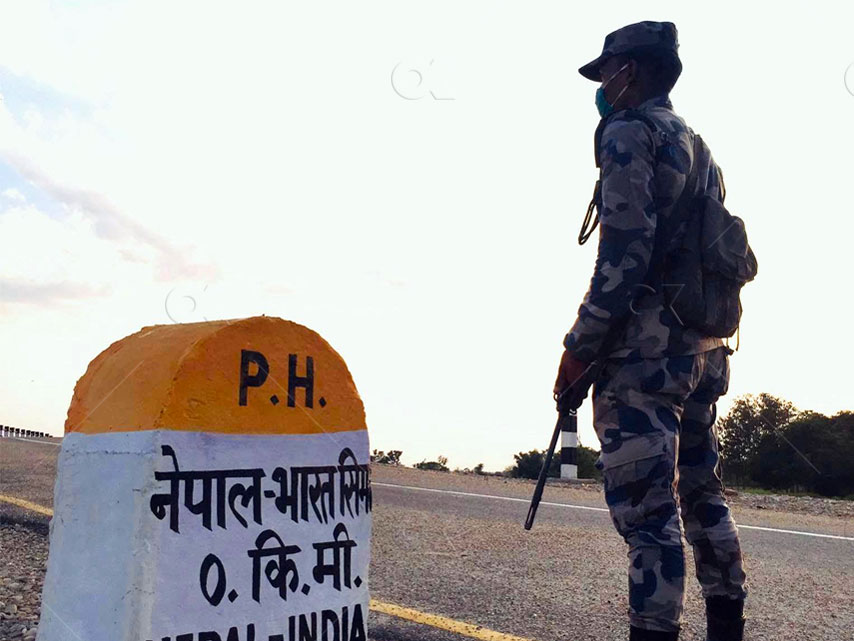
Kathmandu, October 25
The Nepal government has acknowledged that problems of cross-border occupation and encroachment on the no-man’s-land along the Nepal-India border exist in some areas, but it has not disclosed where the encroachment has taken place.
The Ministry of Foreign Affairs said mapping of the affected areas was underway through the Nepal-India Boundary Working Group (BWG) and other mechanisms. It did not specify the number or names of locations identified so far.
The ministry said Nepal remained committed to resolving border-related problems through diplomatic dialogue based on historical treaties, agreements and maps.
The issue was raised by Nepali Congress lawmaker Nishkal Rai, who submitted a written question to the ministry during the second session of the Federal Parliament. The ministry sent its response to the Parliament Secretariat.
Rai noted that Nepal and India have long-standing border disputes in Susta, Kalapani, Lipulekh and Limpiyadhura. He asked how many other locations had been identified by joint Nepal-India teams as facing encroachment on no-man’s land or cross-border occupation, and where those locations were.
However, the ministry’s written response did not provide the requested details.
“The Nepal-India boundary includes some areas where problems of cross-border occupation and encroachment on no-man’s land exist, apart from Susta and the Limpiyadhura, Lipulekh and Kalapani areas, where mapping remains incomplete,” the ministry said.
It added that the BWG and other mechanisms were mapping the locations affected by encroachment and cross-border occupation.
According to the ministry, Nepal and India share a centuries-old, open border, with the present international boundary largely established and guided by the Treaty of Sugauli of 1816.
The BWG was formed in 2014 to carry out technical work related to border management, including the construction, restoration and maintenance of boundary pillars and technical demarcation. Its first meeting was held in Kathmandu on July 15–16, 2015.
Since its formation, the group has held seven meetings. Its seventh meeting took place in New Delhi on July 28–29, 2025.
At that meeting, Nepal and India agreed to complete the remaining technical work on their shared border within three years, excluding the Kalapani and Susta areas.
Against this backdrop, Rai sought details of the work completed to address encroachment and cross-border occupation outside the four disputed areas, as well as the number and locations identified by joint teams.
The ministry’s response, however, stated only that mapping was ongoing.
Reiterating its position, the ministry said Nepal was committed to resolving the issues through diplomatic engagement.
“In keeping with the spirit of the close relationship between Nepal and India, we remain committed to resolving this issue through diplomatic dialogue based on historical treaties, agreements and maps,” the ministry said.