
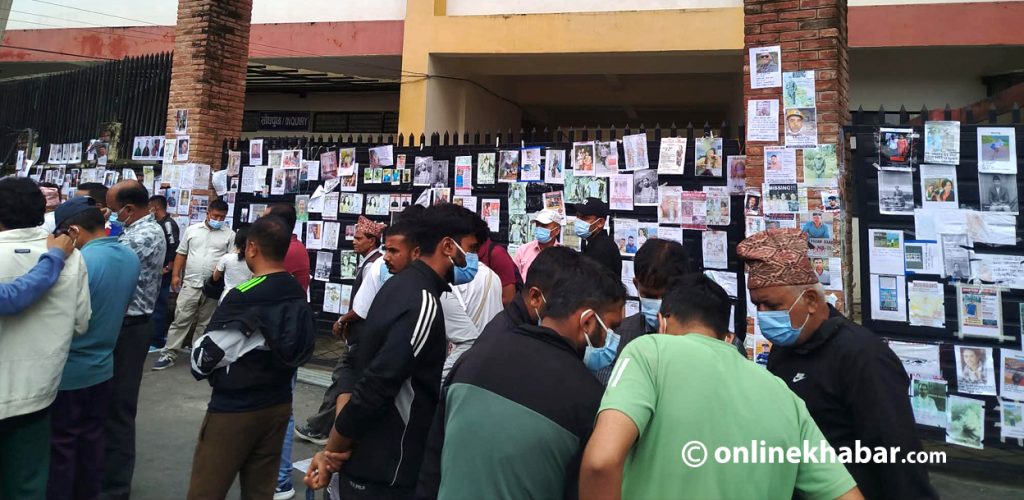
There is a quiet desperation outside the mortuary at Tribhuvan University Teaching Hospital in Maharajgunj.
Some people stare at photographs of missing relatives. Others keep their eyes fixed on the mortuary door, waiting for someone to emerge with an answer.
There is hope on some faces. On others, grief has already settled in. Some, unable to bear the uncertainty, collapse on the ground.
Ambulances and hearse vans continue to arrive and leave the hospital compound. Police officers in personal protective equipment and young volunteers carry bodies from ambulances into the mortuary.
But bringing the bodies here is only the beginning. The harder task is to identify them, preserve them safely and eventually make sure each body reaches the right family.
Bodies recovered from the Bhotekoshi floods have been brought to the Teaching Hospital, pushing its mortuary beyond capacity. According to Dr Gopal Chaudhary, head of the hospital’s Department of Forensic Medicine, 177 bodies have so far been brought to the hospital for management. Postmortems have been completed on 129 of them.
Of those, 85 have been sent for temporary burial, while 21 have been identified by their families and handed over. But the hospital is still overwhelmed. The mortuary can accommodate around 150 bodies. With that capacity already exhausted, about 31 bodies had to be transferred to the cold storage facility at Pashupati on a single day, Chaudhary says.
But space is only one part of the problem.
After eight or nine days, a face is no longer enough
Many of the people who went missing in the floods were found only after several days.
After eight or nine days, decomposition has advanced considerably. Faces have changed. Some bodies have been recovered in pieces. Even bodies that appear largely intact can be difficult to identify by their faces.
For the police officers working inside the mortuary, the familiar process of looking at a face and recognising a person is increasingly no longer possible.
SP Pradeep Singh, who is involved in managing the bodies at the Teaching Hospital, says identification based solely on appearance has become almost impossible in most cases.
“Tattoos, distinctive features of the hands or feet and other identifying marks can help in some cases,” he says. “But for most bodies, identification simply by looking at the face is no longer possible.”
Photographs of bodies with identifiable features have therefore been displayed at the hospital in an attempt to help relatives recognise their loved ones.
But even photographs have their limits.
For bodies recovered in pieces or those that have undergone severe decomposition, recognition becomes extremely difficult. That is where DNA profiling has become increasingly important.
When the face cannot identify the person, DNA can
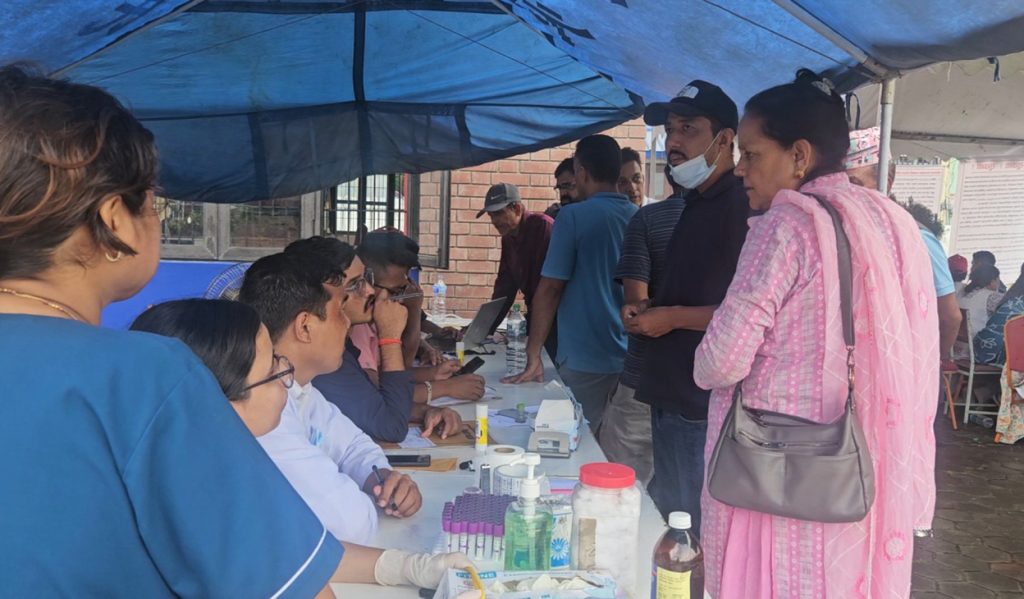
The physical appearance of a body may deteriorate, but the genetic information contained in its DNA remains useful for identification.
At the Teaching Hospital, samples are collected from the bodies. Samples from relatives are collected at the pathology laboratory of the Police Hospital in Maharajgunj.
The closer the biological relationship, the more useful the sample can be for comparison. Samples from a mother, father, son or daughter can provide strong evidence for establishing a match.
DNA identification also removes some of the burden from families.
In the immediate aftermath of a disaster, relatives are often asked to identify bodies while under enormous emotional pressure. When a body has been badly damaged, there is always a risk of mistaken identification based on clothing, jewellery or other belongings.
DNA provides a scientific confirmation.
For families waiting outside the mortuary, however, the process can feel painfully slow.
‘We cannot keep decomposed bodies outside’
As the number of bodies rises, keeping them safely stored has become another challenge.
Decomposed bodies cannot simply be left in an open or ordinary environment. The odour, biological waste and potential health risks mean they need to be kept in an enclosed and appropriately cooled space.
But there is only so much space available.
“We cannot keep decomposed bodies outside,” Chaudhary says. “The smell spreads and the risk of infection increases. So we have no choice but to manage them within the limited space available.”
The pressure is being felt beyond the mortuary itself.
The continuous movement of bodies and the decomposition process have affected the surroundings, with patients, their relatives and people working in nearby institutions also exposed to the strong odour.
A week of working with death
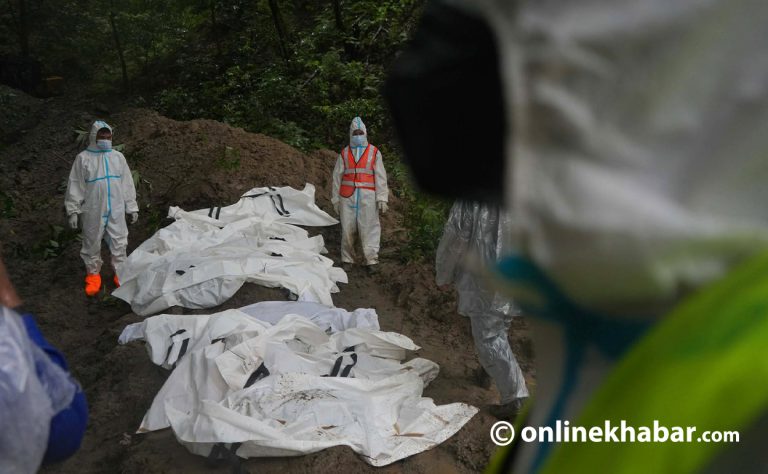
The people managing the bodies are carrying their own burden.
Doctors, police officers and other staff have been working continuously for more than a week, handling decomposed bodies amid heat, strong odours, biological risks and the emotional strain of dealing with grieving families.
There are only a limited number of forensic doctors, making it difficult to provide adequate rotation.
The work is physically demanding. It is also psychologically difficult.
Inside the mortuary, doctors conduct postmortems and collect samples. Police officers record details and work on identification. Outside, relatives wait, sometimes holding photographs of people they have not heard from since the disaster.
The mortuary has therefore become more than a place where bodies are stored.
It has become a centre for trying to reconnect families with people who disappeared in the disaster.
Why Kathmandu is receiving so many bodies
The Teaching Hospital is one of the main centres in Kathmandu for postmortems on bodies recovered from disasters.
As bodies continue to be recovered from flood-affected districts, they are being transported to Kathmandu, adding to the pressure at the hospital.
Chaudhary says a more decentralised approach could help reduce the burden.
Police and medical teams could be deployed in affected districts to conduct preliminary identification, collect samples and complete the necessary legal procedures before bodies are transported to Kathmandu.
But that requires forensic specialists, infrastructure and facilities for DNA sample collection at the local level.
Those facilities are not equally available in all affected areas.
As a result, unidentified bodies or those requiring further forensic examination continue to be brought to the Teaching Hospital.
Bodies that can be identified at the site are handed over to relatives locally.
Inside, police search for clues. Outside, families search for faces.
Police officers take turns working inside the mortuary. Because prolonged exposure to decomposed bodies is difficult, teams are rotated.
Outside, relatives look at photographs. Inside, police record details. Doctors conduct postmortems and collect samples.
A body may provide clues through a distinctive mark, clothing, jewellery or another physical feature. Those clues can lead investigators towards a possible identity. DNA testing can then provide scientific confirmation.
Every detail matters.
Young volunteers work through the smell

The work does not end with postmortems and identification. The mortuary also needs constant cleaning.
Bodies recovered after days in floodwaters can release strong odours, blood and other biological waste. Areas around the mortuary need to be cleaned repeatedly as bodies are brought in and taken out.
A group of young volunteers has been helping with that work.
Wearing PPE and masks and using sanitiser and disinfectant, they clean the area around the mortuary, wash pathways and remove blood or other waste left behind as bodies are transferred from ambulances.
The work has been organised in two shifts.
One group works for a period before another takes over. Yet the cycle continues.
When several bodies arrive at once, the area can quickly return to the same difficult condition, requiring another round of cleaning. For the volunteers, too, the work is not easy.
Some of the bodies are badly decomposed. Others have been recovered in pieces. Working so close to death, day after day, can take a psychological toll. Still, they continue.
Part of the reason is practical—to reduce the risk of infection and keep the hospital surroundings manageable. But there is another reason.
Families are waiting just outside.
The volunteers do not want those families to endure any more suffering than they already have.
The group had initially been involved in rescue operations in Nuwakot and other areas following the disaster. It has now shifted its focus to body management and cleaning, coordinating with the relevant state agencies.
Bodies are arriving faster than they are leaving
The pressure inside the mortuary has another cause: bodies are arriving faster than they can be identified and handed over.
Many of the bodies arriving from different districts cannot immediately be identified.
Those that are identified can be released to their families.
For unidentified bodies, samples are collected for DNA testing and the necessary procedures are completed before temporary burial.
For families, however, that means waiting. Sometimes there is no immediate answer.
Behind every body is a family waiting

Every person standing outside the Teaching Hospital mortuary is waiting for someone.
A husband is waiting for his wife. A parent is waiting for a son or daughter. A brother is waiting for a sibling. For some, the person they are looking for may have been missing for days.
Until a body is identified, even grief remains unfinished.
That is why the challenge at the Teaching Hospital is not simply where to put the bodies.
It is how to preserve them safely, identify them scientifically, return them to the correct families and ensure that each person is treated with dignity after death.
The work unfolding inside the mortuary brings together forensic medicine, police investigation, DNA technology, body storage and humanitarian care in the difficult days following a disaster.
The floods separated people from their families.
Now, inside a crowded mortuary in Kathmandu, doctors, police officers and volunteers are trying to bridge that separation.
Sometimes the answer comes from a familiar tattoo or a piece of clothing. Increasingly, it comes from DNA.
And outside the mortuary, families continue to wait for the answer to one devastatingly simple question: Is the person inside my loved one?