
Nepal’s biggest festivals — Teej, Dashain, Tihar and Chhath — are just around the corner, followed by the winter season.
Normally, this is when Kathmandu’s major commercial hubs would be buzzing with activity as traders stock up for the festive rush.
Instead, the mood in New Road, Bhotahity and Ranjana Galli is one of anxiety and uncertainty.
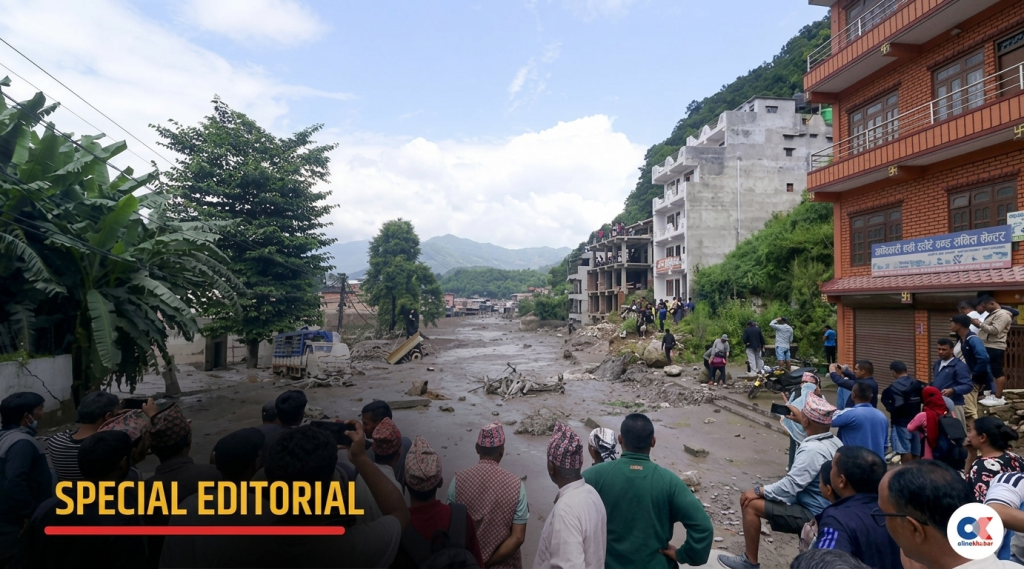
The reason is thousands of tonnes of goods meant for the festive season are now stranded, damaged or lost after Wednesday’s devastating flood in the Bhotekoshi River in Rasuwa.
Billions of rupees worth of clothes, footwear, electronic goods, garlic, onions, ginger and fruits, imported by traders on loans and credit, were being transported through the Rasuwagadhi border point with China. Hundreds of containers carrying such goods were swept away by the flood.
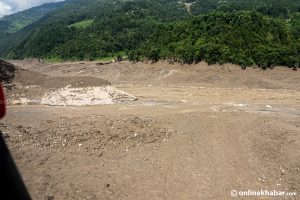
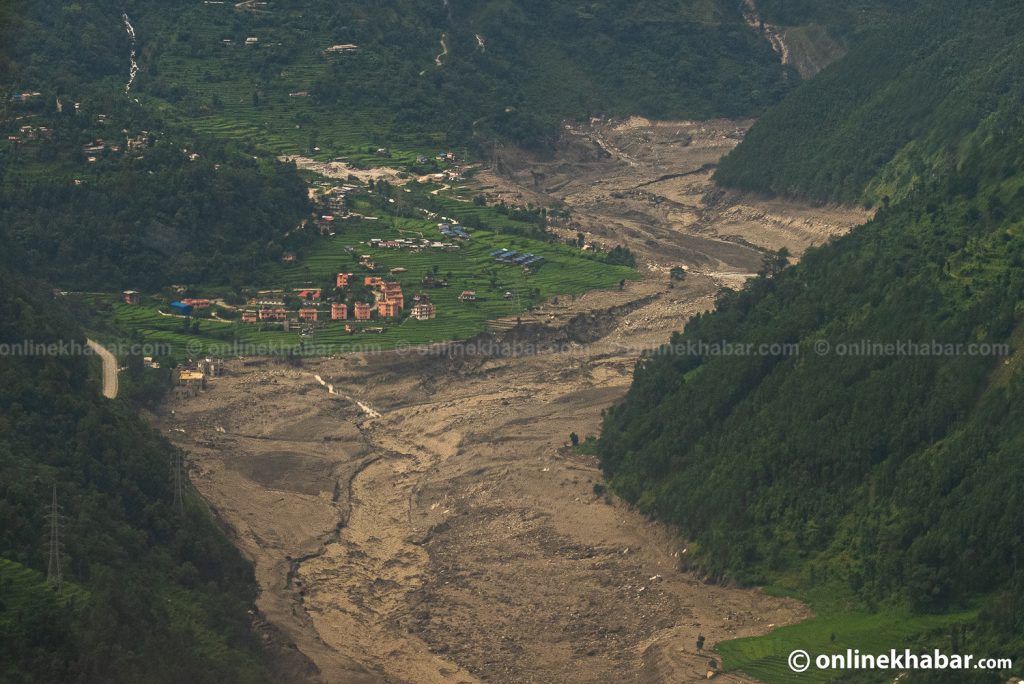
The disaster has also destroyed the Rasuwagadhi customs yard, while landslides have disrupted the road to the Tatopani border point in Sindhupalchok, leaving transit through that route halted for about a month.
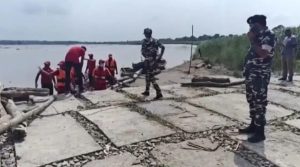
The crisis is no longer only about lost goods and infrastructure. Customs officials, agents and truck drivers who had travelled to Rasuwagadhi to collect shipments are among those missing.
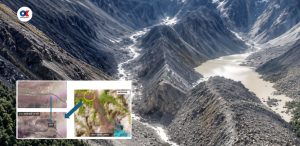
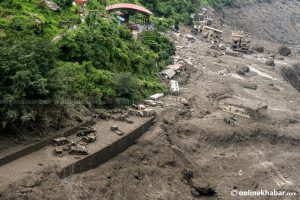
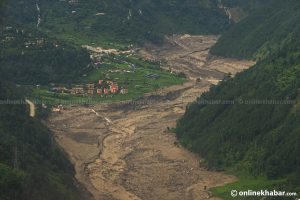
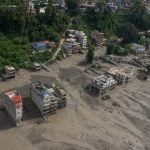
The flood has devastated infrastructure in the Rasuwagadhi area and caused a major human tragedy. The Rasuwagadhi dry port and customs yard, which held infrastructure worth billions of rupees, have been reduced to a riverbed. Hundreds of cargo containers parked there, along with newly imported expensive electric vehicles, were swept away.
For traders who had invested billions in preparation for the festive season, the losses have brought severe financial and psychological pressure.
‘There is nothing left’
Jayant Kumar Agrawal, secretary-general of the Nepal Overseas Exporters and Importers Association, said there was virtually no infrastructure left in the border area and that the humanitarian situation was deeply distressing.
“There is no possibility of opening Rasuwa or Tatopani for now. There is no infrastructure left there; everything has been reduced to a riverbed,” Agrawal said.
Fourteen customs officials remain unaccounted for, he said, while many customs agents, bank employees and truck drivers are also out of contact. Several containers and empty trucks have already been swept away.
Agrawal warned that traders were struggling to think rationally amid the scale of the disaster and that the situation could worsen unless the state immediately prioritised rescue and relief.
Parshuram Dahal, chairman of the RB Complex Business Association in New Road, said communication between traders in Kathmandu and drivers who had travelled to China had also been completely disrupted.
“Most drivers and helpers have their phones switched off, and it is difficult even to get basic information about their condition,” Dahal said. “Some traders’ goods intended for the festive season had already arrived at customs, but those goods have been damaged by the floods and landslides. CCTV footage shows that warehouses and the surrounding area have been destroyed, so a huge financial loss is certain.”
Tatopani offers little immediate relief
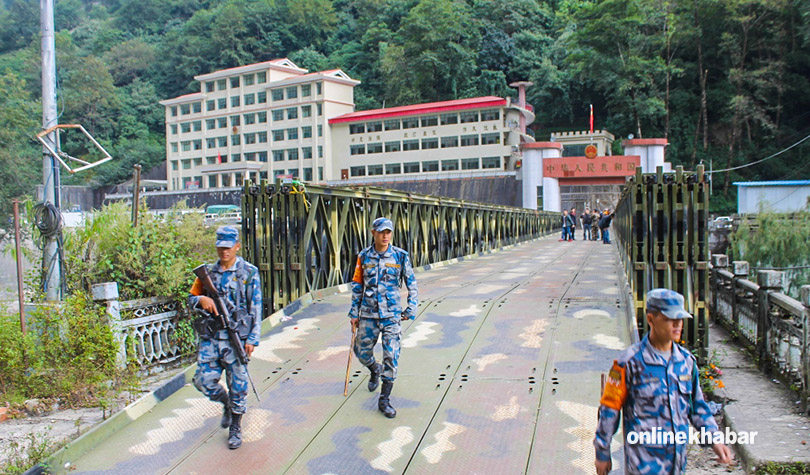
The government is also looking at reopening the Tatopani border point in Sindhupalchok, but the situation there remains difficult.
Although authorities have cleared landslides from the Nepal side and built a temporary road, Chinese authorities have not yet allowed containers to be released.
Deependra Prakash Giri, chief customs officer at the Tatopani Customs Office, said the Chinese side had not agreed to release the containers as previously discussed.
“We expected goods to come from there, but they have not released the containers, saying they have no higher-level order,” Giri said. “They say they are still working on the road and that it will take another two or four days. Vehicles can travel from the Nepal side, but the border is almost completely stalled because containers are not being released from the other side.”
Communication between the two sides is also limited.
“We can communicate with them only through messages at present. A nodal officer has been designated, and messages are exchanged through that person,” Giri said.
Chinese customs officials have moved elsewhere after floods and landslides damaged Liping and surrounding areas on the Chinese side.
Pressure grows on Mustang’s Korala crossing

With neither Rasuwagadhi nor Tatopani offering a reliable route, the Department of Customs has advised traders to consider the Korala border point in Mustang as an alternative.
Korala is located on relatively flat terrain and faces less flood and landslide risk. But traders say using the crossing is more a necessity than a genuine alternative.
The remote Korala border lacks the customs infrastructure, wide roads capable of handling large cargo trucks and warehouse facilities available at Rasuwagadhi and Tatopani.
Bidur Chudal, chief customs officer at the Mustang Customs Office, said cargo vehicles were currently operating through the border.
“We are working with basic infrastructure about 14 kilometres below the border,” Chudal said. “We do not have the sophisticated facilities available on the Chinese side, but the border is operating and vehicles are arriving.”
The crossing has already attracted importers of electric vehicles. According to Chudal, 100 BYD vehicles and 63 Foton electric vehicles recently entered Nepal through Korala, while vehicles from other companies are also on their way.
Ready-made clothes, shoes, bags and rolls of fabric are among the other major imports coming through the crossing.
As pressure has grown on the Rasuwa route, traders have increasingly turned to Korala.
“Earlier, one or two containers used to arrive. Now, as many as eight to 10 containers are arriving daily,” Chudal said.
But Korala cannot currently handle food and other perishable imports. The lack of quarantine facilities and adequate manpower means fruits, vegetables and food products cannot be brought through the crossing.
“Unless there is a quarantine facility, it does not appear possible to bring such goods through here,” Chudal said. “For now, Tatopani or other border points will have to be used.”
The Mustang Customs Office has a sanctioned strength of 18 employees, but only 10 are currently working there.
Dahal of the RB Complex Business Association said bringing goods through Korala was essentially a case of making do with what was available.
“It is better than having no option at all,” he said, adding that transportation through Korala would increase both costs and delivery times.
Transport costs could double
Ram Chandra Parajuli, secretary-general of the Nepal Himalaya Trans-Himalayan Commerce Association, said around 50 to 60 kilometres of road infrastructure on the Chinese side toward the Rasuwa-Kerung border had been completely destroyed.
“The physical condition of the Rasuwa border is extremely damaged. Rebuilding the road infrastructure will require a national-level budget and special efforts from the Chinese side,” Parajuli said.
Diverting shipments to Korala would sharply increase transport costs, he said.
“It takes around two days to reach Kathmandu from Korala. Changing the route in this way will significantly increase transportation costs,” Parajuli said. “As we had already estimated, the price of goods in the market could increase by as much as half.”
Another option is to import goods through the sea route via Kolkata in India. But traders say the route is too expensive, complicated and slow to meet demand during Dashain and the other major festivals.
According to Agrawal, the international geopolitical situation has also affected maritime trade.
“It takes a long time to bring goods from Kolkata. After the war in the Middle East, container waiting times have increased and charges have also risen significantly,” he said. “It takes around one and a half months for goods to reach Kolkata from a Chinese port and another 20 to 25 days to reach Nepal from there.”
A route that takes more than two months would increase bank interest costs for traders while potentially making the shipment arrive after the festive and winter seasons have already passed, he said.
Billions tied up in disrupted supply chains
The crisis is therefore not simply about shortages of essential goods. Traders warn that it could severely damage Nepal’s small and medium-sized business sector.
Thousands of traders who borrowed money at high interest rates and imported goods through letters of credit now face the loss of their capital while their shipments remain stranded or destroyed.
“The floods and landslides have destroyed not only goods and infrastructure but also traders’ capital. Many traders have lost their entire investment,” Parajuli said. “Some may even be forced to leave the business.”
He warned that shortages could emerge in the market because traders would struggle to raise new capital after losing goods they had already purchased.
Business representatives have called on the Chinese government to adopt flexible policies to help reroute stranded shipments by sea or air.
A recurring crisis
The disaster at Nepal’s northern trade routes is not without precedent.
Nepal has faced similar disruptions following the Jure landslide in 2014, the 2015 earthquake, the Bhotekoshi flood in 2020 and repeated monsoon disasters.
China formally declared the Rasuwagadhi-Kerung border an international crossing on August 30, 2017.
Yet the road connecting Nepal to what is officially an “international” border remains far from the standard expected of a major trade route.
Every year, particularly around the festival season in August and September, floods and landslides disrupt the road network, leaving billions of rupees worth of goods stranded or destroyed. Traders, both large and small, have repeatedly suffered losses worth millions.
The scale of Nepal’s dependence on the route is significant.
In the first month of the current fiscal year 2083/84, in Shrawan alone, Nepal imported goods worth Rs 31.74 billion from China. In the previous fiscal year, imports from China exceeded Rs 400 billion.
Risk of shortages and higher prices
Trade and commerce expert Rabishankar Sainju said the government must take immediate steps to prevent shortages of essential goods in the market as the festival season approaches.
Although Korala is being considered as an alternative after the disaster, its transportation costs are significantly higher, he said.
“Korala is an option for bringing in goods, but compared with Kerung or Tatopani, its transportation cost could be almost double,” Sainju said.
He said transporting goods from Kodari (Tatopani) was already more expensive than through the Rasuwa route, and the cost would rise further if traders were forced to use Korala.
“From my preliminary analysis, the transportation cost through Korala is significantly higher,” he said. “Ultimately, the direct impact will be felt by consumers.”
Sainju estimated that around 200 to 300 containers of goods may have been swept away or damaged in the Rasuwagadhi area.
The resulting losses, he said, could run into billions of rupees and have severely affected traders’ confidence.
“Container drivers and traders themselves are missing or out of contact,” he said. “In such circumstances, it is difficult for traders to have the confidence to immediately bring goods through another border.”
With Rasuwagadhi itself blocked, he said traders may be forced towards more expensive options such as Korala or sea and air routes at precisely the time when import demand is at its highest ahead of the festivals.
Sainju urged the government to treat the situation as an emergency.
“The government needs to coordinate on a war footing to prevent artificial shortages and inflation during the festival season,” he said. “If the state can provide some form of subsidy or relief for the additional costs traders incur when using Korala or other alternative routes, it will provide relief to consumers.”
Economist Dr Dill Raj Khanal agreed that the disaster represented a major setback for Nepal’s broader economic development.
“This is a very serious loss for the country. Along with the loss of human lives, the billions of rupees in damage to roads, bridges and power generation will have a serious impact on the economy,” Khanal said.
The destruction at Rasuwagadhi, he said, would also undermine foreign trade and traders’ confidence.
With imports from China disrupted, supplies routed through India or other alternatives are likely to become more expensive. Khanal said the government should therefore consider special concessions or subsidies.
He also called for the government to coordinate with political parties, the private sector and development partners to prepare a time-bound and comprehensive recovery plan.
“Disaster management must move forward on a war footing,” he said. “The Rs 25 billion the World Bank is said to be providing, along with assistance from India, China and other countries, needs to be mobilised effectively.”
He stressed that the government must establish a rapid disaster management system to prevent shortages and control inflation.
For now, Nepal’s main supply chain from China has been severed just as demand for goods is about to surge.
The immediate consequences will be felt not only in warehouses and customs yards, but eventually in consumers’ kitchens and household budgets. If alternative routes prove significantly more expensive and supplies remain disrupted, the resulting price increases could hit low- and middle-income families hardest — and create a ripple effect across the wider economy.