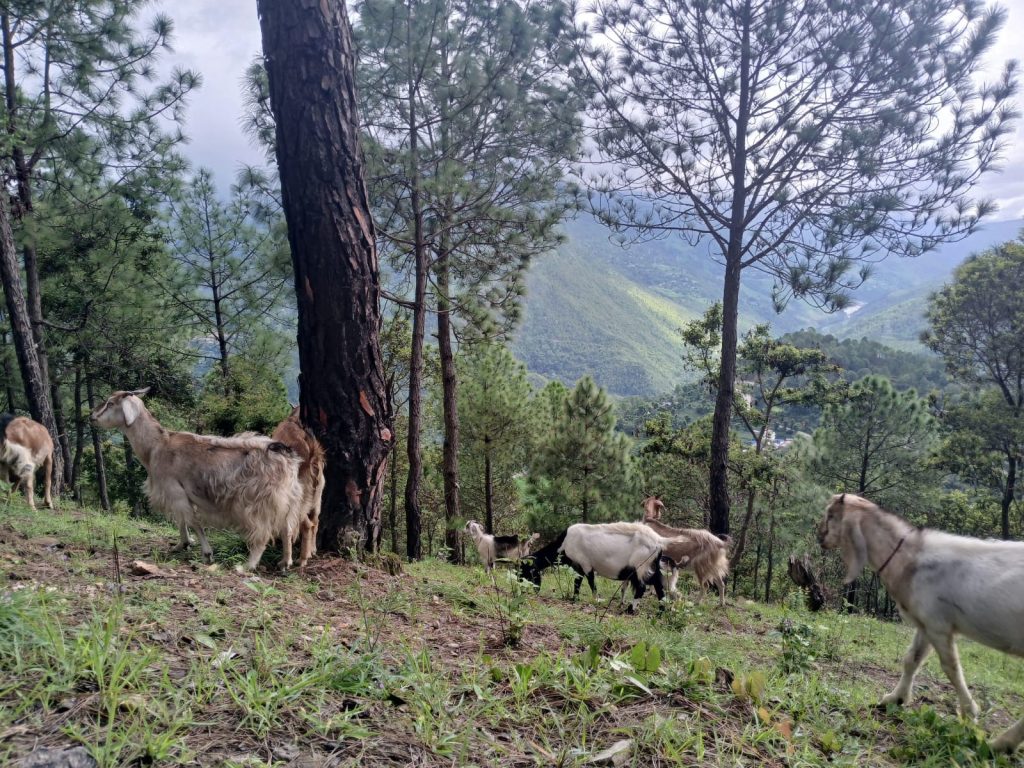
Livestock rearing through grazing has been one of the major livelihoods for centuries; however, feeding patterns have changed with time and circumstances. Born from the urgency of the 1960s and 1970s afforestation drives, when young saplings needed protection and degraded hillsides desperately needed cover, the blanket stopping grazing became gospel. It has been helpful during massive afforestation. Forests came back. But that success story may now be obscuring a quieter crisis unfolding on the forest floor.
Nepal’s community forestry programme is, by any measure, one of the world’s great conservation achievements. In 1992, forests covered just 26 per cent of the country’s land area. By 2016, that figure had climbed back to 45 per cent, nearly double, thanks largely to more than 22,000 Community Forest User Groups (CFUGs) that today collectively manage close to three million hectares across Nepal, directly benefiting roughly half of all rural households. The programme has been lauded globally as a model of participatory resource governance.
But decades of successful protection have created a new problem in many mature forests: dense, impenetrable undergrowth. Without periodic disturbance, shrub layers thicken, fire risk rises, and the conditions that allow natural seedling regeneration deteriorate. In these forests, not the young or actively managed ones, but the mature, well-stocked community forests of the hills, the old logic of total exclusion may be working against forest health.
“There was a time when we used to say no livestock in the forest. It seems that was a mistake. Now we say grazing needs to be open for the health of the forest,” says Chairperson, District FECOFUN, Dolakha, Jagnath Basnet. This view is gaining ground among forest practitioners and ecologists alike.
In mature forests without intensive management, controlled grazing can suppress dense understorey growth, reduce accumulated dry fuel, and help maintain a healthier, more diverse forest floor. Well-planned rotational or seasonal grazing is increasingly recognised not as a threat to forests, but as an ecologically valuable tool for managing them.
Crucially, the legal framework does not stand in the way. Neither Nepal’s Forest Act nor its regulations impose a blanket grazing prohibition. CFUGs retain full autonomy to set rules according to local conditions. What has persisted is not a legal mandate but an institutional habit, a conservation narrative that outlived its original context.
The human cost of rigid rules
The persistence of that narrative carries real costs for those who remain in Nepal’s hills. Livestock rearing- goats, cattle, buffalo- remains central to hill economies, providing milk, meat, manure, and cash income. Community forests are the primary source of fodder and grazing land for most rural families.
A Chauri herder in Kalinchowk Rural Municipality shares, “Every time we (herders) are blamed for forest degradation in community forest meetings, we have started to skip the CF meeting”. The narrative of negative impacts of grazing inside the forest is deeply rooted in common people.
A goat rearer in Bhimeshwor Municipality put it simply: if grazing were permitted, she could expand her herd from 30 to 60 goats. The alternative, stall-feeding, which requires cutting and carrying fodder by hand, is exhausting work, and it is growing harder. With young people leaving for Kathmandu, the Gulf, or beyond, it is increasingly the elderly who shoulder this burden alone.
Nepal’s 2021 census confirmed what many in the hills already knew: the country’s population growth rate has fallen to its lowest in eight decades, at just 0.93 per cent annually. The hill and mountain regions have seen absolute population decline. Over 29 per cent of people from the hill regions have migrated internally in the last decade alone, and Nepal’s net migration figure remains deeply negative. The villages that once needed rules to manage pressure on forests are now facing the opposite problem: too few people, and too little economic activity to sustain rural life.
A 2021 study by Jefferson Fox of the East-West Center, published in the Journal of Peasant Studies, tracked this shift across middle-hills communities between 1992 and 2017. In 1992, the average hill household owned four cows and buffalo and five-and-a-half goats and sheep. By 2017, those numbers had roughly halved. The pressure on forests from livestock has diminished substantially, yet the rules designed to address that old pressure have largely remained unchanged.
Nuance, not a free-for-all
Rethinking grazing does not mean opening all forests to all animals at all times. Context is everything. Regeneration felling areas, where mother trees are retained to promote natural seedlings, require temporary fencing and exclusion, as do newly planted forests in their early years. These protections remain as necessary as ever. What is outdated is the default assumption that grazing is always harmful everywhere.
The path forward is adaptive management: zoning forests by ecological condition and management stage, developing seasonal grazing calendars that protect regenerating areas while opening mature sections, and building monitoring systems that allow CFUGs to track impacts and adjust rules accordingly.
Nepal’s CFUGs already have the institutional capacity for this; the same deliberative structures that produced one of the world’s most successful conservation programmes can produce nuanced, locally appropriate grazing policies too.
A new definition of success
Nepal’s forest recovery is a story worth celebrating. Forest cover has nearly doubled in three decades. Biodiversity has returned to once-degraded hillsides. Community institutions have been strengthened. These gains must be protected.
But the next chapter of Nepal’s community forestry story cannot be written with the rulebook of the 1970s. A country whose hill villages are emptying, whose remaining residents are older and more dependent on livestock than ever, and whose mature forests increasingly need management rather than simply protection, requires a more adaptive approach.
The ideal for Nepal’s hills is no longer just dense forest. It is forests that also sustain resilient rural economies and the communities that have spent generations caring for them. A thoughtful re-examination of long-standing grazing practices, grounded in ecological evidence, local knowledge, and the legal autonomy that CFUGs already possess, can help achieve both.
The fence, in other words, has served its purpose. It may be time to open the gate.