
Artist Krishna Gopal Shrestha’s solo exhibition ‘Archetype’ is on display at the gallery 108, Durbar Marg, from June 12. Shrestha, who is doing his MPhil, encountered the subject archetype during his academic research and felt his artworks were similar to the concept of archetypes, which resonated closely with the themes and visual language of his paintings. “While writing a research article on archetype, I had to study manuscripts, Paubha paintings, and historical artworks and figured out the topic is apt with my painting style,” says Shrestha.
This exploration helped him to get the title for the exhibition. By aligning the meaning of archetypes with his artistic practice, Shrestha has transformed cultural, religious, and historical narratives into a vibrant visual continuum, creating a dynamic dialogue between tradition and contemporary expression.
In the exhibition
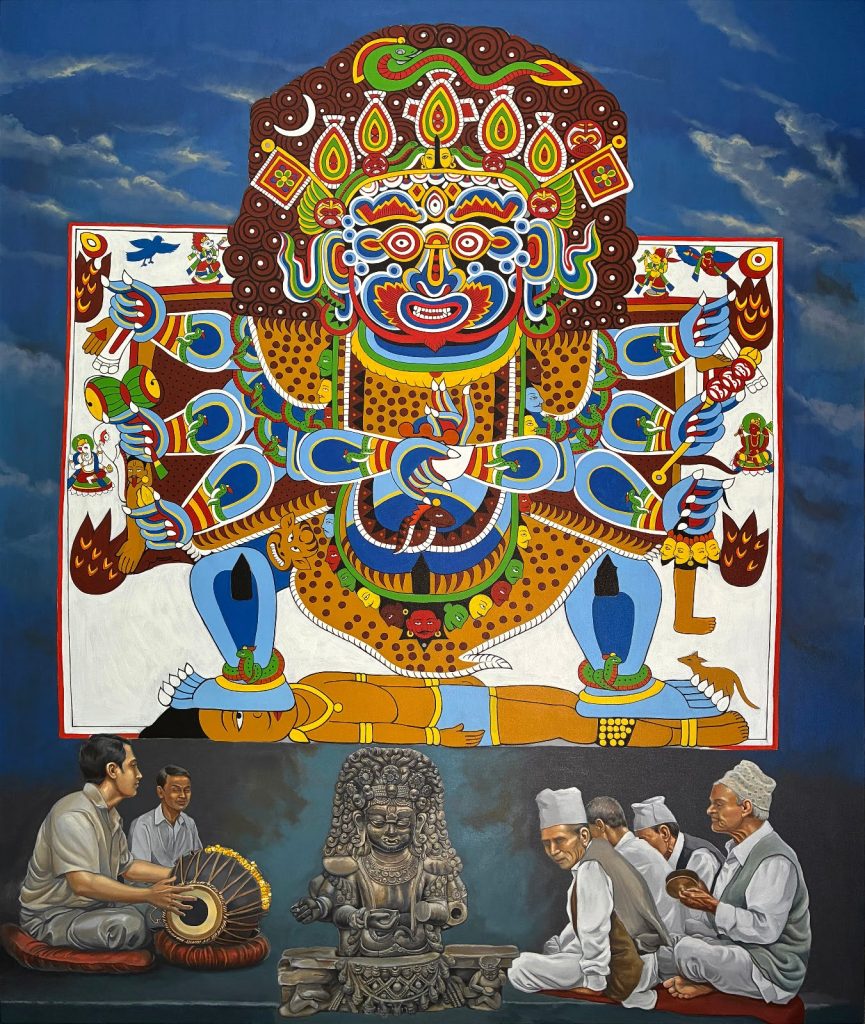
In the exhibition, one can notice that Shrestha’s upbringing in the Kathmandu Valley has undoubtedly influenced his paintings. In most of his paintings, he has explored the rich religious and cultural heritage of the valley.
“My artistic practice is deeply influenced by the environment, society and cultural heritage that surround me. Growing up in the historic town of Sankhu, I was constantly exposed to temples, monasteries, chaityas, traditional water spouts, and other sacred heritage sites. These childhood experiences became a lasting source of inspiration and continue to shape my work today,” says Shrestha.
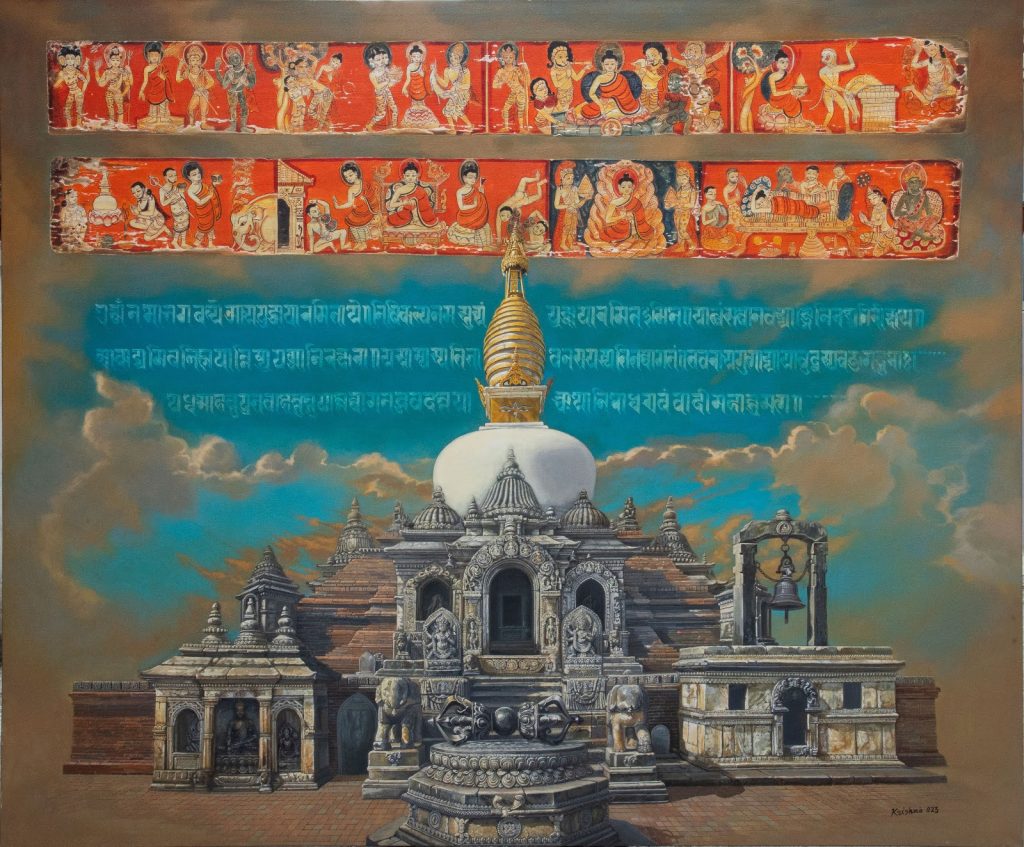
These very architectures are beautifully presented in his paintings. In one of his paintings, “Chilanco Bihar’, at the centre of the painting, he has placed the Chilancho Stupa. The Stupa in the painting has a photographic resemblance to the stupa and its base, formed from stone. Above the stupa, he has placed two horizontal panels depicting scenes from the life of the Buddha and Buddhist teachings, which resemble ancient Buddhist manuscript illustrations. He has painted the figures in a traditional style in vibrant red and golden hues. In between, he has painted sacred script floating among the clouds in a vast blue sky, in the background.
According to him, the script symbolises divine wisdom and the transmission of Buddhist teachings across time. Then, the contrast between the heavenly atmosphere and the earthly monument creates a connection between the spiritual and physical worlds. He says, “Through the integration of sacred architecture, ancient texts, and visual narratives, the artwork celebrates Nepal’s role as a guardian of Buddhist heritage. It conveys the enduring power of faith, wisdom, and cultural memory, inviting viewers to reflect on the deep relationship between historical tradition and spiritual enlightenment.”
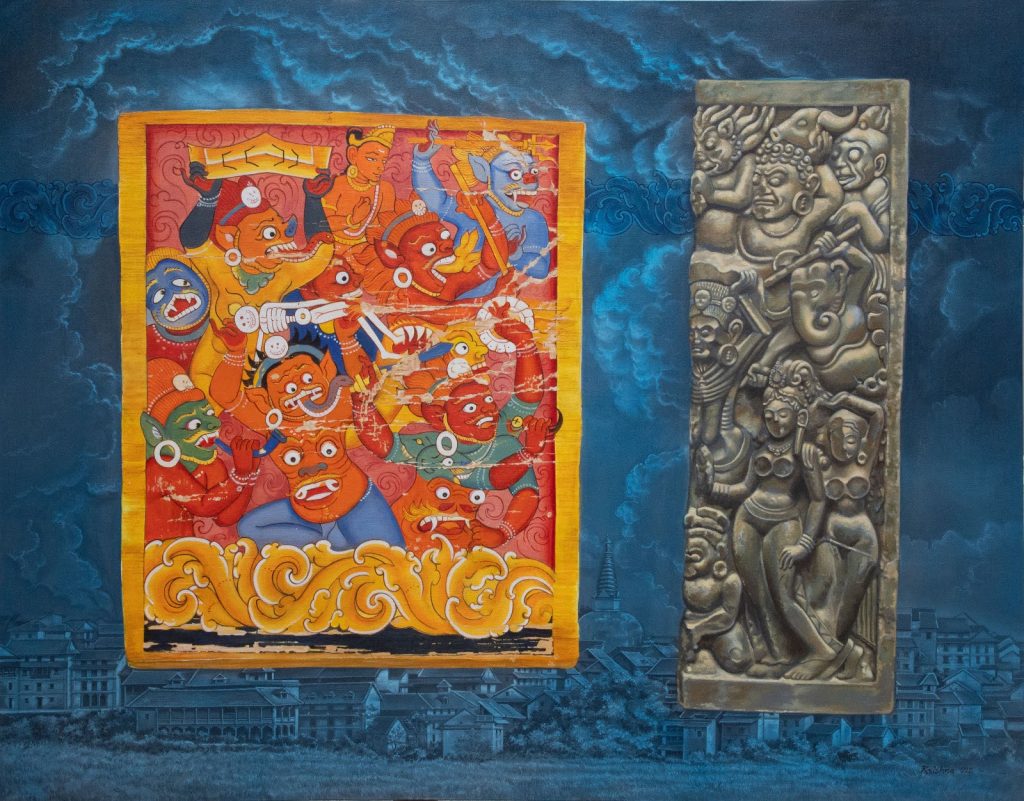
In the exhibition, one can view his inclination not only in Buddhism and its philosophy, iconography, mythology and architecture but also towards Hinduism and its aspects. In the painting titled “Kaliyadaman”, Shrestha has showcased two major forms of Nepali artistic heritage—manuscript painting and sacred sculpture—to depict the Hindu mythological episode of Lord Krishna subduing the serpent Kaliya. The upper section features an enlarged manuscript folio rendered in golden-yellow tones, displaying delicate line drawings and Nepal Bhasa script. In the centre, the artist has transformed the manuscript illustration into a three-dimensional sculptural form.
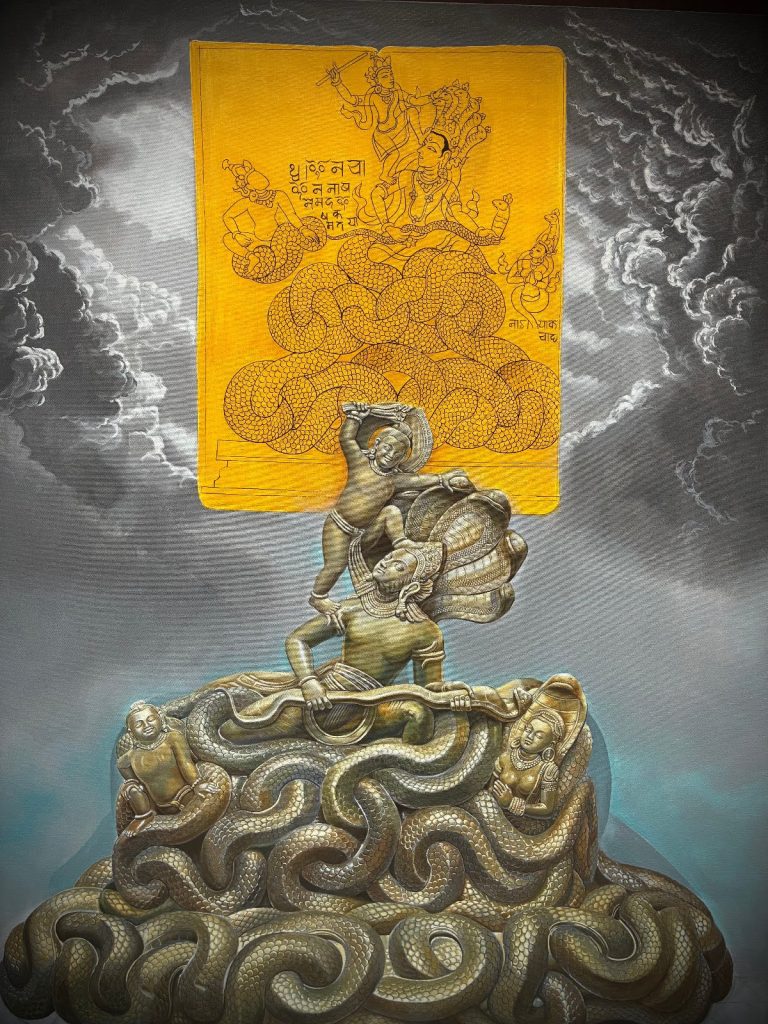
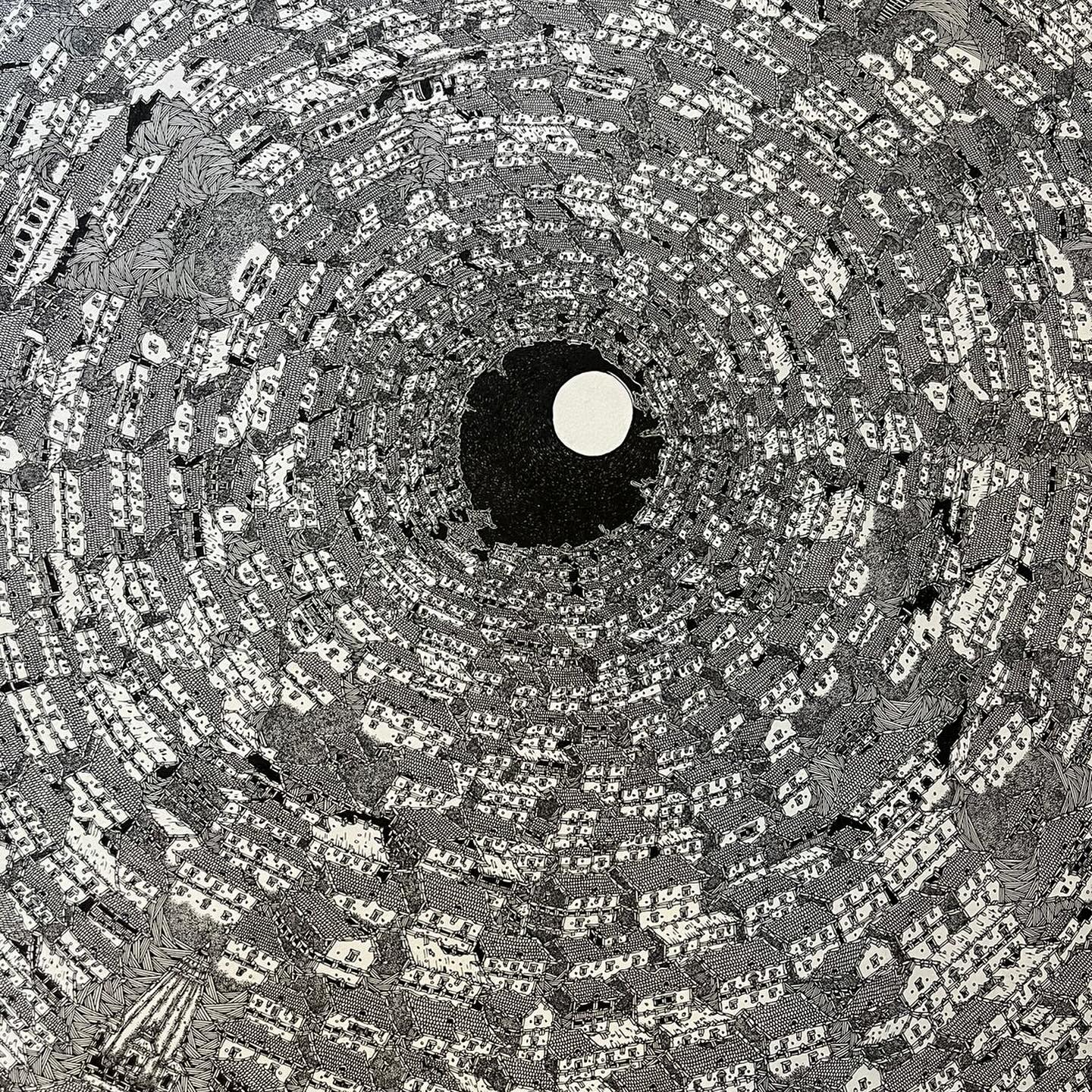
The composition in the painting is rhythmic, and the line formations of the artist in each painting show his mastery. The recurring symbol in his paintings is clouds and the sky. In some paintings, they are calm and subtle, while in others, they are dark and mysterious according to the need of the figures’ mood in the paintings. “My paintings are figurative and mostly architectures where the open luminous sky and the gloomy sky fill the void of movement in my otherwise static paintings,” says Shrestha.
Another highlight in his paintings is his technique, where the stone-like treatment of his figures recalls medieval Nepali stone sculpture and temple art.
Living visual continuum
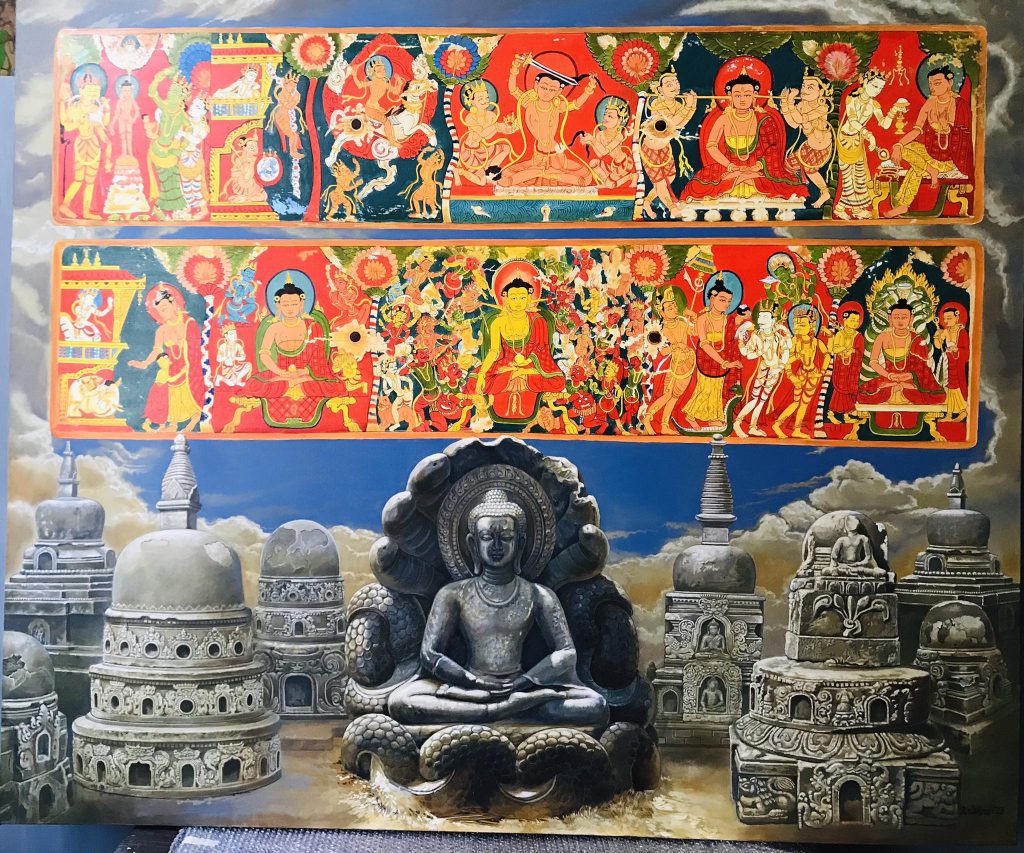
The exhibition is noteworthy in the Nepali art perspective that held together three different traditions simultaneously—Newa paubha painting, Newa architecture and cultural narrative structure—through contemporary fine-art realism.
The paintings in the exhibition are neither purely traditional nor purely modern. In contrast, it shows a contemporary Nepali visual philosophy in which sacred narratives, archaeological heritage, and meditative symbolism coexist within a single pictorial field.
Then the combination of colour and monochrome, narrative and monument, memory and devotion gives the paintings their intellectual and spiritual depth.
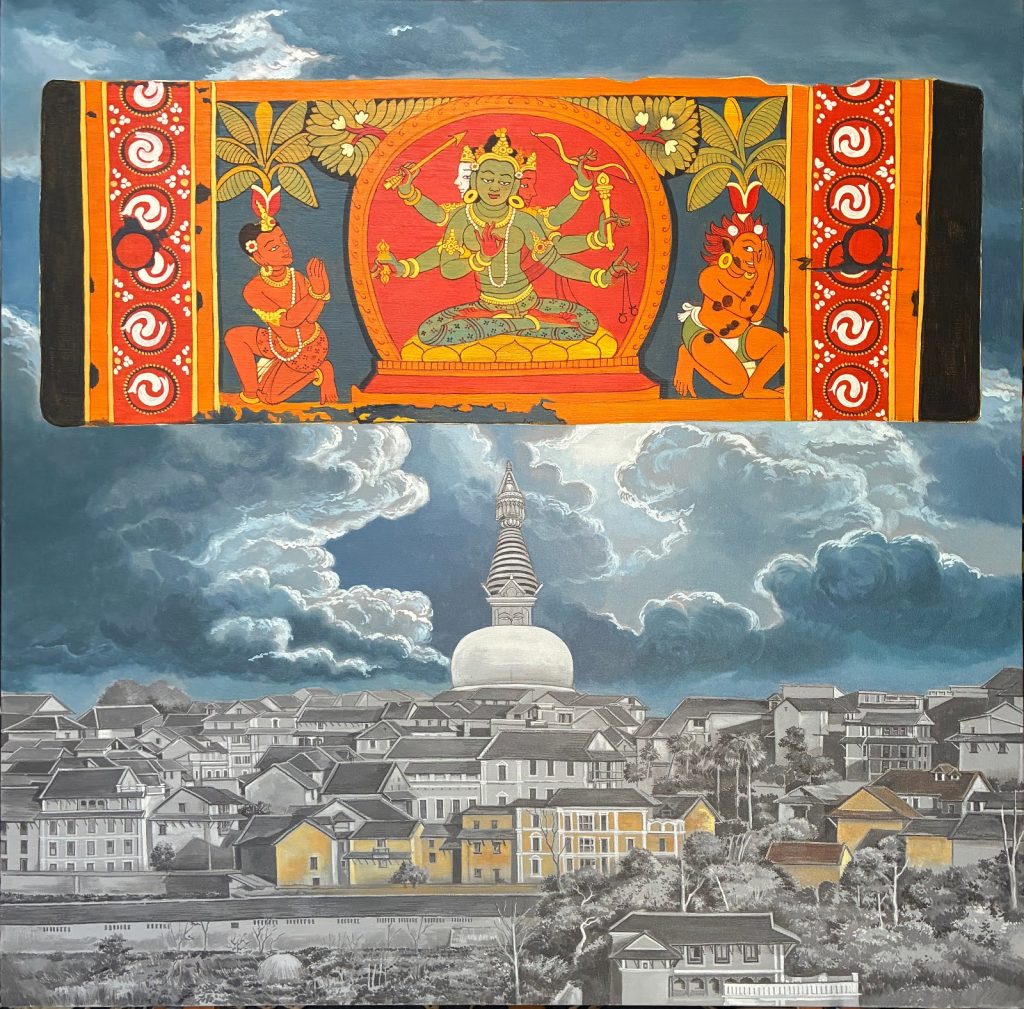
The works reflect the interaction between mythology, spirituality and artistic tradition while highlighting their enduring relevance in contemporary society. The paintings also incorporate visual references from various Nepali art forms, including paubha paintings, manuscript illuminations, murals, and traditional sculptures in wood, stone, and metal. Shrestha adds, “By bringing these diverse elements together on canvas, I seek to create a dialogue between history and the present, revealing the continuous transformation of cultural memory. This body of work is based on research drawn from heritage sites, museum collections, Art publications, and historical studies, celebrating the richness and continuity of Nepal’s artistic heritage.”
Likewise, artist Saroj Bajracharya writes, “In a time shaped by rapid technological change and shifting identities, Krishna Gopal turns to archetypes not as relics of the past, but as living forms that continue to evolve while retaining their symbolic power. His paintings suggest that beneath contemporary experience remain deeper structures of memory and imagination that connect individuals to a broader cultural continuum.”
If you too want to experience the transformation of cultural memory, visit the gallery to witness the exhibition that continues till July 12.