
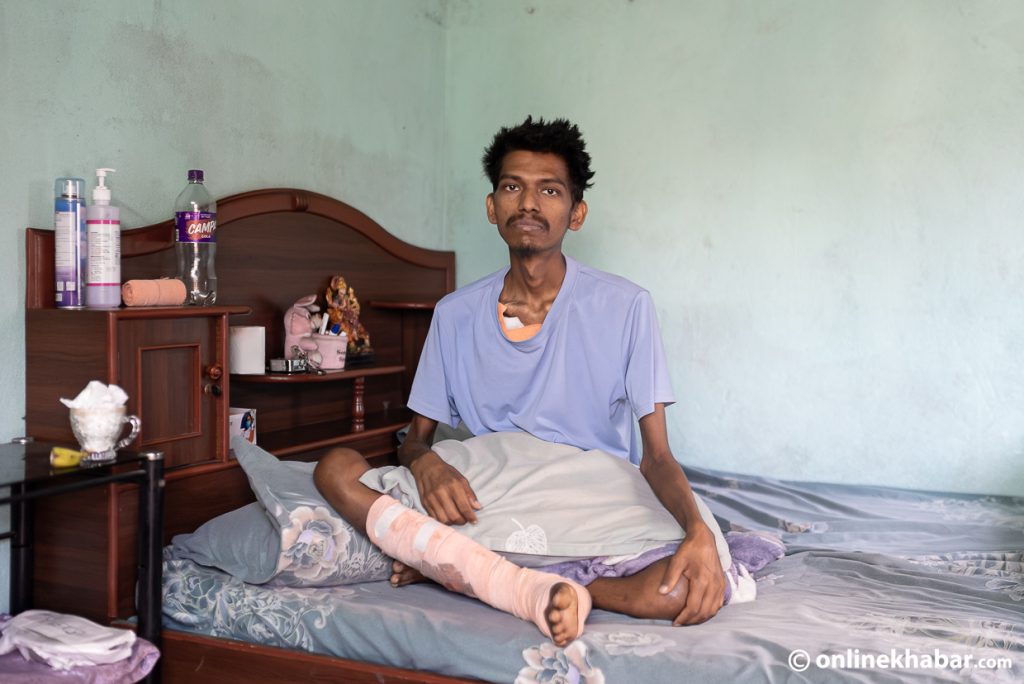
Everything was going well in Prabin Darji’s life. He had a job, was supporting his family, was laying the groundwork for a home, and was feeding his younger siblings.
Then, suddenly, his life took an unimaginable turn. He was diagnosed with blood cancer.
After that, what happened in his life? What did he do? He himself doesn’t know.
All he knows is that his body needs someone else’s blood to keep going. Because his own body can no longer produce blood. His bone marrow has stopped functioning.
The doctors have told him, “If you don’t get blood, your breathing could stop at any moment.”
This fact haunts him, stealing his breath and his peace of mind.
In those moments, he imagines a life where there is no pain in his body and be able to walk around like a normal person.
Imagining costs nothing. But to survive long enough to reach that dream, he bargains with death every single day. Because to live, he now needs a bone marrow transplant, which requires 5 million rupees.
With no property or assets, where would such a sum come from?
The breadwinner
Prabin, 28, grew up in Yamuna Danda, Sindhupalchowk, mostly at his maternal uncle’s house. His childhood was not easy. His father had two wives. His mother ran the household by stitching clothes.
After the earthquake, the family scattered even further. Mental stress increased.
Driven by poverty, he came to Kathmandu at the age of 17.
There, he struggled his way through life. He learned to drive. He rented a room in Tinkune. Gradually, he started building toward his dreams, supporting his family, raising his younger siblings.
Though he himself couldn’t study, he brought his younger brother to Kathmandu and educated him. He saved what little money he could. Things were gradually improving. But life didn’t go as planned.
The first instant
Four years ago, he got dengue fever. He was admitted to Civil Hospital for 7–10 days. After discharge, tuberculosis followed. While taking TB medication, his problems worsened a few months later.
He endured shortness of breath, difficulty climbing stairs, dizziness while walking, and chest pain. Doctors ordered tests.
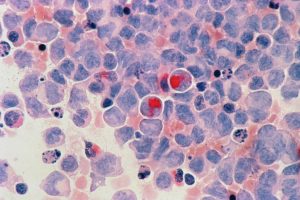
After looking at the results, the doctor informed me that he has been diagnosed with cancer and 70% of the blasts were detected.”
“I was walking, I was working. When they suddenly said I had cancer, I couldn’t believe it. I was shattered,” Prabin recalls.
At the hospital that day, only he and his brother Dipesh were present. Dipesh also thought the reports must be wrong. Eventually, the doctors convinced them that they had to accept the report.
As they said this, Prabin thought of his family’s situation. How could a person with no assets fight cancer?
But there was no choice. He decided to fight the disease. He didn’t even fear chemotherapy at first.
“I didn’t even Google. I accepted it calmly. I just thought I needed to get better and fix things at home,” he says.
However, reality was cruel.
Delayed treatment made it 5 million
Doctors recommended a bone marrow transplant. It costs 1.5 to 2 million rupees.
“The doctors had said that if treated continuously, it would cost up to 2 million. Otherwise, time would run out, treatment would become more complicated, and costs would keep rising,” he recalls. “Due to financial constraints, we couldn’t continue.”
The disease worsened. The transplant cost rose to 4.5 million.
“Now it feels like my dream of living may remain just a dream,” he says.
In the early days, Prabin had two or three lakhs saved from years of hard work. That ran out on tests and medicines. Even the one-lakh government aid was spent on a few tests.
He tried to borrow money. But society shut its doors.
While he sought help, many of them replied,” If a cancer patient dies, who will repay the debt?” That question still haunts him.
Relatives provided no solid support either.
The ordeal of queuing at government hospitals was another burden.
Arriving at 4 am, there would already be 400 people in line. His already-weakened body was forced to move from room to room in government hospitals. This hassle forced him to go to private labs, where money ran out faster.
Unaffordable treatment in India
Thinking of getting a transplant, he planned to go to India. He had the encouragement of friends and his boss at the hydraulics company.
With significant financial support from his boss and a referral to a known doctor, Prabin went to India. There, chemotherapy ravaged his body. He had continuous fever and infections for a month. He needed three pints of blood in a single day.
In a foreign land, there was nobody he knew. He barely managed to get blood from Nepali donors. Dipesh witnessed every moment of his brother’s suffering, the side effects of chemo, the blood struggle, and the worry about money.
“Nepalis in India weren’t as willing to donate blood as they are back home. I was tense, but I didn’t tell my brother about it,” Dipesh says.
When the money ran out, the brothers gave up and returned to Nepal a year ago, leaving treatment unfinished.
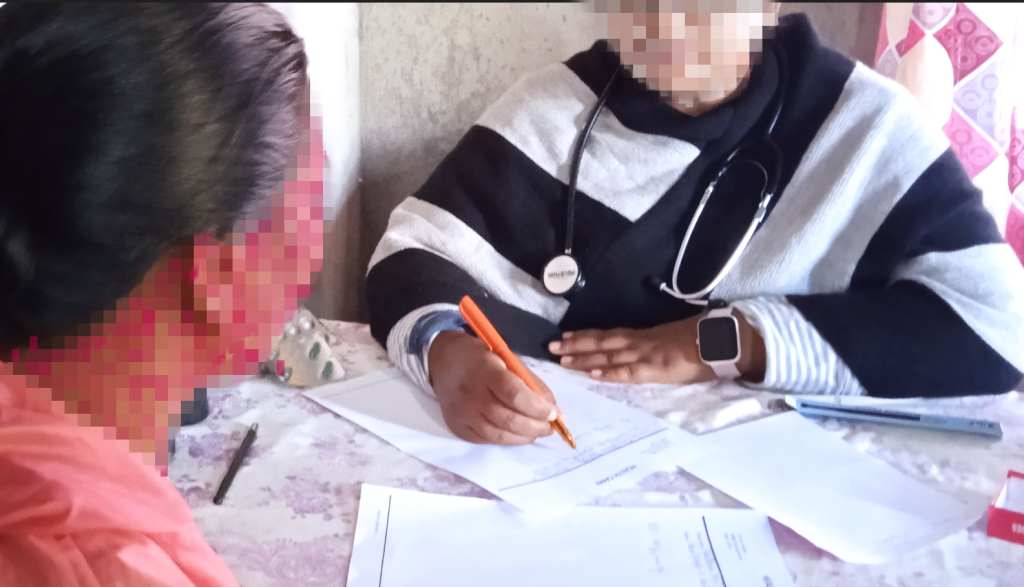
Blood cancer treatment is somewhat cheaper at the Civil Service Hospital and Tribhuvan University Teaching Hospital. When no bed was available at the Civil Service Hospital, he is now being treated at the Teaching Hospital.
“If we have money, we go to the hospital. If not, we just sit looking at each other’s faces, there’s no other option,” says Dipesh.
TikTok as the last resort
Dipesh had originally opened his TikTok account for himself, just to post ordinary videos. But after all their money for Prabin’s treatment ran out, that same TikTok became their last hope.
He began posting videos filmed from the hospital bed, scenes of blood transfusions, and his brother’s struggle.
Gradually, people started watching, feeling sympathy, and sending small amounts of help. Now that help covers room rent, hospital transportation, and daily expenses. But their situation is becoming difficult again.
The medicines have run out.
“Right now we don’t even have money to buy medicine, we’re keeping my brother alive by giving him blood transfusions as much as we can,” Dipesh says.
Sustained by others’ blood
Today, Prabin’s bone marrow has stopped producing blood. So he must receive blood transfusions every week. When blood levels drop, he struggles to breathe. His chest hurts. He feels like he might collapse while walking.
“My body doesn’t work anymore,” he says.
Even though blood is donated for free, the process, tests, bed charges, and day-care fees are all expensive. Thousands of rupees are spent every week.
And they have nearly given up. There are bruises on his body. Due to an infection in his legs, he uses crutches and leans on his brother to go to the bathroom or walk. The infection on his right leg is improving, but it takes time.
“When I don’t have to go to the hospital, when I can put a little weight on my foot, when the pain is less, I feel so happy,” Prabin says. “I look for happiness in small things. If there were money, I could survive.”
They evicted us
For four years, he had been renting a room in a house in Tinkune. Just as he was preparing to be discharged after a long stay in the ICU at the Teaching Hospital, a call came from his landlord a month ago.
After seeing his TikTok videos and learning he had cancer, neighbours and others in the building became afraid. They wouldn’t let them stay, saying cancer was contagious. On top of that, they had already been hearing remarks about untouchability because of their Dalit background.
“We sometimes hear things like ‘because lower-caste people live here, our daughters are becoming sick,'” Prabin says to Onlinekhabar. “Now that the disease has caught us, they wouldn’t let us stay because they said it would spread to them. So we left.”
They now live in a cramped shed made of blocks in Kandaghari.
Dipesh, the only support
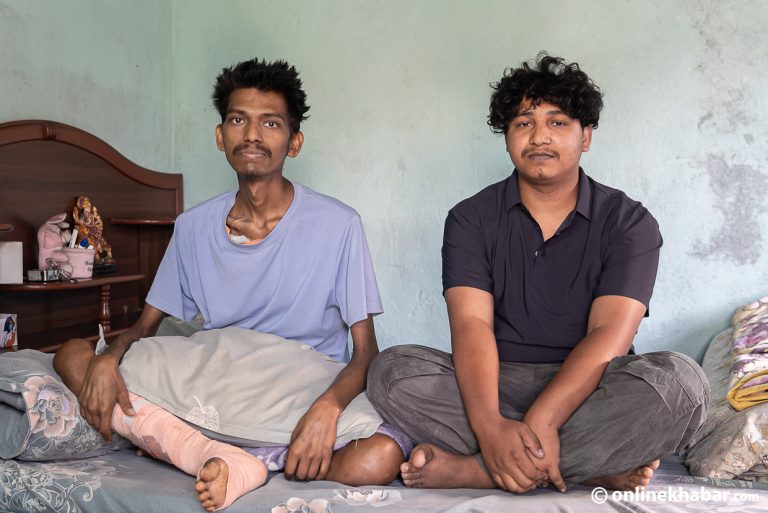
His younger brother Dipesh has carried every one of his pains for four years. He dropped out of his studies, spent nights at the hospital, and searched for blood.
When he saw his brother’s weakened body in India, when Prabin couldn’t speak in the High Dependency Unit (HDU) at the Teaching Hospital, Dipesh stayed strong. He started posting videos on TikTok and Facebook of his brother’s frail body, of blood being transfused.
“We had nothing left to hide,” Dipesh says.
He began seeking help through his monetised account. Some assistance has started coming in.
Still strong
Prabin’s nature is remarkable. His lips and mouth are so dry that he can barely speak. At times, infection torments his body. But he has not surrendered.
“No matter how big the problem, I don’t feel like this problem will take me away,” he says. “A person who has struggled since childhood doesn’t just give up on life.”
He has been coming to terms with the idea that this disease was perhaps written in his fate.
“I have no complaints. As long as I live, I will live fighting,” Prabin says. “I don’t ask God why He did this to me. I have accepted it.”
Yet hope for life is still alive in him. If he recovers, he plans to return to his old work as a driver.
Without a bone marrow transplant, his treatment remains incomplete. The medicines have run out, and there is no money. But Prabin is not waiting for death; he is waiting for treatment.