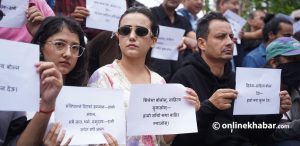


Since the release of the poster for Lalibazar, the film has attracted widespread attention from audiences. In the poster, actress Swastima Khadka is seen pregnant, wearing bright makeup. The subsequent release of its trailer generated additional excitement, largely because audiences learned that the film centres on the Badi community, a marginalised group whose women have historically been forced into prostitution, a practice that has left the entire community stigmatised. A film addressing the Badi community represents a novel subject for Nepal’s commercial film industry.
As Lalibazar approached its release date, a court halted the premiere based on a writ petition filed by members of the Badi community, throwing its release into uncertainty. The petitioners argued that the film would harm the community’s sentiments. However, on May 6, the Patan High Court cleared the way for Lalibazar to be released, permitting it to be screened in cinemas nationwide beginning Friday, May 8.
Lalibazar, directed by Yam Thapa, depicts the poignant mother-daughter story who comes from the Badi community, set against a backdrop of exploitation. Shot in Bardiya, western Nepal, the film begins by introducing Narayan, a postman from the Brahmin community (played by Bishal Devkota), who desires to marry Madhubala, a woman from the Badi community (played by Swastima Khadka), and build a life together.
Gradually, the two fall in love and elope to the city, hoping to build a better life. Things do not unfold as planned, however. Before long, they have a daughter, and it is her arrival that sets the film’s central conflict in motion. Madhubala and Narayan find themselves at odds over her future, whether to raise her to be educated and independent, or to draw her into prostitution, as Madhubala herself has been since childhood.
The first half of Lalibazar is marked by uncertainty; it takes time to establish the central plot and clarify what, exactly, the film is about. Is it the story of a couple in conflict? A father’s struggle for his daughter’s future? A meditation on the bond between mother and child? Or is it a story of a struggle of a woman from a Badi Community? This lack of narrative focus in the opening half may leave audiences feeling detached. But once the film moves into its second half, it finds its footing, picking up pace and delivering the kind of compelling storytelling that keeps viewers engaged through to the end.
One of the film’s greatest strengths is its performances. Swastima Khadka delivers a praiseworthy turn, particularly in her expressions and dance sequences, though her accent during dialogue remains inconsistent, at times convincingly evoking the cadences of far-western Nepal, and at other times falling short.
Child actor Samaira Thapa, who plays the couple’s daughter, and Bishal Devkota both steal the show. Prashamsha Subedi, who portrays the younger version of the same character, is equally impressive.
The film’s weakest link, however, is its antagonist. Rabindra Singh Baniya’s portrayal of Raja Saheb feels stilted and unconvincing. A villain of his stature should provoke genuine unease, even outrage, in the audience, but Baniya never quite inhabits the role with the menace it demands.
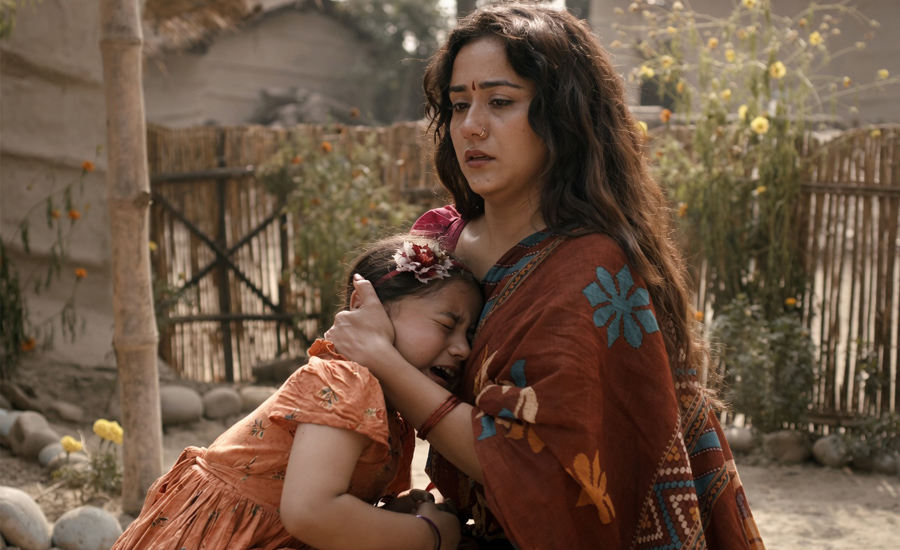
The film also makes an earnest attempt to shed light on a quietly devastating bureaucratic reality: the difficulty children face in obtaining citizenship when they have no access to their fathers, a barrier that ultimately forecloses opportunities and shapes entire futures. It is a problem that afflicts hundreds of thousands across Nepal, and Lalibazar is right to bring it to the screen.
Two scenes in Lalibazar stand out as particularly memorable. The first comes when Madhubala resolves to spare her daughter from the life she herself has known, to give her an education rather than a future in prostitution. As a symbol of that vow, she removes the nose ring from her daughter’s face. The second arrives late in the film, when Madhubala carries her grown daughter on her back as the two flee from their pursuers. It is a visceral, wordless image of maternal devotion, a reminder of how far a mother will go to shield her child from harm.
Despite its strengths and shortcomings, one area where the filmmakers could have significantly elevated the quality of the work is in their exploration of the Badi community. A deeper, more thorough investigation into the community, encompassing their origins, customs, traditions, and current social standing, would have added both richness and authenticity to the narrative.
Notably, women from the Badi community have made remarkable strides in recent years. Sita Badi, for instance, currently serves as Nepal’s Minister for Women, Children and Senior Citizens, a testament to the community’s growing presence and influence in the country’s public life.
The film’s ending, though predictable, is powerful, and ultimately makes the film well worth watching.