
We are often known as Bikas Birodhi (anti-developers). Well, if asking for clean air and saving the environment for future generations makes us anti-developers, then let it. But let me tell you the horror of living in a village where agriculture is the main source of income. Yet, industry is everywhere, constantly polluting the river and killing it with various kinds of chemicals, which are the main source of irrigation.
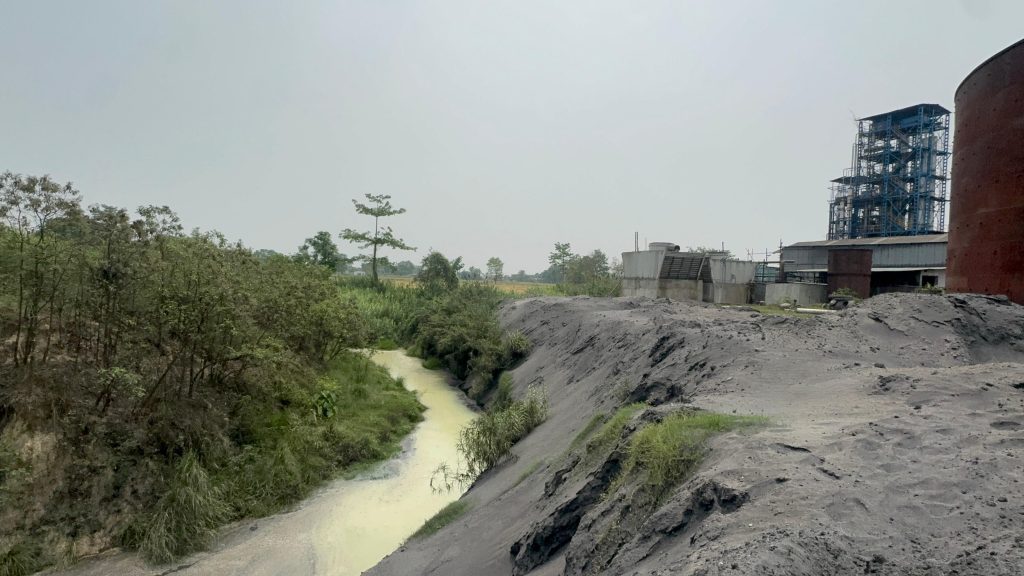
During our field visit to Ramgram Municipality, we found that one of the industries was discharging poisonous waste directly into the river. One of our team members could not even walk through the industry’s gate area, and another member fell into piles of burned debris on the riverbank while taking a video. We were so terrified that we immediately went to the hotel we were staying at, took a shower, and cleaned ourselves. One meter away from the industry, there are piles of burned remnants on an open land, completely mismanaged. You can actually see the two colours of the river, black in front of the industry and clean if you go a little further from the industry area. One of the locals showed us by washing his face in the clean side of the river. This is just an example among many.
The locals of Ramgram municipality informed us that if they come into contact with the water, they tend to develop dangerous skin issues. Not just them, but even if the animals get into the river, they die. The peak heat of Terai and the obligation to breathe the poisonous air is terror. The river I am referring to is Dhanewa, which later joins the Jharai river before both join the Rohini river. People of Ramgram depend on this river not just for irrigation but also for daily life chores.
The black river with various poisonous chemicals, the smell that makes anyone throw up, who stands for even a minute near the river seems nothing less than committing a rape offence by the industries. The continuous attack on the dignity of the river is nothing less than an assault. I perceive it as nothing less than a heinous crime.
While industries are established, shouldn’t the industry implement treatment plans to ensure a safe, sound environment? Yes, industries are essential for the country’s economic growth, but not at the cost of its ground-level citizens. Who are we developing for if the locals are literally crying for their basic livelihood? People of Ramgram are pleading for a safe future for their children. One of the locals, Rama Shankar, said, “This is the situation of the environment just after 3-4 years of establishment of the industries, what will happen even just after 5 years? What will my children do? How will they survive?”
If you argue that the industry is employing locals, the reality seems to be different. Another local informed us that industries are employing Indian citizens, and even when they hire locals, they tend to pay way less. Due to the uncontrollable pollution, locals leave their jobs within 2 years. The locals claim that they are at a disadvantage due to the establishment of industries; they want them away from their village.
Such unplanned establishment of hazardous industries led the community to suffer and created a situation where they had to be displaced from their own homelands for their life. This does not just displace people, it displaces a community, their origin, their tradition and culture, their way of life and their dignity.
Furthermore, Nepal only has a law relating to environmental impact assessment in “The Environment Protection Act, 2019”, which mandates the concerned industry’s impact study and evaluation; there is no law relating to cumulative impact assessment in Nepal. This has created a huge problem not just from the perspective of industry pollution but also from the perspective of the hydropower capacity of the river. While one project or industry might show less impact, the cumulative impact of more industries or projects in one particular river causes immense irreparable loss.
The environment act, 2019, section 15 (1) prohibits, “to cause significant adverse impacts on the public life, public health and environment or do, or cause to be done, any act contrary to the standards determined by the Government of Nepal” and section 16 (2) refrains, “hazardous substance that does not cause significant adverse 11 impacts on the human health and environment as specified by the Government of Nepal”. The Act in section 21 even mandates one environmental inspector in each municipality to monitor and report on the pollution of the municipality, yet almost all the municipalities of Lumbini province had not fulfilled the criteria, which even led to a case in the Supreme Court of Nepal asking for the implementation of the law. Here, we can infer that on one hand, the laws that exist are not implemented properly and on the other hand, the laws that exist are not quite enough to protect the environment from unplanned industrialisation.
Ramgarm municipality has its own significance; it is one of the tentative UNESCO World Heritage sites due to the Ramgram stupa. According to research by Nepal’s Department of Archaeology, the stupa is a Buddhist pilgrimage site that incorporates part of the relics of Gautama Buddha and was constructed between the Mauryan and Gupta periods. This stupa consists of the only intact relic among the first eight parts. It was infamous for years; it has only recently come to light. But even before the stupa gains some recognition, the industries are killing it. The stupa is as significant as the birthplace of Gautam Buddha. Well, the rivers around the stupa are no exception from the pollution.
On the case of Prakash Mani Sharma V. Government of Nepal, which was the case of shifting industry around area of birth place of Budhha in Lumbini, Supreme Court of Nepal decided that, “Although industrial development should be maintained in balance with environmental and cultural protection, there can be no disagreement that, ultimately, the State’s primary priority must be the long term public interest, human health, biodiversity, and the conservation of World Heritage.” It also mentioned that, “Industries that adversely affect World Heritage sites may, where necessary, be relocated or established in alternative locations. However, once heritage is destroyed, it is impossible to restore it to its original state. In this sense, polluting industries operating in the Lumbini area may be relocated, but Lumbini, the birthplace of Lord Gautama Buddha, cannot be relocated to another place.”
Ramgram is part of the Greater Lumbini project, yet Ramgram is being assaulted with industry pollution every day, every minute, even now while you are reading this.
It is high time we realise the value of the clean river. It is high time we protect the dignity of the river and establish its legal personality because there is no use of a doctor, even if the doctor is the most capable one, if the patient is dead. If such pollution continues, our future generations will go to school wearing full-facepiece respirators. I wonder if they will be able to see a clean river.
I wonder if our future generation can imagine the story of the axe and a greedy farmer in clean water. Or will there be a future generation at all?