

Rising military tensions in West Asia have begun to seriously affect Nepal’s foreign employment sector and the global economy.
Millions of migrant workers are employed across Gulf countries, Israel, Jordan, Lebanon, Iran, and Palestine, including over two million Nepali workers. According to the Ministry of Foreign Affairs, while official data show around 1.7 million Nepalis in these countries, the number rises to nearly two million when informal residents are included.
The escalating conflict and instability in these regions have started to directly affect the employment, income, and safety of Nepali workers.
According to data from the Department of Foreign Employment for the fiscal year 2024/25, a total of 839,266 individuals obtained labour approvals for foreign employment. This suggests that, on average, 2,299 Nepalis leave for foreign jobs daily.
Last year, an average of 1,773 workers per day went specifically to six Gulf countries currently affected by conflict. This indicates that tensions in Nepal’s key labour destination countries are likely to directly impact foreign employment.
Shrinking opportunities
Labour and migration expert Jeevan Baniya said such conflicts are likely to directly affect foreign employment. If the war prolongs, the number of workers leaving Nepal will automatically decline, creating additional risks.
He noted that the government has already restricted sending workers to high-risk countries, which could halt outbound migration and even force workers abroad to return.
According to him, the intensifying conflict in the Middle East is beginning to have serious effects on Nepal’s foreign employment, remittances, and overall economy. Job opportunities abroad are shrinking, and existing workers are increasingly at risk of losing employment.
The government now faces a dilemma over whether to issue new labour approvals. Apart from a few countries, the process of sending workers has been halted, and if the conflict continues long-term, opportunities will shrink further.
“Our prime labour destinations are in the Middle East, except Malaysia,” he says to Onlinekhabar. “If the conflict drags on, the pathway for new workers will almost close.”
He added that the situation is also becoming difficult for Nepalis already working abroad, as reduced production and disrupted supply chains increase the risk of job losses. He cited the COVID-19 pandemic as an example of a similar crisis that could recur.
More than 80,000 individuals have registered to return to Nepal through a government-run online portal, with around 7,000 reporting being at risk. Rescue, protection, and repatriation efforts are becoming increasingly challenging.
Air routes in countries like the UAE and Kuwait have been disrupted, making it difficult for Nepalis to return. Many are forced to travel via Saudi Arabia, facing ticket shortages and high prices.
The financial burden on workers also varies depending on whether they return due to expired visas or employer-funded travel.
According to the National Statistics Office’s living standards survey, 76.8 percent of households in Nepal receive remittances, reaching over 5.115 million households. A disruption in income could significantly affect daily life.
Household expenses, education, healthcare, and basic needs are likely to suffer, and asset accumulation may also stall.
As Nepal is heavily import-dependent, rising prices of petroleum products, fertilisers, and seeds will further affect daily life.
“When fuel prices rise, the direct burden falls on consumers, increasing financial pressure on families,” Baniya said. He added that reliance on foreign employment also makes domestic job creation more challenging.
Workers already employed in these countries are also at risk, as companies may cut jobs due to disruptions in production and supply chains. A situation similar to the mass return of workers during COVID-19 could emerge.
Labour expert Rameshwar Nepal said the impact of war extends beyond workers to the broader economy. “If oil prices rise, transportation costs increase, which raises the price of all goods and ultimately increases poverty,” he said.
Currently, around 20 percent of the population lives below the poverty line. If the situation persists, this rate may stagnate or even rise, as cumulative inflationary pressures build over time.
Long-term impact on labour market
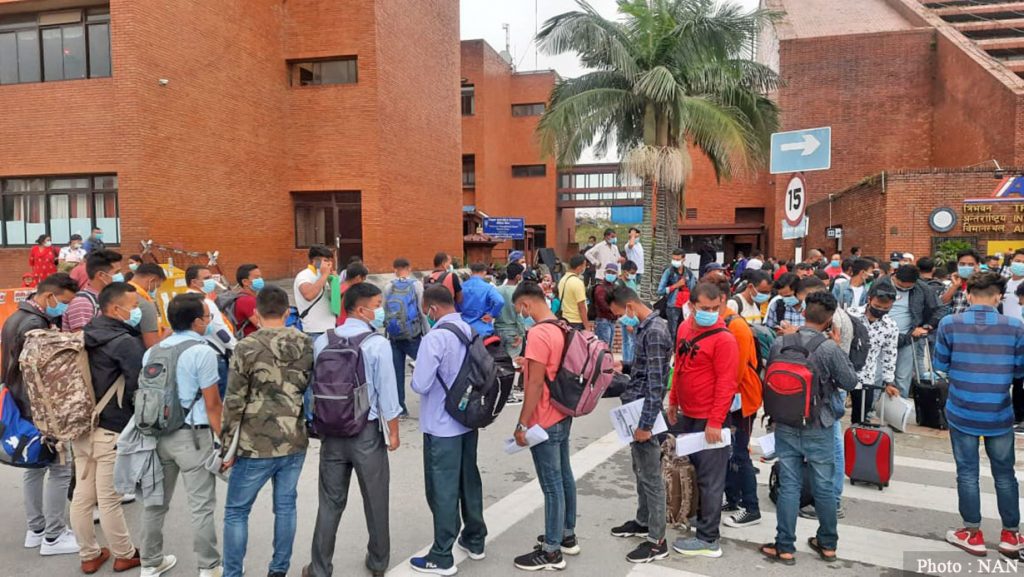
If the conflict continues, long-term effects could be even more severe. On one hand, new workers will be unable to go abroad; on the other hand, returning workers may struggle to find employment in Nepal.
Nepal already faces high unemployment, particularly among youth. Each year, hundreds of thousands of young people enter the labour market, and reduced foreign employment options could worsen the situation.
Some workers have expressed unwillingness to take risks under such conditions. According to them, it is better to go hungry than to risk their lives; if they survive, they can work later.
Others, however, prefer to stay despite the danger rather than return to unemployment in Nepal.
Over time, domestic job opportunities may also shrink, while inflation and unemployment could drive up poverty.
“It may not seem significant daily, but over time, the cumulative impact increases poverty,” he said.
Women and domestic workers at greater risk
Domestic workers, especially women working informally, are at higher risk. They face uncertainty about both their safety and job security.
Labour and migration expert Meena Paudel noted that informal workers, particularly women domestic workers, are more vulnerable than those who migrated through formal channels.
“If there is no record of them, how can they be rescued in times of crisis?” she questions.
Although the government has urged workers to register, many remain outside the system, complicating relief and rescue efforts.
She added that prolonged conflict in the Middle East will affect employment as sectors like oil, hospitality, and tourism suffer. Competition for jobs will increase, and those in the informal sectors will be most at risk.
Rising risk of exploitation
As the labour market shrinks, competition for jobs will intensify, often putting Nepali workers at a disadvantage.
Dr Paudel warned that this situation could enable brokers and human traffickers to thrive. There is a growing risk of fraud, as workers may be lured by false promises of new destinations, especially those already in crisis.
The tensions in West Asia are also affecting Nepal’s tourism sector. Disruptions in international flights, security concerns, and global uncertainty could reduce tourist arrivals.
This would impact jobs in hotels, travel, and service industries, putting not only foreign employment but also domestic employment at risk.
Experts emphasise the crucial role of the government in such situations, updating worker data, ensuring regular communication through embassies, and preparing rescue plans if needed.
In the long term, they suggest Nepal should adopt policies to generate domestic employment by attracting investment, expanding industries, and focusing on skill development.
The growing tensions in West Asia have created serious challenges for Nepal’s foreign employment sector, with multidimensional impacts such as job losses, reduced opportunities, declining remittances, and rising inflation.
Dr Paudel has advised workers to stay safe and avoid falling into the traps of brokers.
“Stay where you are and remain patient. Use the support provided by the state and embassies,” she says, adding that efforts are ongoing to reach even unregistered workers.