
An investigation by the Central Investigation Bureau (CIB) of Nepal Police found evidence that chartered helicopter flights, and in some cases even regular commercial flights, were misrepresented as medical evacuations in order to claim insurance money.
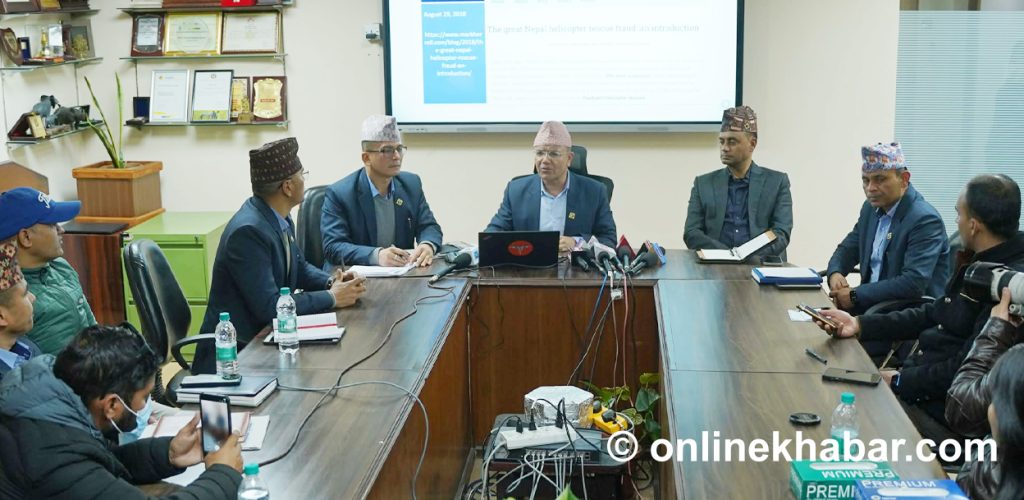
The findings were disclosed on Sunday at a press briefing at the CIB office in Lazimpat. The bureau’s chief, Manoj K.C., an Additional Inspector General of police, informed that the so-called rescues were fabricated.
“Even charter flights were shown as rescues to obtain insurance payments,” K.C. says. “These were not genuine rescues but fake ones.”
Investigators said regular flights were also falsely labelled as rescue operations, with fabricated rescue schedules and passenger records submitted to support insurance claims.
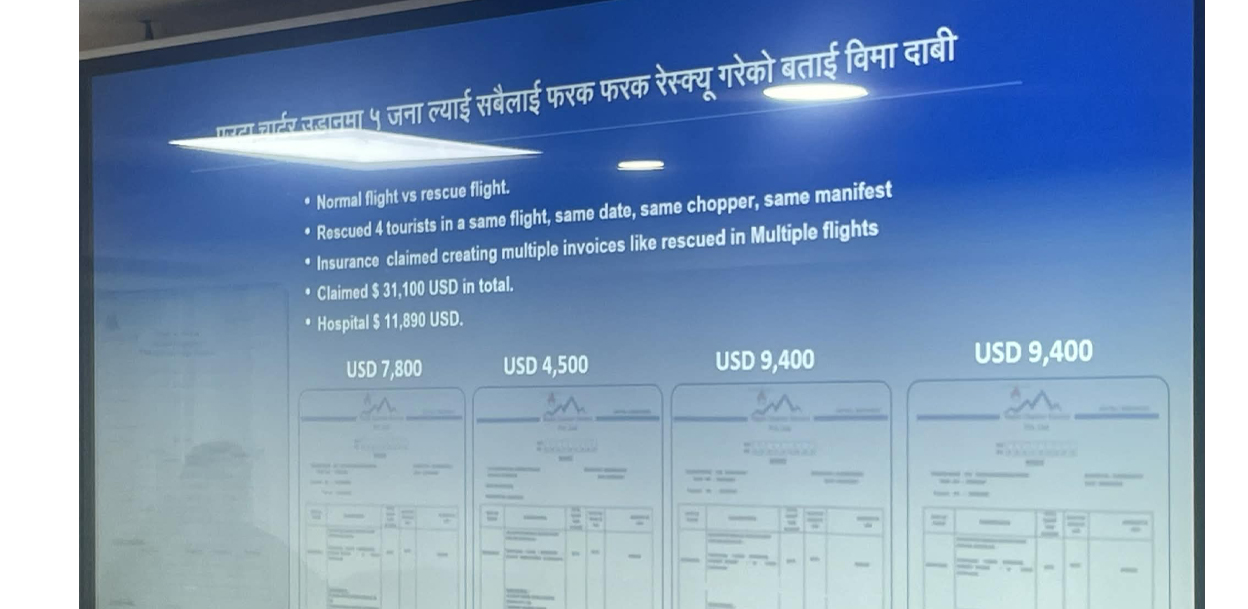
According to officials, in some cases, multiple tourists travelling on a single charter flight were billed as having been rescued separately and at different times, a practice known as “single flight, multiple billing.”
As per the investigation, trekking tourists returning along the same route after completing their journeys were persuaded to fly back to Kathmandu on chartered helicopters, which were later presented as emergency evacuations.
The CIB said it had received multiple complaints in recent years, including one as recently as December 16, 2024, and another on September 28, 2025. The Ministry of Home Affairs also formally requested an investigation into fake rescues earlier this winter.
Authorities allege that the scheme involved illegal collusion among trekking and travel companies, helicopter rescue firms, hospitals and tourist guides, primarily targeting foreign trekkers.
The CIB is currently investigating fake rescues carried out since 2022.
Six arrested
After conducting a separate investigation over the past two and a half months, including during public holidays, the CIB announced the arrest of six people accused of orchestrating the fraud.
Those arrested include Jayaram Rimal, owner of Mountain Rescue Service Pvt. Ltd., and its manager, Bibek Pandey, Rabindra Adhikari, owner of Nepal Charter Service, and operations manager Bibek Raj Thapaliya, and Mukti Pandey, owner of Everest Experience and Assistance Pvt. Ltd., along with its manager, Subash K.C.
All six are affiliated with three companies that investigators say were involved in at least 317 fake rescues.
According to the CIB, the Mountain Rescue Service reported evacuating 1,248 tourists between 2022 and 2025. Of those, 171 were found to be fraudulent, resulting in insurance claims totalling $10.31 million.
Nepal Charter Service reported 417 rescues, of which 75 were found to be fake, with insurance payouts of approximately $8.23 million.
Everest Experience and Assistance reported 601 rescues, including 71 fraudulent cases, with insurance claims amounting to $1.15 million.
In total, investigators estimate that the three companies obtained $19.69 million through fake rescue claims.
“This is preliminary data, and the figures could increase,” a CIB investigation officer says to Onlinekhabar.
As fake rescues increased, insurance companies covering foreign trekkers began suspending premium payments, according to CIB officials.
At least three insurance companies have completely halted premium payments, citing mounting losses from fraudulent claims. Some claims submitted by rescue companies were also rejected outright.
Potential Charges
The six suspects are being investigated under multiple provisions of Nepal’s criminal code, including organised crime, forgery, fraud and offences against the state.
Investigators said the case falls under Section 51 of the Criminal Code, which prohibits acts detrimental to national interest, as well as Section 249 (fraud), Section 253 (illegal financial gain), and Section 276 (document-related offenses).
Authorities allege that fake medical reports and helicopter invoices were forged, fraudulent insurance bills were submitted, and tourists were falsely warned of life-threatening altitude sickness to justify evacuations, damaging Nepal’s international reputation in the process.
The case is being treated as an organised crime involving collusion among trekking agencies, hospitals and helicopter companies. Money laundering charges may also apply.
The modus operandi
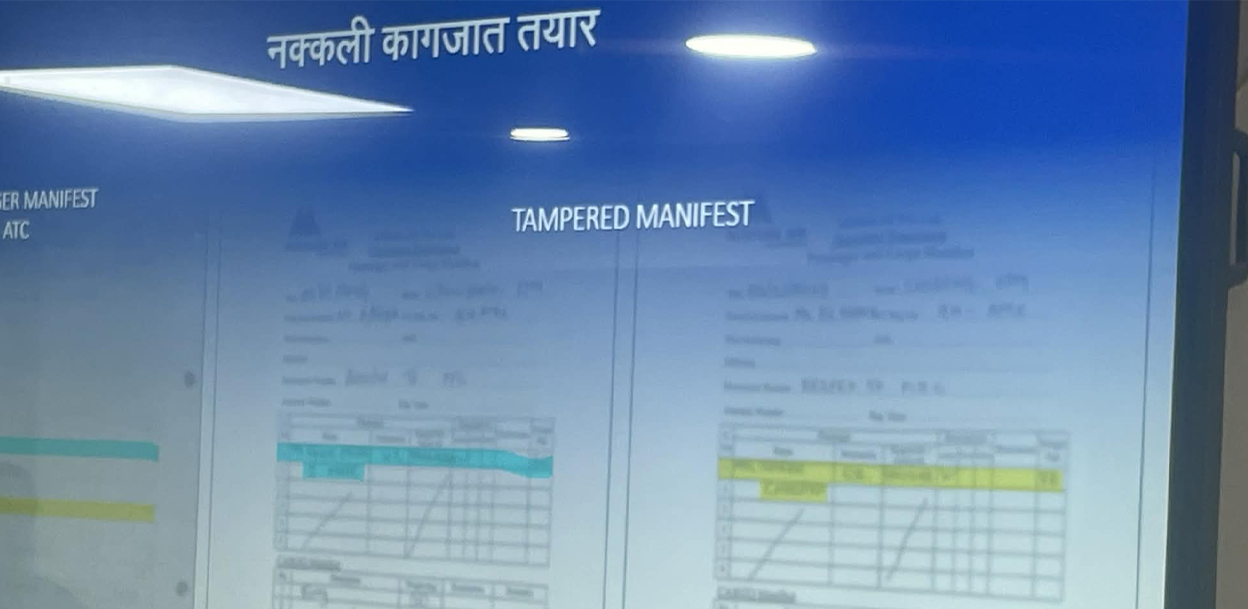
Foreign tourists travelling to Nepal typically purchase insurance before trekking in high-altitude regions. Investigators say travel agencies first verified the tourists’ insurance policies before planning fake rescues.
Once in the mountains, guides allegedly exaggerated minor symptoms commonly associated with altitude, pressuring tourists into helicopter evacuations that were medically unnecessary.
In many cases, officials said, tourists would recover simply by descending to a lower altitude, yet were still flown to Kathmandu and taken to specific hospitals favoured by the rescue operators.
Rescue companies and hospitals then submitted separate or lump-sum bills to insurance providers.
Older cases, hard to prove
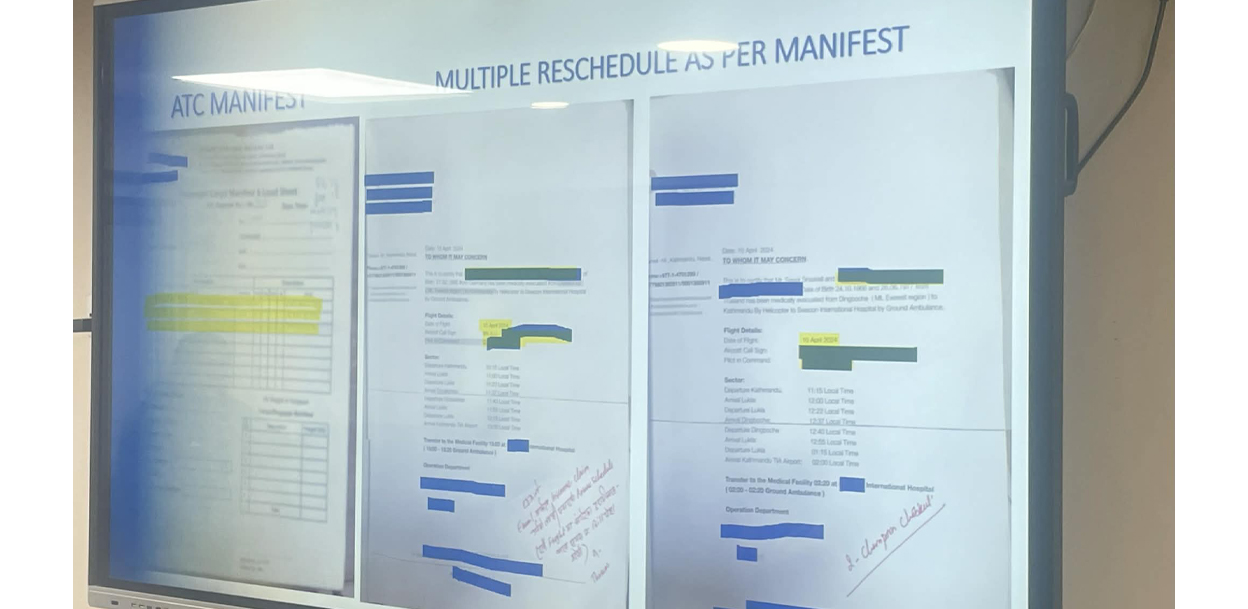
While the current investigation covers cases since 2022, authorities acknowledged that fake rescues had been reported as early as 2018. However, the lack of documentation has made older cases difficult to prosecute.
In 2017, a travel assistance firm reported that nearly 35 percent of rescues were fraudulent. That same year, reports emerged of trekkers being deliberately made ill through food contamination to trigger evacuations and earn commissions.
A government investigation committee formed in 2018 recommended further police inquiry and led to the introduction of new rescue monitoring guidelines. But officials say the absence of records has hindered retrospective investigations.
The CIB warned that fake rescues risk tarnishing Nepal’s international image and could eventually make the country a “no-go destination” for tourists.
Officials also cautioned that fraudulent evacuations could delay or obstruct genuine rescue operations, potentially putting lives at risk.