
Butwal, December 1
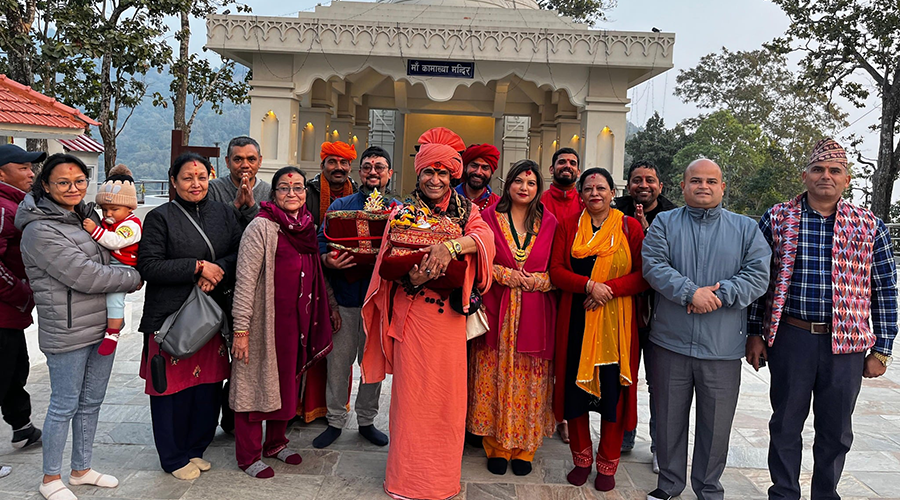
Kamakhya Dham, located at Basantapur in Palpa near Butwal, has recently developed not only as a tourist destination but also as a popular wedding venue.
Under the leadership of the IME Group, the Lumbini Cable Car, the first in Lumbini Province came into operation two and a half years ago with an investment of Rs 1.5 billion involving both the company and local stakeholders. The company reports that around 400,000 tourists have used the cable car in this period, with a significant number of visitors coming from various cities in Uttar Pradesh, India, according to manager Prajwal Ghimire.
The upper station of the cable car houses the famous Shaktipeeth Kamakhya Devi Temple and the Durga Temple, where worship has reportedly been performed for nearly a century. Owing to these sacred sites, both Nepali and Indian visitors have increasingly begun choosing the area as a wedding destination.
Hindus believe that receiving blessings from Goddess Kamakhya ensures a successful married life, brings the joy of children, and helps overcome life’s obstacles. This belief has contributed to the growing number of couples choosing to marry at the temple, said chief priest Suresh Paudel.
Just two days ago, Vijay Jaiswal and Chandni Jaiswal from Uttar Pradesh, India, arrived in Basantapur with their relatives and got married there.
“Marriage is a memorable and joyous event for everyone, so we chose a new destination,” said groom Jaiswal. “Our family are devotees of Kamakhya Devi, but travelling to Guwahati in India is far, so we decided to marry at Nepal’s Kamakhya Dham instead.”
He said that Basantapur hill, located about 1,000 meters above sea level, is green, peaceful and beautiful, making their wedding experience especially delightful.
“Compared to last year, the number of couples marrying here has increased this fiscal year. This month alone, five couples are getting married,” chief priest Paudel said, adding that the first couple of the wedding season is from Uttar Pradesh.
Hari Aryal, president of the Butwal Chamber of Commerce and Industry, said that even if a small percentage of Uttar Pradesh’s 240 million population could be brought to Butwal each year for cable car rides and visits to the Basantapur hill station, it would positively impact Rupandehi’s economy.
“The government authorities must work with the private sector to attract Indian tourists to hill stations such as Basantapur, Nuwakot and Hill Park near Butwal,” Aryal said. “Tourism is the easiest means to revive the economy weakened after the Gen Z movement.”
The cable car connects the lower station at Bamghat in Butwal-3 with the upper station at Basantapur in Tinau Rural Municipality-3 of Palpa. The upper station, located about three kilometres away, can be reached in 12 minutes.
According to operations manager D.N. Kayastha Sainju, the proportion of Indian visitors increased from 8 per cent last fiscal year to 21 per cent this fiscal year. Nearly 100,000 Indian tourists have visited in the past two and a half years. Visitors from other countries account for less than one per cent.
Prem Shrestha, chairperson of Tinau Rural Municipality, said that Basantapur once deserted for decades has become vibrant following the operation of the cable car.

Facilities such as a zipline, sky cycling, giant swing, children’s park, viewpoint, restaurant, and seminar hall have been built in Basantapur.
The cable car offers free rides on birthdays and special discounts for groups of more than 50. A grand evening aarti is held on the first day of every month.
Manager Ghimire said that Basantapur is around 7 to 10 degrees Celsius cooler than the Tarai, making it pleasant in summer and warm in winter, attracting tourists year-round.
He said that due to religious and tourism infrastructure, favourable climate in all seasons, and a peaceful environment free from noise and pollution, Basantapur has become a preferred destination not only for Nepalis but also for tourists from Uttar Pradesh, India.
The cable car, built by Austria’s Doppelmayr Company, is 2.6 kilometres long and has 25 gondolas, capable of transporting up to 6,000 tourists daily.
The Province Tourism Development Council has listed Basantapur as a major tourist site following the operation of the cable car, according to council chief Ramu Joshi.