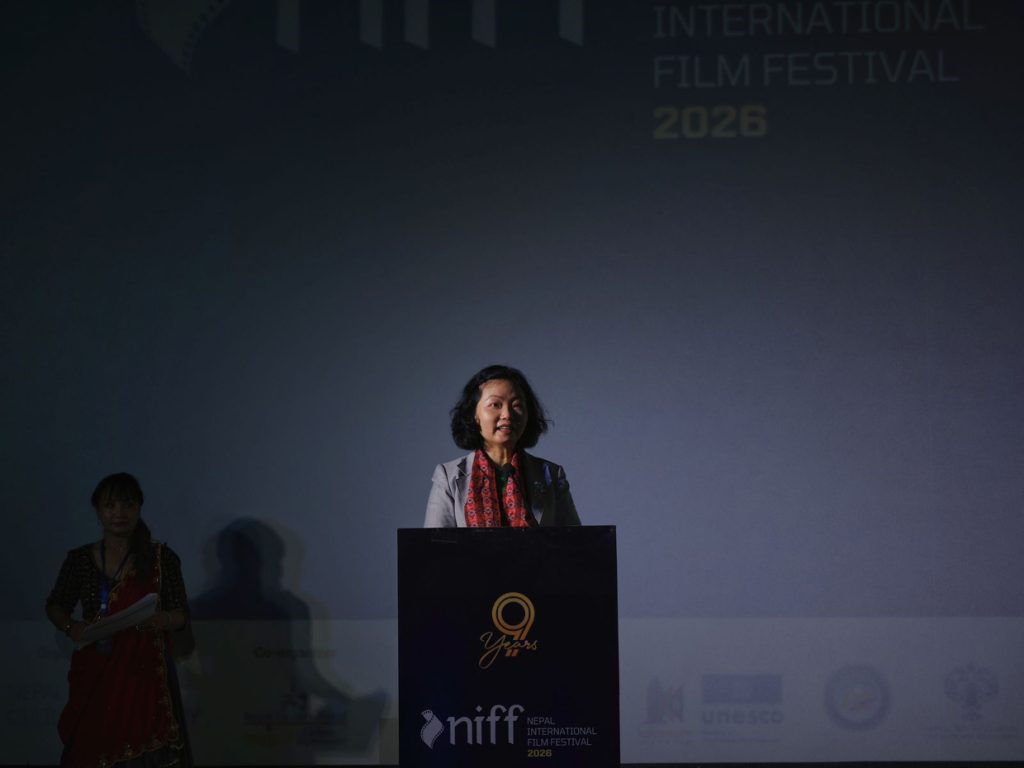
Chinese professor Xun Zhan is in Kathmandu. She has arrived in Nepal’s capital as a jury member of the Nepal International Film Festival (NIFF). She is the head of the Department of Journalism and Communication at the University of Electronic Science and Technology of China, as well as a professor and media expert. With expertise in new media, international communication, and intercultural studies, Zhan is also affiliated with various think tanks in China. She has research and study experience at the University of California, San Diego and the College of William and Mary, and holds an analytical perspective on media ecology and visual storytelling.
Here are excerpts from a conversation between Onlinekhabar and Zhan on her experience at the festival, the state of Nepali cinema, and the prospects of Nepal–China collaboration in film and media:
You are in Kathmandu as a jury member of NIFF. What has your overall experience of the festival been like?
NIFF feels like a very professional organisation. The organisers are friendly and supportive. It seems to be improving every year. They treat everyone equally, especially giving equal respect to foreign directors, producers, and filmmakers, which is very important. The screenings are well-planned and held at excellent venues, which impressed me.
Today, young audiences prefer watching videos on mobile devices, but the experience of watching films on the big screen is still very important. The emotional impact created by a large screen, sound system, and audiovisual experience is very different from that of a mobile phone. Festivals like this provide a great platform to bring films from around the world together and show what people are creating globally.
From a media and storytelling perspective, how do you view the current state of Nepali cinema?
To be honest, I still need to study Nepali films more. I haven’t watched many Nepali films before, so it is difficult to give a definitive evaluation. However, based on my first impression, Nepali films seem to include a lot of song and dance, similar to Indian films, which is less common in Chinese cinema.
This might also be my own preconception. Nepali films have a sense of joy and vibrancy, which I like. From what I see, filmmakers here are learning and progressing, which is a good sign for the future.
As an expert in cross-cultural communication, how do you see culture being represented in Nepali films today?
Culture is reflected through visuals, language, and sound. The pronunciation of the Nepali language, music, and storytelling style are different from Chinese or English, and that uniqueness is its strength.
However, at the level of emotions, there is similarity everywhere. Themes like separation, love, and death are universally understood. When such elements are portrayed in films, audiences from any country can relate. Cultural aspects like traditions, clothing, and music are also clearly visible in Nepali films.
How can Nepali cinema connect with international audiences, especially China, while preserving its originality?
The story is the most important element. If the story is strong, audiences can understand it even without knowing the language. The symbols, emotions, and visuals we use are often universal. How the story is told is even more important. For example, films like The Lion King have delivered the same message worldwide. Similarly, a good story and presentation can connect with audiences from any country.
Despite cultural differences, how can Nepal and China create stories that resonate with audiences in both countries?
Joint research is essential. Before writing, creators should study the culture, history, and background of both countries. Nepal and China are both located in the Himalayan region and share many cultural similarities.
Stories based on themes like prayer flags, Buddhist culture, and historical connections can be easily understood by audiences in both countries. I also encourage Nepali filmmakers to explore themes related to Tibet.
What are the most promising areas for Nepal–China film collaboration right now?
It can begin with co-writing, followed by joint film production. Artists, locations, and experiences from both countries can be combined. We need to understand each other better. Some may be fascinated by Nepal’s lakes, others by China’s pandas. Perspectives differ, so dialogue is necessary.
Practically speaking, how can such collaboration be strengthened?
Small programs can be initiated through universities or research institutions in both countries. Writers, directors, and professors can be brought together for training and exchange. Topics like wildlife, the Himalayan region, documentary filmmaking, and AI technology can be shared. This will lay the foundation for larger collaborations in the future.
How can Nepali filmmakers enter the Chinese market?
Language is a challenge, but not impossible. Both governments need to take initiatives to promote collaboration. Policy-level support can make market entry easier.
How can Chinese films expand their market in Nepal?
Chinese films have not paid much attention to markets like Nepal, as they are more focused on Western markets. However, there is great potential if governments and experts from both countries become more active.
How can film be used as a tool of cultural diplomacy?
Film plays a major role in cultural exchange. When filmmakers visit each other’s countries, they can truly understand the culture. Such experiences build deeper connections.
What can Nepal learn from China’s film industry?
There should be diversity in storytelling. Films should not be limited to love or family stories. Both countries face investment challenges, so films can be made by incorporating commercial elements. The use of AI technology is also very important today, as it simplifies the production process.
How can stories from smaller film industries reach international audiences?
Social media is the most effective medium. English subtitles or AI translation can remove language barriers. Nepal has many stories related to mountains, tourism, and nature. Documentaries and films on such themes can attract global audiences.
How do you see the future of Nepal–China media collaboration?
I am very optimistic. If we make efforts, collaboration will grow stronger. There may be some challenges initially, but things will gradually improve.
As a jury member, what do you focus on while evaluating films?
The most important aspects are story and emotion. Technical elements are also important, but technology alone does not make a good film. If the story and emotional impact are weak, I would not choose such a film.
What do you like most about Nepal?
Everything, the people, their warmth, and the culture. I made many friends here. They invited me to their homes and shared meals, which was a very emotional experience for me. I love the smiles, the blue sky, the mountains, and the natural beauty here. Nepal is truly beautiful.