Kathmandu, November 1
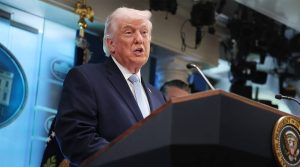
US President Donald Trump has said the United States has largely destroyed Iran’s military capabilities but still has “one or two” targets to deal with, as Tehran warned that any renewed attack would trigger an immediate and far-reaching response.
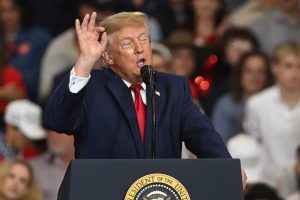
Speaking to reporters at his Florida residence on Saturday, Trump said negotiations with Iran to end the war were progressing, although he questioned Tehran’s reliability.
“We’ve knocked out their nuclear. We still have to take care of, I would say, one or two sites, but we can do that in 10 minutes,” Trump said.
He specifically referred to Pickaxe Mountain, a suspected underground nuclear complex, saying it was among the remaining targets. The Iranian government has denied that nuclear activities are being carried out at the site.
Trump said Washington was not in a hurry to launch further offensive action because it had already inflicted extensive damage on Iran’s military and nuclear programme.
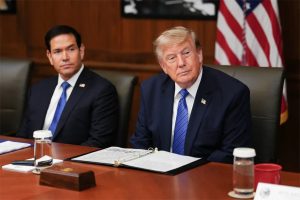
Earlier on Saturday, US Secretary of State Marco Rubio said Trump had not decided whether to order fresh strikes against Iran and that Washington remained open to a diplomatic solution. Rubio added that the United States could achieve its military objectives if it chose to do so.
The statements came as Iran’s Supreme Leader Mojtaba Khamenei warned the United States and Israel against launching another offensive. He said any threat would be met with an immediate and geographically unrestricted response.
“Any level or type of threat must be met with an immediate, impactful and geographically unrestricted response,” Khamenei told senior military commanders, according to a statement.
He also ordered military commanders to update Iran’s target list to include all types of tangible and intangible assets belonging to what he called the “American-Zionist enemy”.
The meeting was reportedly the first between Khamenei and senior military commanders since he assumed the leadership in March, following the killing of his father, Ayatollah Ali Khamenei, in US-Israeli strikes. The younger Khamenei has not been seen publicly since before taking office.
Strait of Hormuz tensions push up oil prices
The conflict has disrupted shipping through the Strait of Hormuz, a key global energy route that normally carries around one-fifth of the world’s oil consumption. Tehran has restricted shipping through the waterway and previously warned that it could also consider severing undersea cables in the strait.
Iranian state television reported on Saturday that a ship travelling through the strait had struck a mine and caught fire. The Islamic Revolutionary Guard Corps said on Friday that three oil tankers had been halted after encountering unspecified incidents or hitting mines.
The restrictions have driven up global energy prices, adding to the economic and political pressure on the United States ahead of its midterm elections this week.
The elections could affect Trump’s ability to advance his domestic and foreign policy agenda, with gains for the opposition Democrats potentially limiting his room for manoeuvre.
In Israel, voting in a general election on Tuesday left Prime Minister Benjamin Netanyahu’s political camp with the largest number of seats in parliament but short of a majority. The formation of the next government remains uncertain.
Netanyahu has described the situation as a “historic, one-time opportunity” to bring down the Iranian government, while Trump has previously suggested that further military action could come after the US midterm elections.
Diplomatic efforts continue
Diplomatic efforts are under way to prevent a resumption of hostilities, with Qatar and Pakistan mediating between Washington and Tehran.
Qatari mediators arrived in Tehran on Friday, while US Vice President JD Vance sent a letter to Iran’s security chief, Mohsen Rezaei.
Rezaei, who heads Iran’s Supreme National Security Council, confirmed receiving and reading the letter in a video broadcast on Iranian television. He said he had not yet responded but described the change in Washington’s tone as a positive sign.
“I read the letter. I haven’t yet responded. Their tone has completely changed,” he said.
Iranian Foreign Minister Abbas Araghchi said there were currently no plans for direct meetings with US officials, adding that mediators were continuing consultations on Tehran’s conditions.
“Iran’s conditions are clear, and consultations regarding them are ongoing among mediators,” he said in an interview with Al Jazeera, according to state news agency IRNA.
Rezaei said Iran would continue restricting passage through the Strait of Hormuz until its demands, including the release of frozen Iranian assets, were met.
Despite the diplomatic efforts, there has been no lasting agreement to end the conflict.
Iranian army spokesman Mohammad Akraminia warned that renewed fighting would expand the conflict beyond its current geographical scope.
“The flames of war will undoubtedly engulf a much wider geographical area,” he said in a social media post.
Araghchi also warned on X that there would no longer be any “red lines” if hostilities resumed.