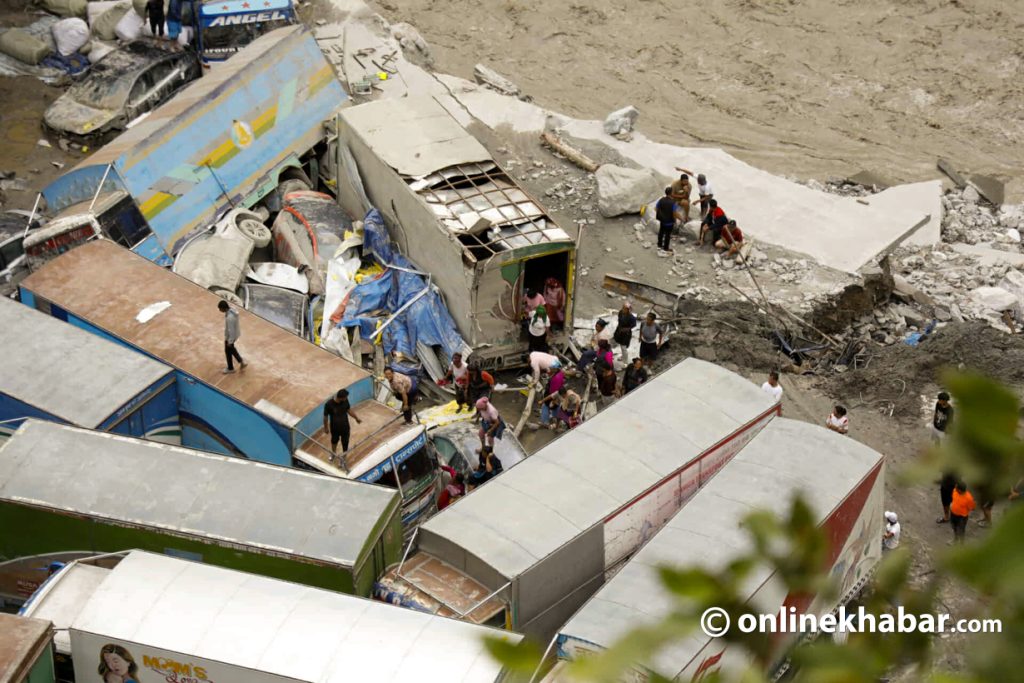
Last Friday, the water stopped again. Floodwaters had entered the intake of the Melamchi Water Supply Project at Ambathan in Helambu, Sindhupalchok, on Thursday night, turning the river too turbid to treat. By morning, Kathmandu Upatyaka Khanepani Limited (KUKL) had suspended distribution across the Valley. A week later, the taps are still dry for many households, and the KUKL office where I sit as an intern is full of people who want to know one thing: when will the water come back?
I don’t have a good answer for them. I don’t have a good answer for myself either. By day, I am the voice explaining supply schedules and alternative ways to frustrated customers. By evening, I am one of those customers, standing over an empty bucket in my own room, feeling the same anger I spent all day trying to calm in someone else. It is an uncomfortable place to stand inside the institution and outside its promises at the same time.
But it is also, I think, the right place from which to ask why this keeps happening, monsoon after monsoon, to a project the state itself has called a matter of national pride.
A crisis with a very long memory
File
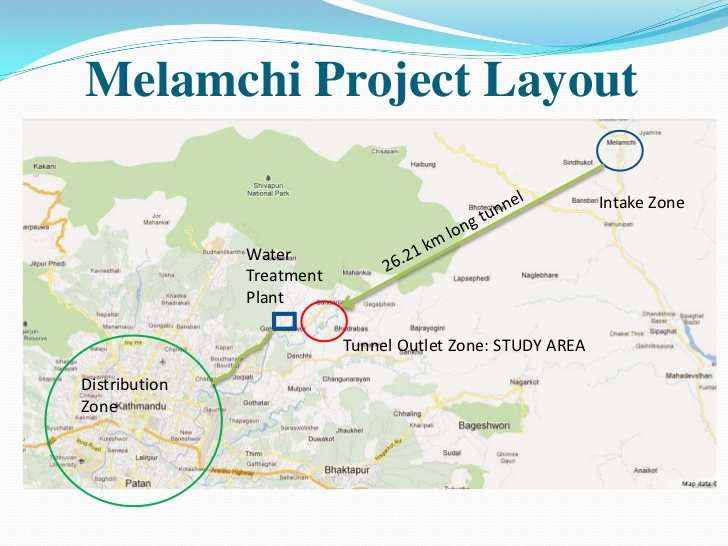
An historical review of the Melamchi Water Supply Project’s timeline confirms a protracted story of delays, administrative hurdles, political failures and tragic setbacks spanning nearly five decades. Initially identified among thirty potential water sources in a 1973 study, the Melamchi River was selected in the early 1980s primarily for its seemingly straightforward land acquisition prospects.
Following the establishment of the Melamchi Water Supply Development Board in November 1998, the Asian Development Bank approved an initial $464 million loan in December 2000. However, the initiative quickly faltered as the World Bank withdrew its support in 2002 over the government’s failure to appoint foreign private operators, followed by the funding exits of NORAD in 2005 and SIDA in 2006. While Nepal successfully convinced the ADB to cover the resulting $133 million financial deficit caused by the exit of the aforementioned financiers, political upheaval from the Maoist insurgency caused the project to thoroughly miss its initial 2006 completion deadline.
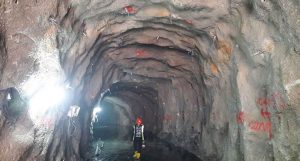
Following the brief appointment and subsequent 2007 termination of British firm Severn Trent International’s management contract, the project was split into two sub-projects and its budget scaled down to $317.3 million. Progress was further stalled by local protests padlocking the site office in 2010 and the cancellation of a Chinese contractor’s agreement in 2012. Although tunnelling finally commenced in earnest around 2009 and the Italian firm CMC completed the 26-kilometre conduit in 2018, that contract ended abruptly in 2019 amidst disputes over payment issues.
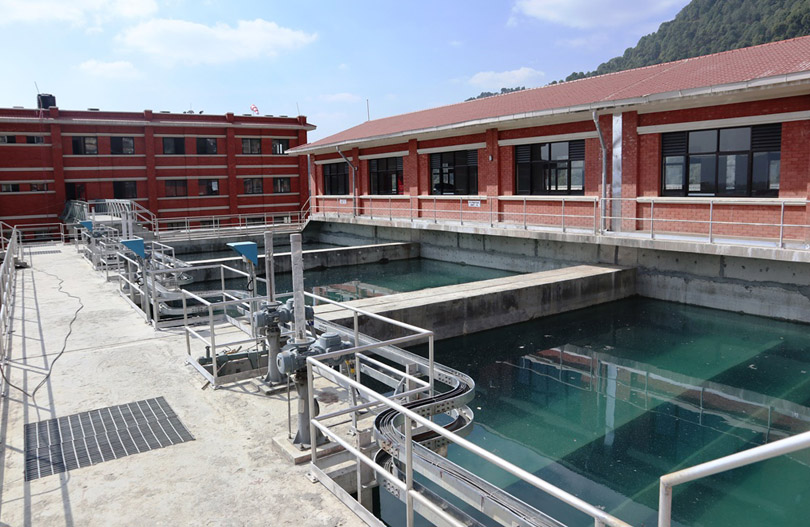
Following a catastrophic bulkhead gate failure during tunnel testing in July 2020 that resulted in the deaths of two workers, water from Melamchi finally reached the Sundarijal treatment plant on March 6, 2021, marking the tentative culmination of a deeply troubled, multi-generational infrastructure endeavour.
The ghost of 2021
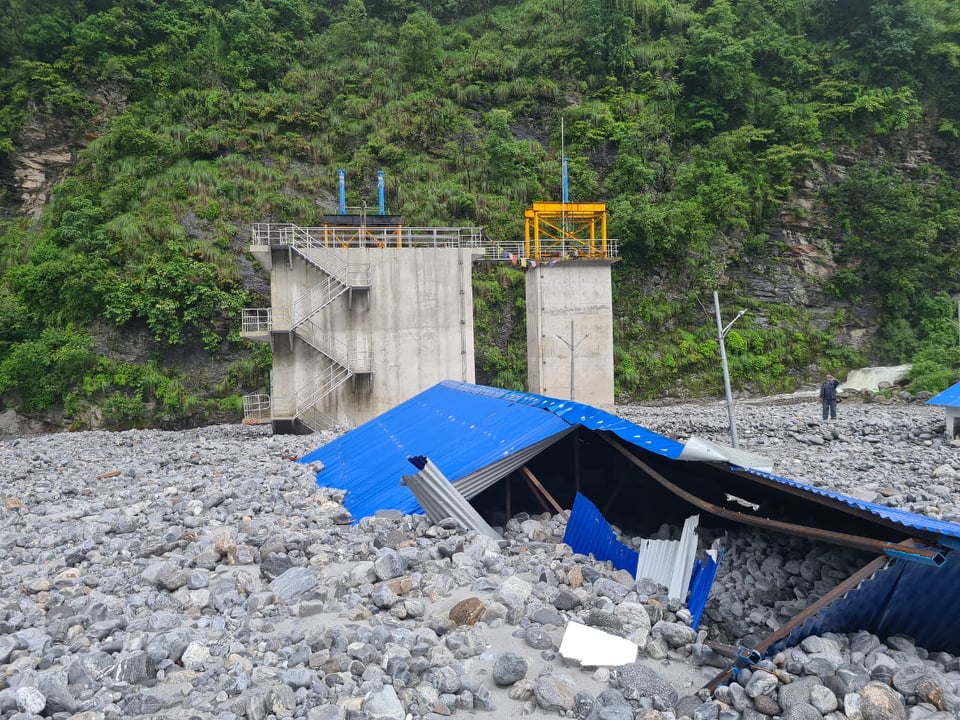
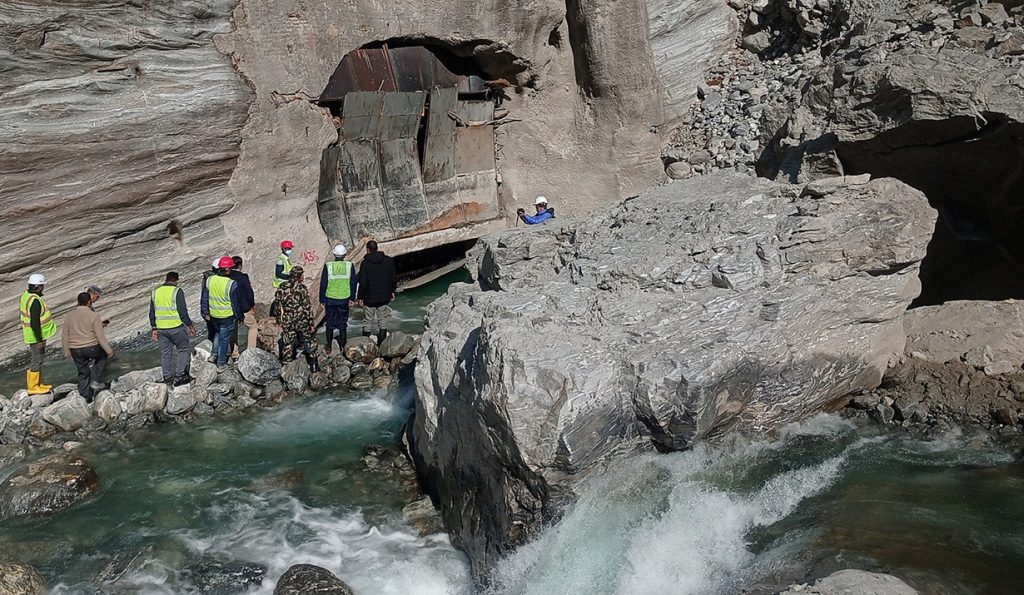
On June 15, 2021, barely three months after that long-awaited arrival, a catastrophic flash flood tore down the Melamchi and Indrawati rivers. The flood, triggered by multiple factors, killed five people, left 20 missing, and buried the project’s headworks under debris.
A second flood in August 2021 buried the site further, under an estimated twenty feet of rock and silt. A later Asian Development Bank review found that the flood had exceeded the structure’s design capacity by a factor of 4.5, giving a sobering admission that the headworks had never been built for the river it actually had to survive.
Since that year, the arrangement has been unmistakably temporary. Every monsoon, the intake is protected by makeshift diversion structures rather than the permanent headworks the project was supposed to have. Every monsoon, when the river turns muddy or floods again, Melamchi Water Supply Development Board (MWSDB) closes the valve into the tunnel to protect it from silt and damage, and the Valley falls back on tankers, boreholes, and whatever local sources remain.
This is not a metaphorical cycle but a literal one happening for the last 5 years. Each cycle is reported as breaking news. None of it, at this point, is actually new. A curse, after all, is not a single bad event. It is a bad event that returns on schedule, dressed each time as a surprise.
The curse and its price
Call it a curse, but not one cast by anyone outside this valley, as every ingredient is domestic. The headworks sit where they sit because Nepali officials picked Melamchi over other sources in the early 1980s, reportedly because land acquisition looked easier there. The tunnel took twenty-three years because of decisions, and indecisions, made by successive governments, contractors and financiers. And the temporary fix that has stood in for a permanent solution since flash floods destroyed the headworks in 2021 persists because of a decision, renewed every year, to study the problem again rather than finish solving it.
A February 2023 damage assessment backed by the Asian Development Bank recommended relocating the headworks about 400 meters upstream onto bedrock, for roughly Rs 1.5 billion, against the more than Rs 13 billion it would take to stabilise the current landslide site. By 2024, officials were citing a new site 700-800 meters upstream at Sarkathali and a cost nearer Rs 4 billion after a Cabinet meeting back in mid-2024 gave “conceptual approval” to build somewhere suitable. The design keeps moving. The ground has not been broken yet. As this monsoon set in, the tunnel mouth was shut once again, the Valley once more leaning on the Ribarma stream and the Bagmati River to get through the season.
None of this is only an engineering story. Nepal has already spent around 69 billion on Melamchi, and officials say 4.5 billion more is needed just to make the existing headworks reliable throughout the year before a single rupee goes toward the long-promised second phase diverting the Yangri and Larke rivers, which would still cap total supply at only 510-520 million litres a day.
Against that ceiling, KUKL’s own annual report for fiscal year 2024/25 puts the Valley’s daily demand at 514 million litres. Even running every source it has, including Melamchi, KUKL manages barely an average of 232.42 million litres a day, which is around 45 per cent of demand. Strip out Melamchi, Ribarma and the Bagmati, as this monsoon has, and production collapses to 91 million litres, which is just 18 per cent of demand, or say one litre delivered for every five needed.
Also, this 91 ML comes with a high cost of degradation of groundwater. The boreholes drilled ever deeper as the water table falls are causing centuries-old stone spouts to dry. Researchers who have studied the project’s delay describe a government that is “blame-averse” meeting a public caught in a “paradox of social resilience” where every new coping mechanism that gets the Valley through one more dry week quietly lowers the pressure to ever finish the job.
The intern and the customer
I did not set out to write a technical history when I started drafting this. I set out to explain a feeling: the strange vertigo of telling a stranger across the office that the supply will resume “soon,” while knowing that my own tap, in my own room, has not run since Friday either. But the two things turned out to be the same story. The panic in KUKL’s office this week is not really about one flood. It is about four decades of a promise renewed just often enough to survive, and broken just often enough that no one quite trusts the next renewal. Seeing the sheer frustration caused by, and to a greater extent, the negative psychological impact Melamchi water has had on its customers, I dare say, the people of Kathmandu just had seen enough.
The people here would not bear another whole year of just a feasibility study to know that it is monsoon and the main water source is on a collision course, just like the previous year. This has been known since at least 2021, arguably since the 1973 survey that first tried to solve this problem by looking anywhere but at the Valley’s own neglected local sources.
A curse this well documented is no longer a mystery but a maintenance backlog wearing a dramatic name. What breaks it is not fate changing its mind. It is a permanent headworks actually being built, on the schedule the studies themselves have already recommended or the alternative concrete plan to explore and utilise other local sources within the valley. Whatever the case, the government must respond and prevent its lamenting citizens from going without water, at least from next year.
Until then, I will keep explaining the schedule to the people in front of me at the counter. And I will keep going home, some evenings, to no water at all, thirsty, like the rest of the Valley, in the middle of the rain.