
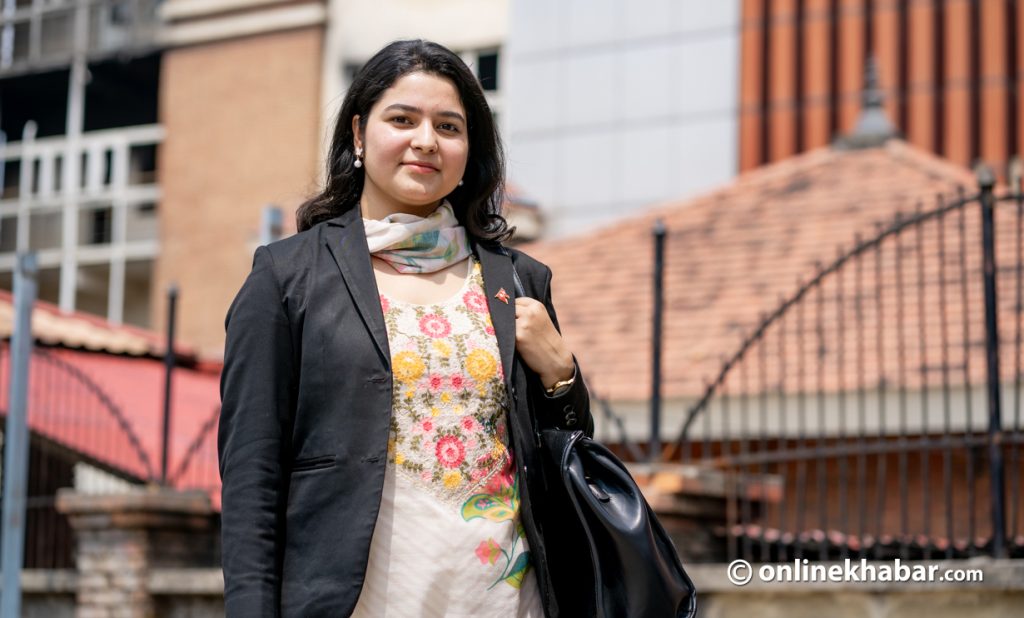
Shreena Nepal (25) published a poetry book while she was in Grade 8. On the back cover, she wrote: “I must give something to society.”
Having already charted her future path at that young age, Shreena today is not merely a student at Kathmandu School of Law; she has become a young lawyer, writer, and activist who has filed dozens of public interest writs at the Supreme Court.
She has been persistently fighting cases on issues ranging from removing the “pink tax” on sanitary pads, preventing misuse of the petroleum pollution tax, regulating surrogacy and IVF, restoring the Kumari Chhen’s torana, and securing women’s citizenship rights.
Driven since childhood by the feeling that she must give something to society, Shreena has carried the journey she began with a school poetry book all the way to the Supreme Court.
Childhood and family influence
Born on September 4, 2000, in Ilam, Shreena Nepal
has lived in Bhaktapur with her family since a young age and still lives there with her parents and younger brother. Her family was ordinary but encouraging. Her father, Navaraj Nepal, is active in the media sector, while her mother, Jhuna Sharma, is a homemaker.
“The environment in my home was always encouraging,” she says to Onlinekhabar. “My mother taught me ethics and values; my father taught me responsibility toward society.”
Shreena’s maternal grandfather used to write poetry in Sanskrit. Perhaps under his influence, she developed a love for writing poetry from a very young age.
She was a quiet child who preferred sitting in her room drawing, writing poetry, and doing handicrafts, yet she was active in extracurricular activities at school, participating in oratory and poetry competitions. Teachers would read her writing not only to her own class but to other sections as well, which encouraged her greatly.
“Friends used to tease me, saying, ‘Don’t tell Shreena anything, she’ll just write about it,'” she recalls.
In Grade 8, she published her first article on gender justice and also released a poetry book that year, supported jointly by her school and parents.
“At that time, I wrote whatever came from within,” she says, adding that she is still amazed looking back at that book. “I wonder how a child in Grade 8 could write about such deep subjects.”
Education and writing
Shreena’s schooling took place entirely in Kathmandu, first at VS Niketan, then at Pathshala from Grades 1 through 10, and for her +2 at Ambassador Academy, where she studied science.
After passing the School Leaving Certificate (SLC) in 2016, her parents wanted her to continue in science, and she agreed, thinking it would leave all options open. During her high school years, she read voraciously, books on social and political topics beyond the syllabus interested her far more than her coursework.
After the SLC, she participated in the “SLC Princess” beauty pageant, where grooming and competition among 50 girls brought significant changes to her personality. After finishing her +2, she worked at Radio Janata for nearly a year, where she developed her speaking skills, and for a time also worked in serials, music videos, and short films.
“But I felt this wasn’t enough,” she says. “I must give something to society.”
It was then she realised, not science but law was her path.
“Law is the field through which I can give something to society,” she says. With her parents’ full support, she enrolled at Kathmandu School of Law (KSL).
Beginning of activism and legal journey
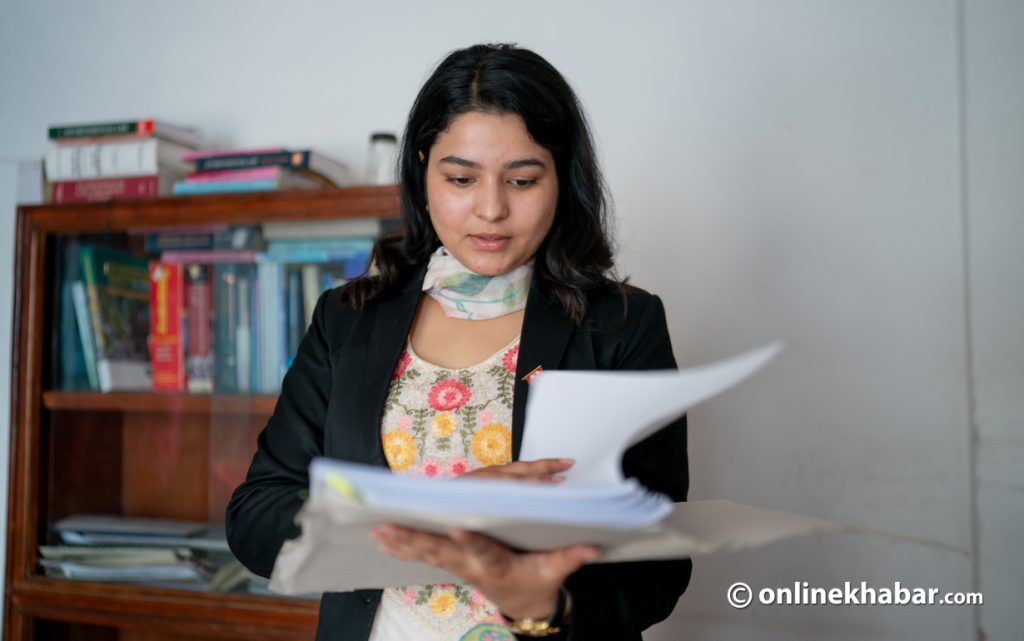
After joining KSL, Shreena’s activism intensified. In her very first year, she joined a campaign against acid attacks, seeking to collaborate with Ujjwal Bikram Thapa, but the Covid lockdown intervened. Still, the campaign succeeded after an ordinance was issued.
In her second year, she filed a writ against the “pink tax” on sanitary pads. Together with friends, she researched the issue for six months, examining UN reports, pad company data, and government statistics. Their group demanded the removal of taxes on imported pads, incentives for domestic production, and no customs duties on raw materials. It took more than a week just to get the case registered, but she did not give up.
In her third year, she filed a case on the “pollution tax” Rs. 1.50 per litre on petrol, at a time when Kathmandu’s air pollution had reached alarming levels and the government was misusing the collected funds. An interim order was issued directing that a separate fund be created.
These cases gave her the conviction that change is possible. Her activism extended beyond college: she began leading the 16-day campaign against gender-based violence and conducted legal awareness classes in government schools within the Kathmandu Valley.
To date, Shreena has filed dozens of public interest writs. The sanitary pad tax case she registered was decided four years later, and the court issued a mandamus ordering the tax to be removed and domestic industry to be promoted. The full text of the verdict is still awaited.
Writing journey: Inspired by events
Shreena’s writing is driven by events and emotion.
“If someone tells me I shouldn’t do something because I’m a girl, I write immediately,” she says.
She once watched the film Pink and got up at 12:30 in the morning to write.
“If something touches me, I write.”
From Grade 8 to now, she has published more than 50 articles in various media, some of which include My Republica, Nagarik, Rising Nepal, Kathmandu Post, and various online outlets. She now writes on gender justice, human rights, heritage, and the environment, linking her writing to law: what exists in society, what the law says, and what the gap is between the two.
After her first poetry book, two more books are now being prepared. One, Not at Last, deals with the impact of modernisation, cultural change, and the heritage crisis. She is also writing a book on citizenship based on her thesis, having already collected data by requesting information from district administration offices in all 77 districts.
“There are patriarchal barriers in the bureaucracy that issue citizenship to women,” she says. “That is why I am writing this book.”
International experience and plans
In 2024, she received a scholarship to attend training on “Cinema Advocacy and Human Rights” at the Global Campus in Italy, after which she implemented a project in collaboration with a metropolitan city authority.
She is also associated with Photo Circle, has participated in international workshops, and has worked with indigenous communities in Dharan, Khokana, and Chitwan. She has worked as a researcher on the Feminist Memory Project.
She is now working at the intersection of eco-feminism and heritage feminism.
“Heritage and women have always been linked, but no one has looked at this from a feminist perspective,” she says.
Personal life and message
These days, Shreena still posts poems on Facebook but is afraid to publish them formally.
“It was easier before; now I fear others might not like them,” she says.
Her plans are clear: fight many more social cases, publish her books, and bring eco-feminism into the mainstream. She visits the Supreme Court every day, asking after the decisions in her cases.
“This matters enormously to me,” she says.
Shreena’s journey began with a small poetry book, but it has since grown into a national movement. With family encouragement and firm resolve, anything is possible. Her message to young people, “Write about what touches you, speak about it, fight for it. Give something to society.”