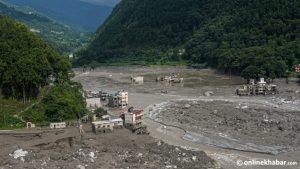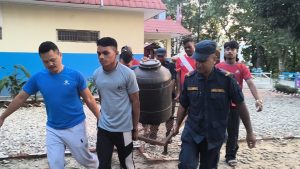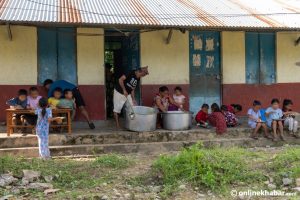

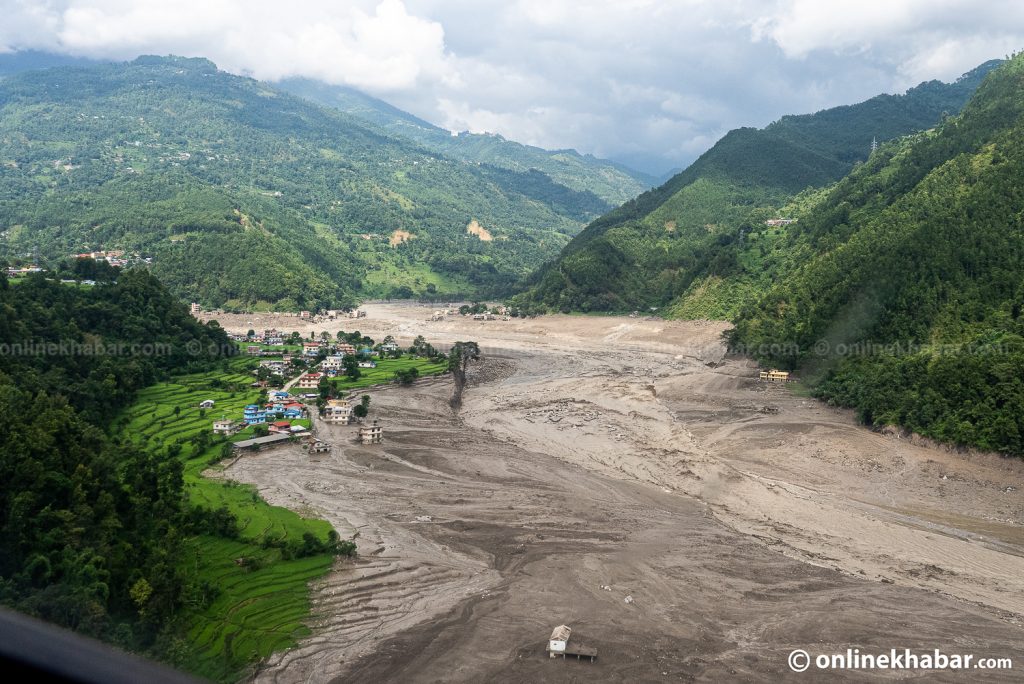
Around 9 AM on Wednesday, a sudden, severe flood originating in the Tibetan region of China caused massive loss of life and property in Nepal’s northern districts, including Rasuwa and Nuwakot. The flood, which came down through Rasuwa’s Bhotekoshi River, wreaked havoc across Timure, Syaphrubesi, Melung, Betrawati, Trishuli Bazaar, Dhungebazaar, and other areas. The flood swept away around 19 bridges, including the one leading to Dhading’s district headquarters.
As of this report, according to Nepal Police data, 157 bodies have been recovered so far. Positive identification of these bodies is still pending.
A large number of people remain missing. Nepal Police central spokesperson and DIG Abinarayan Kafle says that even the exact details of the missing are yet to be confirmed. According to him, 32 Nepal Police personnel alone are missing. Meanwhile, Armed Police Force co-spokesperson and DSP Shailendra Thapa says 9 armed police personnel remain out of contact so far.
Similarly, 44 army personnel are also out of contact. According to army spokesperson and Assistant Chief of Army Staff Rajaram Basnet, 44 soldiers have not been in contact so far; these were personnel deployed to secure Langtang National Park and hydropower facilities. This brings the total number of missing security personnel to 85.
Among Nepal Police and Armed Police Force combined, 41 personnel remain missing, including officers from the Timure, Syaphrubesi, Rasuwagadhi, and Melung police posts. On the armed police side, 9 personnel from the Timure Border Out Post (BOP) are missing. Assistant Sub-Inspector Santosh Rijal, who witnessed the event firsthand, says it is still not possible to assess the full extent of the damage.
Stationed at Betrawati Police Post, Rijal had been using a megaphone to warn people about the incoming flood when it suddenly struck, forcing him to flee to save his life. So far, 97 people have been rescued by air.
Following the sudden flood, the government and security agencies have shown active engagement in search and rescue. Prime Minister Balen Shah, upon learning of the incident, informed the public via Facebook that he had already directed agencies to mobilise for search and rescue.
He appeared to prioritise the Rasuwa flood from the outset, announcing that Nepal Army, Nepal Police, and Armed Police Force teams had already moved toward the flood-affected areas.
A Cabinet meeting was held following the incident, which decided to declare the flood-affected municipalities as crisis zones and focus on search and rescue. The meeting also authorised the Home Minister to mobilise all available resources, including helicopters.
The Home Ministry and Ministry of Defense were tasked with immediately rescuing the injured and those in distress and moving them to safe locations — further evidence that the government treated the Rasuwa flood with considerable seriousness.
Likewise, a meeting of the National Disaster Risk Reduction and Management Authority was held at the Prime Minister’s Office in Singha Durbar, where officials were briefed on the damage caused by the flood.
During the crisis, instructions were given for everyone to focus, from their respective positions, on rescuing, searching for, and providing relief to affected citizens in the flood zone.
Earlier, during flooding in the Nakkhu River within Kathmandu itself, citizens who had climbed onto a tin rooftop awaiting rescue were swept away, a case that drew criticism at the time for the state’s lack of urgency in rescue efforts. Similarly, the state mechanism was criticised for failing to act proactively in the Roshi River flood and the incident of buses buried in Dhading. However, experts believe the government has shown clear activeness in the search and rescue response to the current Rasuwa flood.
Home Minister Sudan Gurung himself went to the Kathmandu airport to oversee rescue preparations. Following government directives, all three security agencies were mobilised for search and rescue.
Nepal Army teams were deployed from the Dhunche and Trishuli barracks for search and rescue. Army spokesperson Basnet said a skilled disaster management team was also dispatched from the No. 6 Battalion headquarters in Gajuri, Dhading.
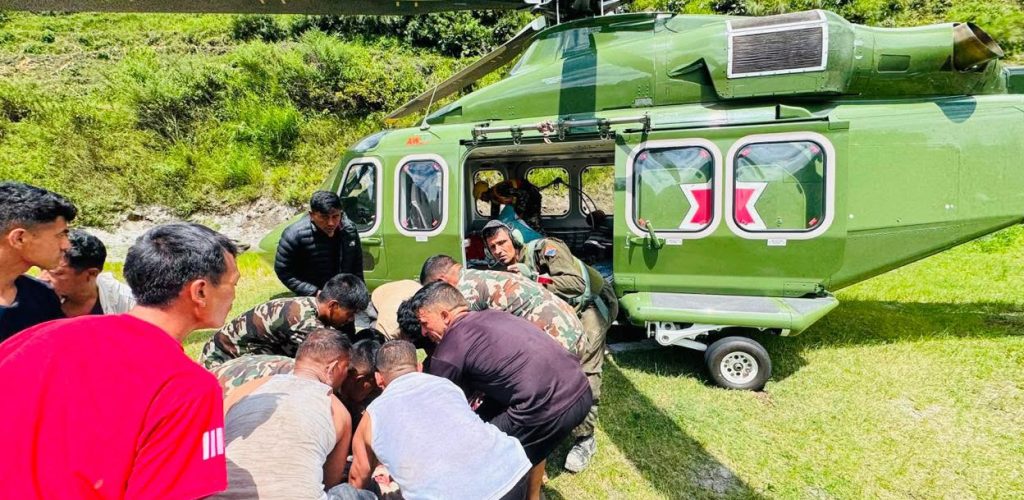
An Mi-17 helicopter along with the Nepal Army’s Emergency Medical Rescue Team was also deployed. Spokesperson Basnet said 97 people were rescued by air alone. Alongside the army, Armed Police Force teams were also deployed for rescue; according to the force, 1,100 personnel were mobilised. Nepal Police teams have also been deployed for search and rescue.
Ratindra Khatri, a retired Major General of the Nepal Army and an expert in crisis, emergency, and disaster management, says security agencies and the government have shown activeness in search and rescue during this disaster.
“Security personnel themselves are missing in large numbers. The flood risk persists. Yet, they remain active in search and rescue,” Khatri told Onlinekhabar. “This activeness should be viewed positively.”
However, the security agencies themselves have acknowledged a shortage of adequate resources for rescue operations. The Armed Police Force, which holds primary responsibility for disaster rescue, does not have a single air asset of its own for rescue operations. Personnel say they are often forced to travel on foot, which creates problems when that isn’t feasible.
While the Nepal Army was able to speed up rescue using its own helicopters, the Armed Police Force had to wait for private helicopters, something they themselves acknowledge caused some difficulty in their rescue efforts.
“We have made our best effort in search and rescue from our side. But the lack of air assets has been a problem,” said one security official. Nepal Police, too, lacks adequate resources, including air assets, for rescue work.
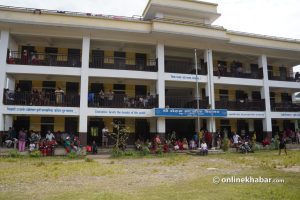
Space was cleared and kept on standby at the Armed Police Force’s APF Hospital, TU Teaching Hospital, and the National Trauma Centre to receive the injured brought in through search and rescue.
Teams from the Trauma Centre, Nepal Police, Armed Police Force, and Nepal Army, including doctors, were sent to Trishuli. Those rescued and brought to Kathmandu are being treated at APF Hospital, TU Teaching Hospital, and the Trauma Centre.
A total of 15 helicopters, 7 from the Nepal Army and 8 from the private sector, carried out rescues. Ten ambulances were kept on standby at the airport to transport those airlifted to hospitals. This sequence of events also shows the government’s active role in post-rescue treatment and management.
Khatri believes the government has used its resources to the fullest extent possible. “Right now is the time to support search, rescue, and relief efforts, rather than picking apart shortcomings; we should unite and fight against this disaster,” he said. “It’s also evident that supplies from emergency warehouses have been put to use.