

Kathmandu, October 5
The government has begun preparations to restructure key regulatory and public health institutions in the health sector.
The government has moved forward with a concept to establish a Centre for Disease Control (CDC) for disease control and surveillance, a Food and Drug Administration (FDA) to regulate medicines, food and other health-related materials, and a National Health Accreditation Authority (NHAA) to assess and certify the quality of health institutions.
Secretary at the Ministry of Health and Food Safety Dr Bikash Devkota said the government plans to develop the new institutions based on the changing needs of the health sector and international practices.
There is a concept to modernise the existing Department of Health Services. Along with disease control and surveillance, the new structure would focus on research, studies, academic activities, national and international coordination, and evidence-based health policy formulation.
“CDC is another form of the existing Department of Health Services,” Devkota told Onlinekhabar. “We are seeking to develop it in a modern and scientific way, making the implementation of existing achievements more effective and strengthening national and international coordination.”
According to him, various divisions and structures currently under the Ministry of Health and the department could be integrated within the CDC. Preparations are also underway to establish a separate structure and develop capacity for research and investigative work.
The issue of establishing a CDC in Nepal is not new. Although it has been discussed for a long time, the structure has not been established. Devkota said the government has now moved ahead with the work with confidence that it can be implemented.
“We have been discussing doing this for a long time. It is not a new concept, but it has not happened so far,” Devkota said. “This time, however, we have moved ahead with the confidence that it will happen.”
Although Nepal’s public health system is based on primary healthcare and public health, there is a need to develop institutional capacity in line with the changing disease burden, epidemics and health challenges.
“The principle is based on moving forward from the current public health and primary healthcare system. But it has not been fully achieved,” Devkota said. “The disease burden, health challenges and needs are changing. A scientific and modern model is needed for that.”
He said the health system has so far been operated according to the available resources and human resources capacity, adding that a new structure could make more effective use of even limited resources.
The debate over establishing a disease control centre in Nepal in line with international standards began soon after the promulgation of the Constitution in 2015. However, the proposal has repeatedly remained stalled due to opposition from ministry employees and groups seeking to retain senior positions.
According to senior officials at the Ministry of Health, establishing the CDC would mean abolishing the existing Department of Health Services and various divisions and centres under it and creating an integrated structure. Currently, each of these bodies has a separate director. Officials have been obstructing the proposal because merging all of them into a single centre would eliminate the posts of 10 to 12 senior officials and leave only one director.
The issue of establishing a CDC was also included in the policy and programme for fiscal year 2020/21, presented by then-President Bidya Devi Bhandari. At the time, the ministry had formed a committee under the coordination of Dr Dipendra Raman Singh and moved the work forward. There was pressure to establish the centre at the time due to fears surrounding the coronavirus pandemic. However, the plan remained limited to paper after efforts were made, under bureaucratic pressure, to retain the existing large and cumbersome structures.
At the time, a proposal was made to abolish the existing department and merge the functions of divisions and centres that duplicated the ministry’s work, including the Epidemiology and Disease Control Division, Curative Service Division, Management Division, Nursing and Social Security Division, National Centre for AIDS and STD Control, National Tuberculosis Control Centre, National Public Health Laboratory, National Health Training Centre, and National Health Education, Information and Communication Centre, into a single powerful disease control centre.
The structure of the centre had already been prepared with six divisions and 195 positions, but it was shelved due to concerns over power and positions. The proposal included divisions for non-communicable disease control, communicable disease control, HIV/AIDS, leprosy and sexually transmitted disease control, tuberculosis control, health and biomedical training, and health promotion and communication.
It was proposed that the centre would have a single director, with staff assigned accordingly to the divisions. It was expected that bringing all the structures together would significantly reduce the number of administrative, accounting and other staff currently working separately in different centres and divisions. This concept has now been brought forward again.
The policy and programme for fiscal year 2026/27 included the CDC, FDA and NHAA. The ministry is currently holding discussions with relevant agencies on developing the structures.
Regulation to cover food and medical devices, not just medicines
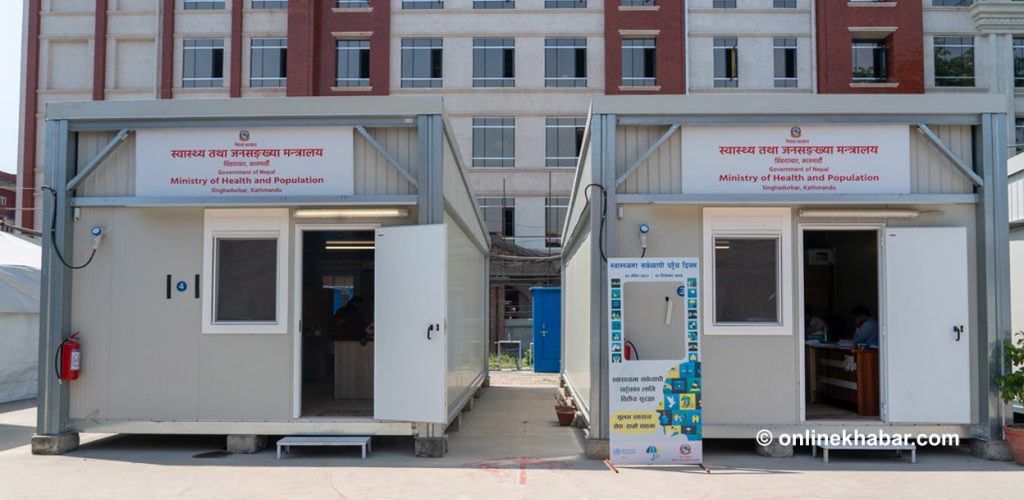
Another important structure proposed by the government is the Food and Drug Administration (FDA). The Department of Drug Administration currently mainly regulates medicines. The proposed structure, however, would cover food products, cosmetics, medical devices and other areas in addition to medicines.
According to Secretary Devkota, the FDA concept includes making the structures currently responsible for food and drug regulation under the Ministry of Health more organised and scientific.
“The structures related to food and drug administration are also under the Ministry of Health,” he said. “There is a need to make these structures more scientific, research-based and effective.”
The proposed FDA would not be limited to medicines. Discussions are underway to create a structure that would extend regulation to food, medicines, cosmetics and medical devices. He said there are also discussions about bringing tobacco products and alcohol within its regulatory scope.
“FDA can oversee food, drugs, cosmetics and medical devices,” Devkota said. “Tobacco products and alcohol, among other things, can also be included.”
However, no final decision has been made on the exact form of the FDA structure. Options under discussion include placing the Department of Drug Administration and the food-related structure under a single higher authority or creating a new structure encompassing both.
“These can be taken forward as two branches under a single higher authority. Alternatively, a new structure can be created by merging the two,” Devkota said. “A model can also be developed by expanding their scope and adding various divisions and branches.”
The ministry plans to study practices in different countries to develop a structure suitable for Nepal.
Separate authority proposed to assess health institution quality
Another important concept put forward by the government is the National Health Accreditation Authority (NHAA).
At present, the Ministry of Health assesses health institutions on the basis of certain standards and checklists when granting operating permits and conducting monitoring. However, the ministry has concluded that a separate independent body is needed for international-level quality certification and for measuring the actual quality of health institutions.
The NHAA would be responsible for measuring, certifying, grading and accrediting the quality of health institutions.
“Currently, we prepare a checklist to assess the quality of an institution. Government employees go and inspect it, and if it meets the standards, we grant permission to operate,” Devkota said. “But a separate authority is needed to certify the level of quality of each institution.”
Hospitals and other health institutions could be classified and certified at different levels in line with international practices. A concept has also been put forward to grade institutions based on their quality, service capacity, human resources, infrastructure and other standards.
“Just as there are international-level quality certifications such as ISO and MSO, there is a need for an authority to certify and grade quality in the health sector as well,” Devkota said.
The ministry plans to develop the NHAA as a body that operates differently from the monitoring and operating-permit functions currently carried out by health divisions.
‘The ministry alone cannot make the decision’
The ministry says it will not make a hasty decision on the three structures because they would bring major institutional changes to the health system. According to Devkota, national and international practices will be studied and discussions held with experts, stakeholders and other ministries. The ministry has already conducted an initial workshop on the issue. It now plans to build a common understanding through further workshops and discussions.
“We have held a general workshop for now. We will now conduct a series of workshops,” Devkota said. “We will hold discussions with all concerned parties. We will look at international and national practices and move forward to determine what model is suitable for Nepal.”
According to him, creating the new structures is not a matter that can be decided solely by the Ministry of Health. Since the structures would need to encompass other government agencies and various stakeholders in the health sector, the government plans to move forward by developing a common understanding.
“This is a major issue. The ministry alone cannot create such a structure and say it has been established,” he said. “We will move forward by developing a common understanding so that other ministries and all concerned agencies can also accept it and the structure can be effective.”
The government aims to clarify the concepts for these structures and prepare drafts of the necessary legal provisions within the current fiscal year. According to Devkota, the immediate priority is not to establish the structures at once but to advance the legal and institutional preparations required for them.
“We will hold further workshops, meetings and discussions after Tihar. Within this fiscal year, we will prepare the concept paper and move ahead with drafting the law for the necessary policy arrangements,” he said.
He said laws should be formulated to give the three structures autonomous roles.