
Kathmandu, January 27
Prime Minister Sushila Karki has emphasised that religious beliefs and cultural heritages should not be affected while carrying out development construction, including road infrastructure.
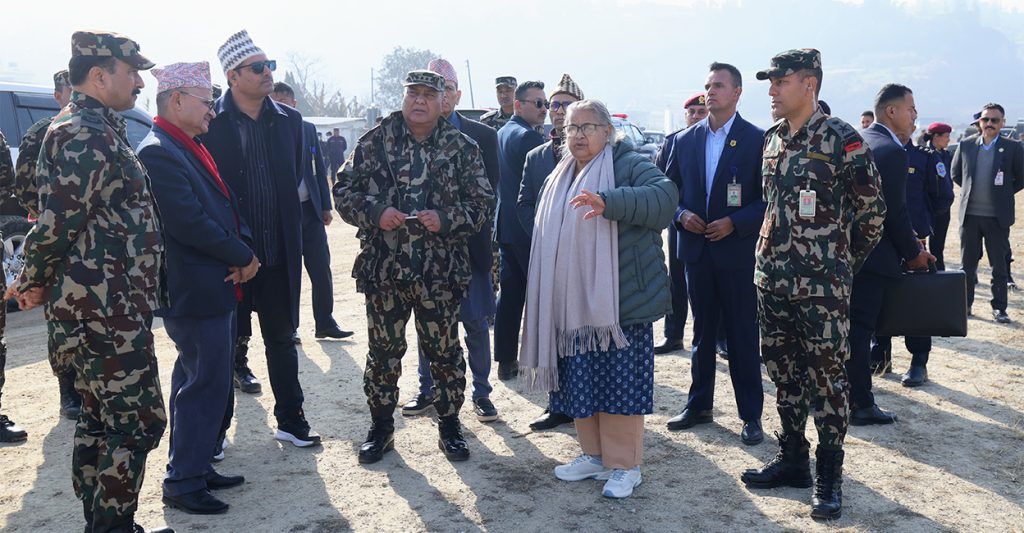
In the course of inspectingthe Kathmandu-Tarai/Madhes fast track, the national pride project, today, the Prime Minister directed the bodies concerned to find a solution after taking the concerns of locals seriously.
She mentioned, “The concerns of the locals should be taken seriously, and a solution should be found for them. The demarcation along the section, as well as the zero point, should also be changed if needed. We should forward development construction without hurting their faith.”
The Prime Minister also suggested making arrangement of necessary vacant places while constructing physical structures. “Open space is needed during a natural disaster. It is also required for people’s movement, festivals, fairs, and gatherings. Therefore, we should abandon the idea of building any structure after seeing an open space. We should plan and build a structure by leaving open space,” she argued.
The Prime Minister’s team comprises the Minister for Physical Infrastructure and Transport, the Minister for Foreign Affairs and the secretaries of different ministries, among other officials. Previously, Chief of the Army Staff Ashok Raj Sigdel and project chief Major General Dharmendra Jha had informed Prime Minister Karki about the project’s progress so far and related challenges.
There was a slight delay in starting the project as the detailed project report (DPR) of this road under construction under the management of the Nepali Army took time to be approved. The physical progress of the expressway project, which has a total length of 70.977 km, has currently reached around 45 per cent.
Under the expressway, more than 87 bridges will need to be constructed. Among them, some are of a specific type and up to 82 metres tall. As these bridges have also reached the final stage of construction, the Army has stated that the project will be completed within the scheduled date of Chaitra-end 2083 BS and within the initial estimated cost of Rs 213 billion.
This will be a short-distance highway connecting Kathmandu Valley directly with the central Tarai region. After the construction of the expressway, it is expected that transportation of goods from the Tarai to Kathmandu will significantly reduce costs and time, and contribute considerably to the country’s economic development.
There are seven tunnels under the project. The Army has stated that it is making special efforts to accomplish the tasks according to the project’s objectives.