
Kathmandu, October 16
At 2:45 pm on Wednesday, the parliamentary hearing of Giribahadur Sunar, Nepal’s proposed ambassador to Saudi Arabia, began with a warning from committee chair Bodh Narayan Shrestha.
“Complainants will not be allowed to name anyone. If anyone names someone, the hearing process will be suspended,” Shrestha told the meeting.
Complaints had been filed against Sunar, including allegations of violence against women. After the procedural announcement, Sunar was asked to present his action plan for the ambassadorial post. He outlined his plans, but the hearing soon shifted to questions about the allegations against him.
“You are appearing before this committee for a hearing. You will have to face our tough and sharp questions. Please do not lose your patience or become angry because of them,” said Madhukumar Chaulagain, a lawmaker from the Rastriya Swatantra Party (RSP), before beginning his questions. “My best wishes to you.”
Sunar faced allegations of an extramarital relationship, mistreating a woman even after reaching a settlement at a district police office and ending his relationship with a former partner, threatening her and pressuring her to take her own life. The complaints also referred to his detention in Germany, where he was allegedly handcuffed before being sent back to Nepal.
Another allegation was that Sunar had collected Rs 3.3 million in collaboration with RSP lawmaker Khagendra Sunar during the promotion process of a deputy inspector general of police.
Chaulagain sought clarification on these issues. In response, Giribahadur Sunar acknowledged that he had been in a romantic relationship with the woman and that they had also had a physical relationship. However, he denied the allegations of violence against women and rejected the other accusations.
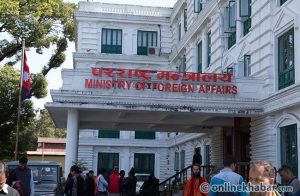
The lawmakers appeared unconvinced by his responses. They also questioned allegations that Khagendra Sunar collected money from various people while Giribahadur managed it. Questions were raised about whether spiritual leader Swami Anand Arun had visited the Ministry of Foreign Affairs to lobby for Sunar’s appointment and about Sunar’s affiliation with the Hamro Nepal Party.
Sunar answered the questions, but lawmakers said his explanations were unsatisfactory.
Insisting that he had evidence to support his position, Sunar displayed a pen drive and urged the lawmakers not to reach a conclusion after hearing only one side. He asked them to examine the evidence he said he possessed.
“Looking at the complainant’s account of her suffering and the evidence submitted in connection with it, it is difficult even to look at you,” said CPN-UML lawmaker Padma Aryal. “But we are here because we have to hear both sides. You are not here to make counter-allegations; you are here to explain the allegations against you.”
Sunar continued to insist that he was innocent. Yearman Pun, a lawmaker from the Nepali Communist Party, urged him to consider the implications for his public standing and withdraw his candidacy.
RSP lawmakers Gazala Samim Mickerani and Deepak Bohara also supported Pun’s appeal.
Sunar, however, refused to withdraw.
“You asked me to quit. Why should I quit?” he responded.
The hearing was consumed by allegations and counterarguments, leaving little time to discuss the nominee’s diplomatic priorities or action plan. Questions about the allegations and the evidence continued until around 4 pm. Sunar was then asked to leave while the lawmakers held an internal discussion.
The members reached a consensus: Sunar could not be approved as ambassador to Saudi Arabia.
They also discussed the other nominees among the 13 proposed ambassadors. There was agreement between the ruling and opposition parties to approve the nominees for 10 countries, while further discussion was considered necessary on the candidates for Malaysia and Japan.
Informal complaints stall another nominee
Chudamani Kharel, Nepal’s proposed ambassador to Malaysia, had not faced any formal complaint before the parliamentary hearing committee.
After the Cabinet recommended ambassadors for 13 countries at its meeting on September 18, the committee had invited complaints over a 10-day period. No formal complaint against Kharel was filed within that period. However, several allegations emerged during his hearing.
Committee member Rajiv Khatri said information concerning potential conflicts of interest and financial transactions had been received informally.
“Information was received that he had taken millions of rupees from some locals in Jhapa on the promise of arranging land through grants, and that he had started repaying the money after his name was proposed for ambassador,” Khatri said during the hearing. “There were also complaints, with supporting evidence, that he used multiple social media accounts and blocked some people after taking their money.”
Kharel was also accused of taking money from recruitment agency operators on the promise of working for their interests as ambassador and using a vehicle provided by a businessperson. Khatri said the vehicle’s registration number had also been provided.
“Documents have been received alleging that millions of rupees in unsettled accounts remained from his work with various organisations, and that he took crores of rupees on the promise of arranging public land in Pokhara,” he said. “Information linking your name to land-related matters in the Tarai-Madhesh region has also been received.”
Kharel denied the allegations, saying he had not been involved in any financial transactions or the alleged activities.
“I have no involvement in these allegations. I do not have to respond to claims made without facts or evidence,” he said.
Committee chair Shrestha said arrangements could be made, if necessary, for Kharel to listen privately to audio recordings submitted as evidence. Lawmakers said further evidence was needed because the allegations and denials had not established the facts clearly.
Chaulagain said the committee needed to examine the evidence before reaching a conclusion, given that Kharel denied the allegations while others claimed to have proof.
“We need to examine the evidence before moving the discussion forward when the two sides contradict each other,” he said.
Pun also said it would be inappropriate to proceed without gathering further evidence.
“If he says no and we keep saying yes, we will get nowhere. So let us put the process on hold,” Pun said.
The committee then discussed whether to continue the hearing or suspend it until further evidence was obtained. It decided to seek additional evidence and temporarily halt the process concerning Kharel. The committee subsequently decided not to endorse his nomination.
A precedent for parliamentary oversight
Nepal currently has one of the strongest governments in its history, with the RSP-led administration holding a majority just short of two-thirds in Parliament.
Against this backdrop, the rejection of two out of 13 ambassadorial nominees, alongside the decision to hold another nomination, has been described by Nepali Communist Party leader Pun as a historic precedent.
“The hearings were conducted by looking at the individuals’ qualifications and capabilities. Those against whom questions were raised have been stopped,” Pun told Onlinekhabar. “This is a historic precedent. No matter how powerful a government is, Parliament and its committees can exercise proper oversight if they choose to.”
RSP leaders also described Wednesday’s decisions as significant for developing a new political culture.
Speaking to Onlinekhabar during the hearings, Chaulagain said the party had come to break bad practices and establish more civilised and systematic procedures.
“We have come to break certain bad practices and establish a civilised and systematic process. We are trying to adopt a practice similar to the confirmation hearings in the United States,” he said.
In Nepal’s parliamentary history, this is only the second time that the Parliamentary Hearing Committee has formally rejected a nominee for a public office. The first such case occurred on July 2, 2018, when the committee rejected the nomination of then acting Chief Justice Deepak Raj Joshee for the post of chief justice.
According to Nepali Congress lawmaker Anand Prasad Dhungana, that was the first time the committee had rejected a nominee for a constitutional body’s leadership or the position of chief justice.
Questions had been raised about Joshee’s academic certificates and date of birth, as well as controversies surrounding some of his rulings. The committee declined to endorse him, saying he had failed to provide satisfactory answers during the hearing.
The Nepali Congress, then the main opposition, boycotted the committee. Of its 15 members, 10 — nine from the then ruling Nepal Communist Party and one from the then Federal Socialist Forum — voted to reject Joshee’s nomination.
The committee cited five reasons for its decision: his failure to present a clear action plan for the chief justice’s role; unsatisfactory answers about his conduct and performance; unresolved doubts about his academic certificates and date of birth; questions about his public conduct and past actions; and his failure to inspire confidence in his ability to safeguard judicial independence and effectiveness.
Nominees who withdrew their names
There have also been cases in which nominees withdrew before the parliamentary hearing process was completed, often when rejection appeared likely.
On June 16, 2024, the Constitutional Council recommended Krishnaman Pradhan for the post of election commissioner. Complaints accused him of sexual exploitation and misconduct. The committee also heard allegations that he had sexually exploited a woman over an extended period and reached a settlement involving Rs 12.5 million.
With his nomination unlikely to secure approval, Pradhan withdrew his name on July 29, 2024, and the appointment process ended.
Similarly, questions were raised about the academic qualifications of Ram Krishna Bhattarai, who had been recommended as ambassador to Sri Lanka by the Cabinet on July 29, 2024. The committee requested his bachelor’s degree certificate, but he failed to submit it. He subsequently withdrew his nomination on September 24, 2024.
The hearing committee has previously given nominees an opportunity to withdraw before formally rejecting their nominations. This time, Sunar and Kharel were also asked to withdraw, but neither agreed. The committee ultimately decided not to endorse them.
The fate of the proposed ambassador to Japan remains unresolved.
The 45-day deadline and automatic approval
Article 292 of Nepal’s Constitution requires parliamentary hearings before appointments to the positions of chief justice, Supreme Court justices, members of the Judicial Council, heads and officials of constitutional bodies, and ambassadors.
A 15-member Parliamentary Hearing Committee has been formed, comprising 12 members from the House of Representatives and three from the National Assembly.
The committee cannot keep a hearing process pending indefinitely. Under Rule 25(2) of the Joint Committee (Working Procedures) Regulations, 2023, it must conduct the hearing and send its decision to the relevant body within 45 days of receiving a nominee’s name.
If the committee fails to make a decision within 45 days, the nominee is considered automatically approved, clearing the way for appointment.
This provision has previously enabled appointments to constitutional positions without parliamentary hearings.
The case of Samim Mian Ansari
On December 20, 2020, then Prime Minister KP Sharma Oli dissolved the House of Representatives. Before that, on December 15, the Constitutional Council had recommended 38 people for positions in various constitutional bodies. Of them, 32 were appointed, as the dissolution of the House prevented parliamentary hearings.
Even after the Supreme Court overturned that dissolution, the House was dissolved again on May 21, 2021. Subsequently, 20 officials recommended by the Constitutional Council were appointed without parliamentary hearings. Fifteen writ petitions were filed at the Supreme Court seeking to overturn those appointments.
The 45-day deadline had also been central to the appointment of Samim Mian Ansari as chair of the Muslim Commission in 2019.
The Constitutional Council recommended Ansari on January 20, 2019, and sent the recommendation to the hearing committee on January 24.
The committee held an extensive discussion on February 10, examining his documents, a citizenship dispute and complaints against him. Disagreements emerged even among lawmakers from the then ruling Nepal Communist Party, and the committee failed to reach a decision.
The government wanted to proceed with the appointment once the 45-day deadline expired, and the committee did not reach a conclusion before that deadline. The period ended on March 9, 2019, after which Ansari was deemed automatically approved.
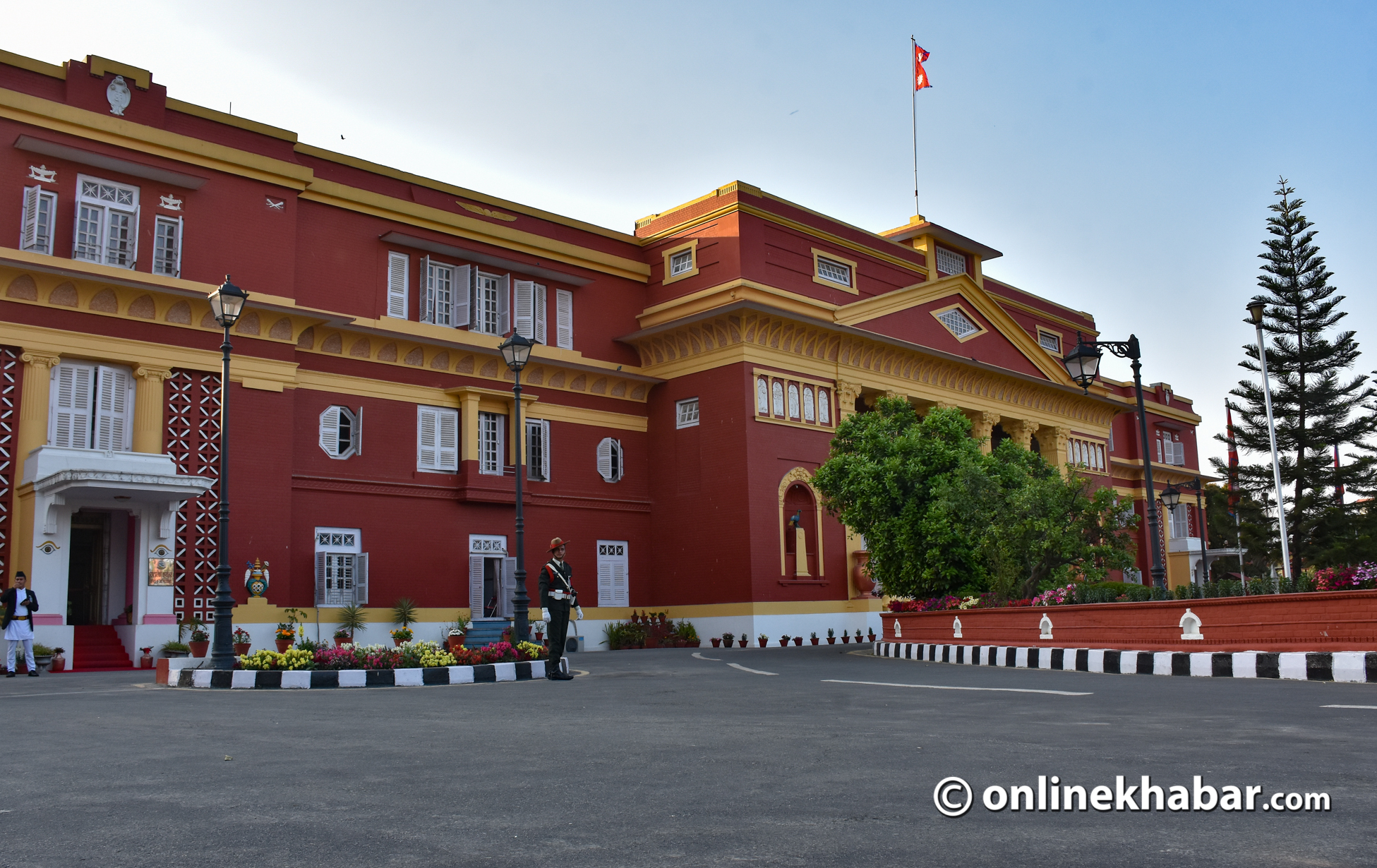
He formally assumed office after taking the oath of office and secrecy at Sheetal Niwas on March 21, 2019, in the presence of then President Bidya Devi Bhandari.
Another test over the Japan nomination
The practice of waiting for the 45-day deadline to expire before proceeding with appointments has once again come under scrutiny.
The committee has put on hold the nomination of Thapa, proposed as Nepal’s ambassador to Japan.
The government recommended 13 ambassadorial nominees, including Thapa, on September 18. The committee invited complaints against the nominees on September 25 and has since made decisions on 12 of them.
A complaint against Thapa alleged that he held permanent residency (PR) in Japan. During the hearing, he said he had already relinquished his own PR status. However, he acknowledged that his wife still held Japanese PR and that a house in Japan was registered in her name.
It also remains unclear whether Thapa received any services or benefits from the Japanese government while working with a local government there. Questions have been raised about potential conflicts of interest given his long stay and employment in Japan, as well as property ownership there.
The committee has withheld approval while it examines the complaints and supporting evidence. Chair Shrestha said the committee had sought relevant information from Japan through the Ministry of Foreign Affairs.
A final decision on Thapa is expected at a committee meeting after Dashain.