
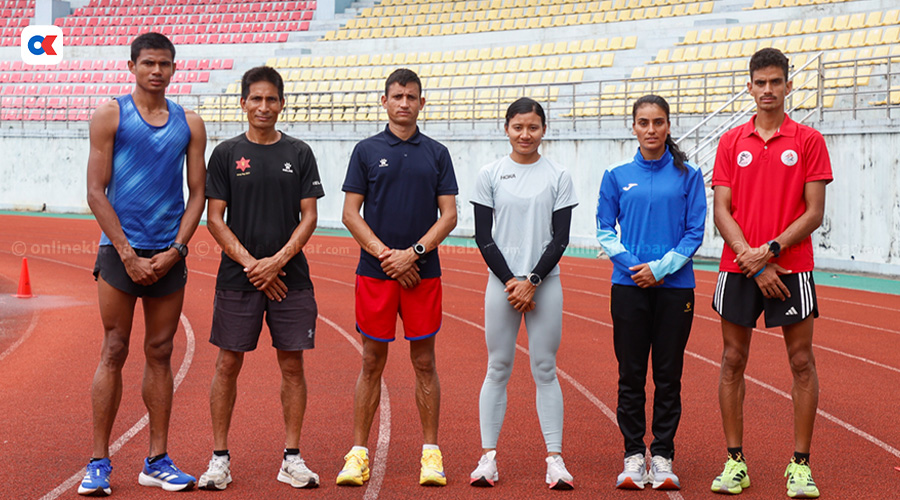
For Nepal’s athletics team, the 20th Asian Games will be about more than simply taking part. Six athletes will represent Nepal in athletics at the Aichi-Nagoya Asian Games in Japan from September 19 to October 4, with several arriving at the continental event carrying ambitions of breaking long-standing national records — and, if everything falls into place, challenging for a medal.
The six athletes — four men and two women — are currently training twice a day at Dasharath Stadium as part of their preparations.
The men’s team comprises Som Bahadur Kumal, Mukesh Bahadur Pal, Rajan Rokaya and Khadak Bahadur Khadka, while Santoshi Shrestha and Purnalakshmi Neupane will compete in the women’s events.
For Shrestha and Kumal, the Games will be a return to familiar territory. Shrestha will make her second Asian Games appearance, while Kumal will compete at the continental Games for the third time.
For Pal, Rokaya, Khadka and Neupane, however, Aichi-Nagoya will be their first Asian Games.
Nepal’s athletics athletes have been appearing at the Asian Games since the inaugural edition in New Delhi in 1951. Yet, despite that long history, the country has never won an athletics medal at the continental Games.
That record stands in contrast to athletics’ contribution to some of Nepal’s biggest international sporting achievements.
Jit Bahadur KC won Nepal’s first international athletics medal at the 1973 Asian Athletics Championships, taking bronze in the marathon. He repeated the feat in 1975.
Ajit Kumar Yadav later created history by winning gold at the 2019 Asian Youth Athletics Championships, while Deepak Adhikari won a historic gold at the 2022 Asian Cross Country Championships in Kathmandu.
Now, six athletes are hoping to add another chapter to that history.
Khadka chasing a record that has stood for nearly four decades
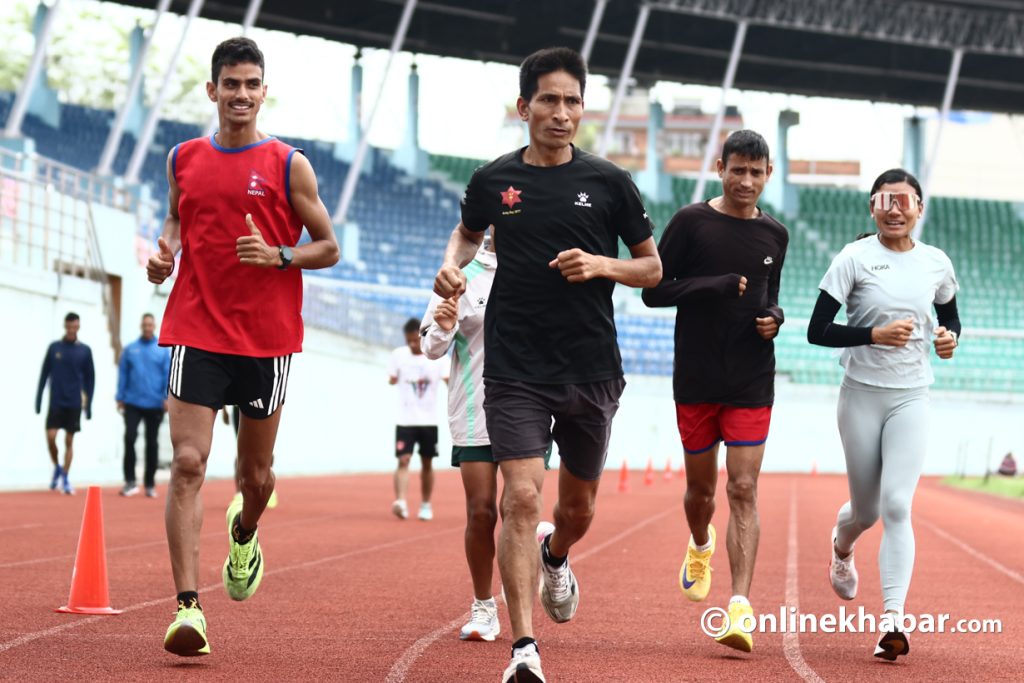
For Khadak Bahadur Khadka, the Asian Games debut comes with a very specific target: break one of Nepal’s most enduring athletics records.
The Nepal Army marathon runner will compete in the men’s marathon and has set his sights on the national record held by legendary runner Baikuntha Manandhar.
Manandhar ran 2 hours, 15 minutes and 03 seconds at the 1987 South Asian Games in Kolkata. The record has survived numerous attempts to break it over the years.
Khadka believes he is now close.
He has reduced his marathon time from around 2 hours and 18 minutes to approximately 2 hours and 15 minutes and wants to make the final jump in Aichi-Nagoya.
“Baikuntha Manandhar’s achievement has made us chase that time even today. I want to thank him. He also blesses us and tells us that we are getting close and should keep doing well,” Khadka said.
“If the weather, my health and everything else support me there, I believe I can break the record.”
Khadka, who is originally from Jajarkot, came to athletics through an unusual route. He first joined the Nepal Army as a soldier and spent 11 years in service before becoming involved seriously in competitive running.
“I was a soldier first and an athlete later. I did not even know that running was a sport,” he said.
His entry into athletics came through the army’s physical training and sporting activities. He eventually chose marathon running without competing in other events first.
For Khadka, simply making it to the Asian Games is already a significant achievement. But he wants to use the opportunity to chase a record that has survived for almost four decades.
Santoshi wants more than another medal
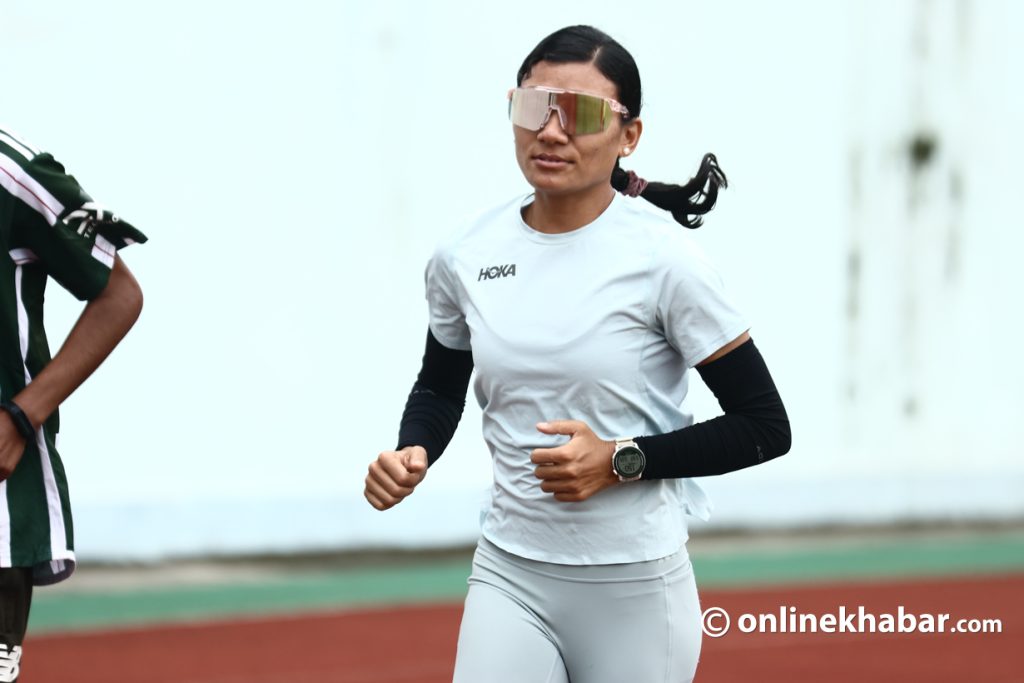
Santoshi Shrestha, the “Golden Girl” of Nepali athletics after her historic gold at the 2019 South Asian Games, will return to the Asian Games with two national records already under her name.
She will compete in the women’s 5,000m and 10,000m, events in which she holds the national records.
Her 5,000m record stands at 16:36.61, while her 10,000m record is 34:47.77.
Shrestha knows competing in two events will bring additional pressure, but she believes the preparation is similar for both.
“There is some pressure when competing in two events because if the event you have focused on comes later, it can create stress. But the training for both is the same. During the Games, you have to handle the pressure,” she said.
The 2019 South Asian Games champion is realistic about the medal challenge in Aichi-Nagoya. The gap between Nepal and the continent’s best runners remains, but she believes that gap is narrowing.
“We have to give our best. We don’t know whether that will result in a national record or a personal best. We have to be realistic about the medal,” she said.
“There is a gap, but we are working hard and that gap has become much smaller. If we break records, we can create a path for the next generation.”
For Shrestha, the goal is therefore not limited to the medal table. A strong performance and new records could help create a stronger foundation for athletes who come after her.
Mukesh wants to rewrite two national records
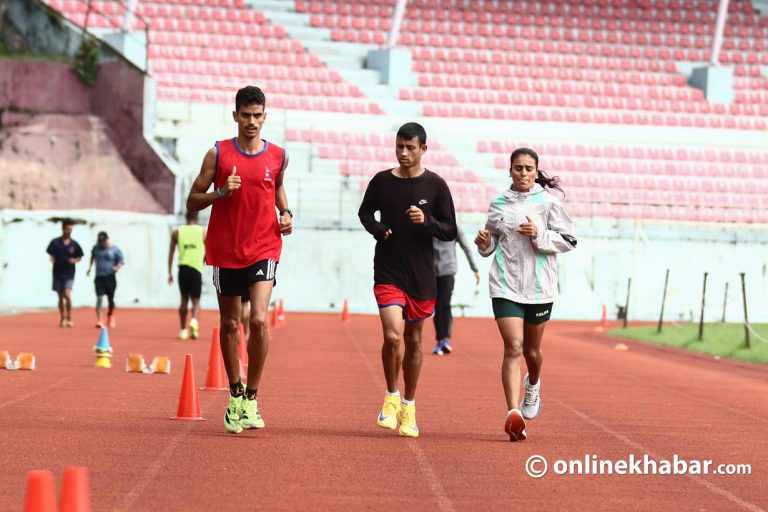
For Mukesh Bahadur Pal, the Aichi-Nagoya Games will be his first Asian Games, but the occasion itself is not new territory.
The Nepal Army middle-distance runner has already competed at the World Championships, Asian Championships and South Asian competitions.
He will race in the men’s 1,500m and 5,000m, with national records in both events firmly in his sights.
“I have competed at the World, South Asian and Asian Championships, but this is my first Asian Games. I am excited and have the goal of doing well,” Pal said.
His ambitions extend beyond simply participating.
In the 1,500m, Gopal Bahadur Adhikari holds the national record of 3:46.63, set at the 1993 South Asian Games. The mark has remained untouched for 33 years.
Pal is currently running around 3:49 and believes the record is within reach.
“I have been trying to break the national record in the 1,500m for a long time. I have worked very hard and suffered for it. I am getting closer. This time, I am determined to break it,” he said.
The 5,000m national record belongs to Rajendra Bhandari, who clocked 14:04.89 at the 2004 Athens Olympics.
Pal wants to challenge that record too.
He believes breaking the 1,500m mark could also have significance beyond his own career, potentially bringing Nepal closer to the Asian Games podium in future editions.
“If I can break the 1,500m record, there will be a possibility of a medal at future Asian Games. That is why I am working hard,” he said.
Pal also hopes to put Nepal on the international athletics map.
“The government has invested in us, and we are putting in our blood, sweat and effort. My attempt will be to give the country a medal. Even if I cannot win one, I want to show the world how much a Nepali athlete can achieve.”
Rajan shifts focus from marathon to 10,000m
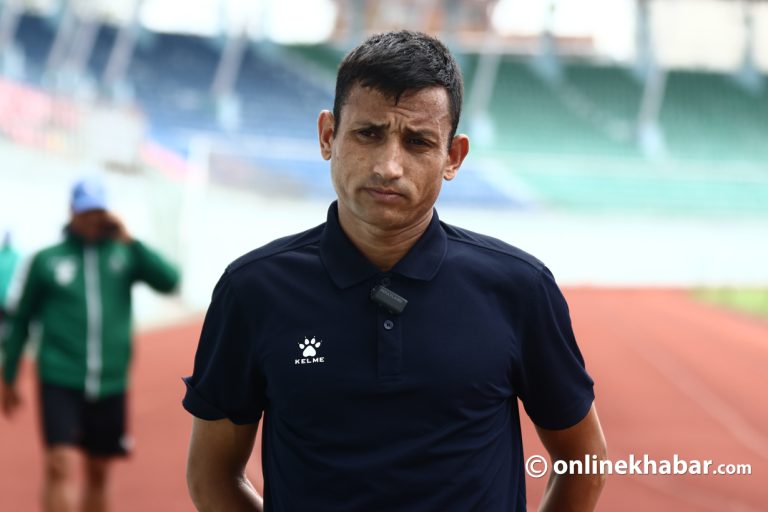
Rajan Rokaya will have two events on his schedule — the 10,000m and marathon — but his attention is increasingly turning toward the shorter distance.
Like Khadka, Rokaya is a Nepal Army runner and has traditionally competed in the marathon. He also raced in the marathon at the 19th Asian Games in Hangzhou. This time, however, the 10,000m is his priority.
“My two events are the 10km and marathon. My focus will be on the 10km. I will also run the marathon,” Rokaya said.
Moving from marathon training to the faster 10,000m requires additional work on speed, he said.
“I am a marathon runner, so I have to work harder to adapt to the 10km. I have to struggle a little more. But my speed has been very good in the closed camp.”
Rokaya is following in the footsteps of fellow Nepal Army athlete Deepak Adhikari, who set the national record in the men’s 10,000m at the Hangzhou Asian Games.
Adhikari clocked 29:35.06 in Hangzhou.
With Adhikari not competing this time, Rokaya will take on the event.
He is reluctant to make a precise prediction about his result.
“Ninety-five percent is our effort and five percent is luck. Until the race starts and we reach the ribbon, you cannot say what will happen,” he said.
Purnalakshmi targets a national record on her debut
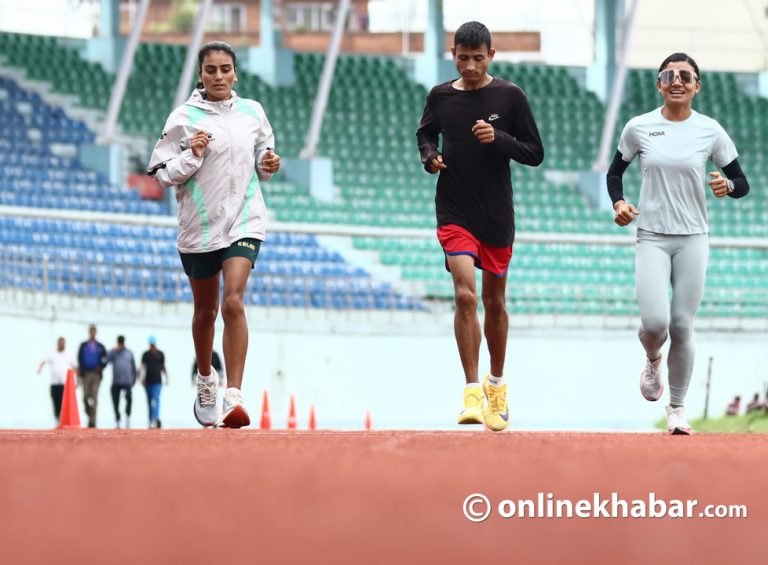
For Purnalakshmi Neupane, Aichi-Nagoya will be a first taste of the Asian Games. The Nepal Army athlete will compete in the women’s 1,500m and 5,000m, sharing the 5,000m field with Shrestha. Her main focus, however, is the 1,500m.
Neupane is targeting the national record in the event, currently held by Saraswati Bhattarai, who clocked 4:33.94 at the Rio Olympics.
A debut at the Asian Games will therefore come with a clear personal target: close the gap to a record that has stood for a decade.
Som Kumal has the podium in sight
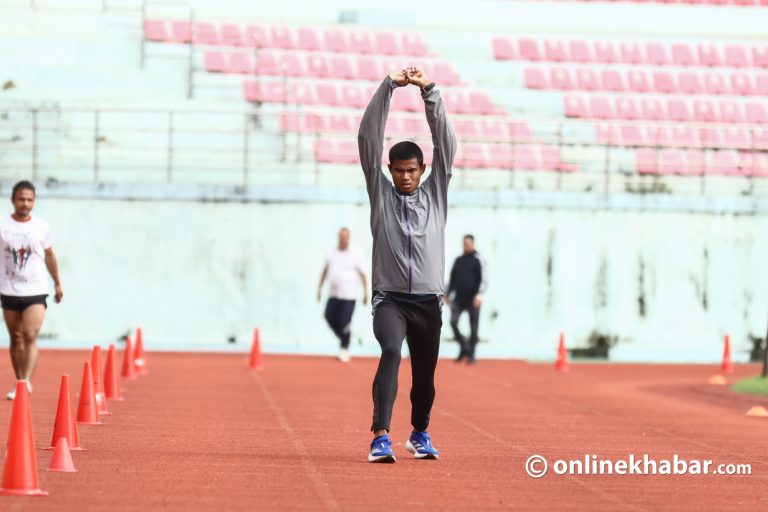
Among Nepal’s six athletes, Som Bahadur Kumal has the most Asian Games experience. A third appearance awaits the middle-distance runner, who will compete only in the 800m this time.
Kumal competed in both the 400m and 800m at the 2018 Asian Games in Jakarta and again in two events at the 2018 edition? No — at the 19th Asian Games in Hangzhou.
His biggest achievement came in Jakarta, where he set the national 800m record at 1:50.25.
Four years later in Hangzhou, he came close to improving it, finishing in 1:50.38.
This time, Kumal has decided to focus entirely on the 800m.
His recent training times have been around 1:49, giving him reason to believe he can lower his national record.
The bronze medalist at the previous Asian Games clocked 1:48.51.
That puts Kumal within striking distance, according to Nepal Athletics Association Secretary RK Bista, if the athlete can continue improving.
Three years of preparation behind the team
The six athletes are now training twice daily at Dasharath Stadium under coach Uttam Khatri.
They have been preparing under the Mission 2026 programme for around three years and are currently staying in a closed camp alongside athletes from other sports.
The National Sports Council and Nepal Athletics Association are supporting the preparation.
Unlike many team sports, athletics is ultimately measured in numbers — seconds, minutes and metres. The team is therefore using timing data to assess how close the Nepali athletes are to the level required to challenge for medals.
According to Athletics Association Secretary RK Bista, the athletes’ current performances are being compared with the timings of athletes who won bronze medals at the previous Asian Games.
The goal is not only to prepare them physically but to give them a realistic understanding of where they stand against Asia’s best.
The athletes are also expected to compete in the Indian Open World Athletics Continental Tour Silver-level event, beginning in India on August 22. The final number of Nepali participants has not yet been confirmed, although Bista said the Asian Games camp athletes are likely to be included, along with possibly one additional athlete.
For a country that has sent athletes to every Asian Games since 1951 without winning an athletics medal, Aichi-Nagoya represents another opportunity.
The six runners know the gap remains difficult to bridge. But they also know that records are there to be challenged — and that for some of them, the numbers are already getting close.
Nepal’s six athletics representatives at Aichi-Nagoya
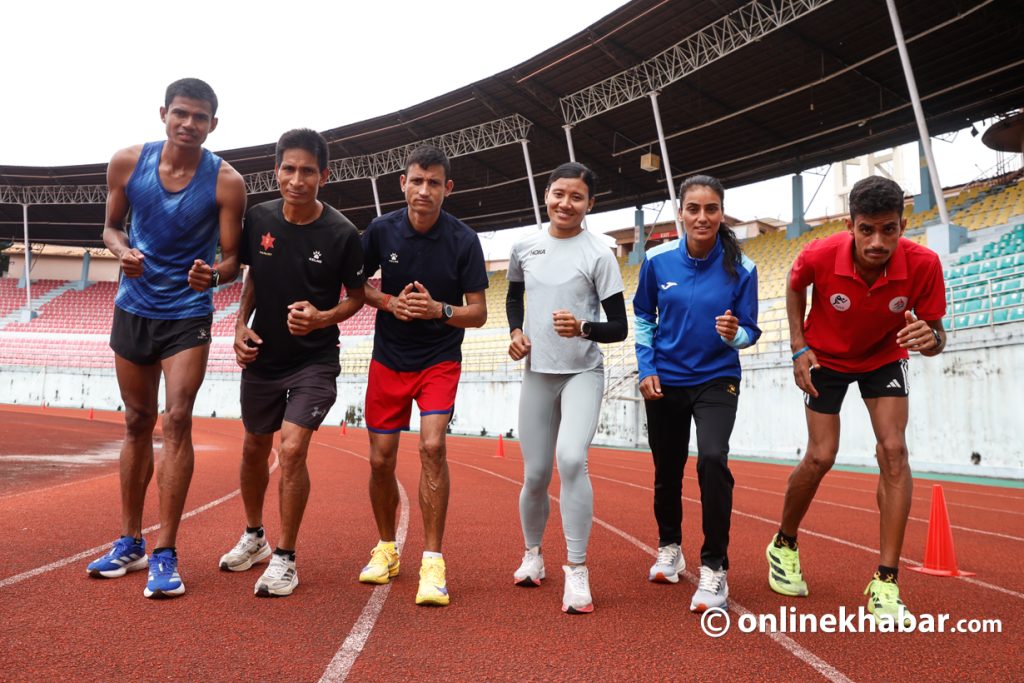
Som Bahadur Kumal — Men’s 800m
Mukesh Bahadur Pal — Men’s 1,500m and 5,000m
Rajan Rokaya — Men’s 10,000m and marathon
Khadka Bahadur Khadka — Men’s marathon
Santoshi Shrestha — Women’s 5,000m and 10,000m
Purnalakshmi Neupane — Women’s 1,500m and 5,000m