
Kathmandu, November 23
The tourism and civil aviation sectors have reasons to be optimistic about Prime Minister Balendra (Balen) Shah’s visit to India. In particular, an agreement to make the Bhairahawa air route bidirectional and the launch of the Ayodhya–Janakpur railway service have brought momentum to some long-pending issues between Nepal and India.
The joint vision document titled Developed India and Prosperous Nepal – Reimagining Partnership, issued alongside the prime minister’s visit, mentions agreements to open new transit and air routes to strengthen connectivity. The joint press statement issued following talks between the two prime ministers specifically mentions an agreement to make the Bhairahawa route bidirectional.
However, the arrangement was not mentioned in Indian Prime Minister Narendra Modi’s address or in the agreements signed between the two governments. This has raised doubts about whether the agreed air route will actually be implemented.
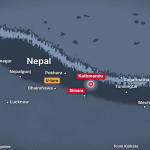
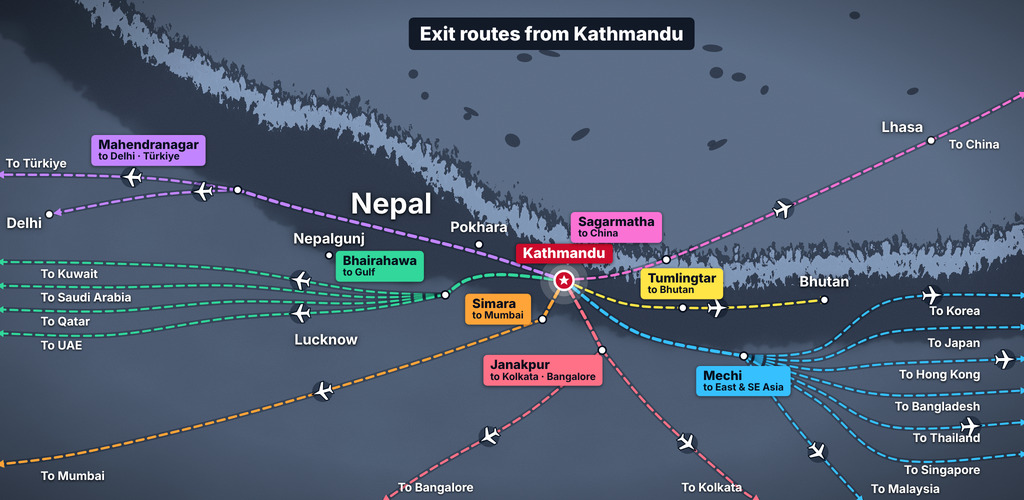
According to the joint press statement, both sides have agreed to make the existing one-way B345 route (Kathmandu–Bhairahawa–Lucknow) bidirectional.
The two sides have also agreed to hold technical consultations to finalise the procedures and other arrangements for implementing the route, as well as to address other civil aviation issues currently under discussion.
In 2018, India had agreed to open the Biratnagar and Janakpur routes for flights to Kathmandu, as well as the Mahendranagar route for cross-border flights. However, those routes never became operational at the technical level, with the process instead facing delays and complications.
Meanwhile, Nepal has placed greater emphasis on making the Mahendranagar entry point bidirectional than on the Bhairahawa route. The Mahendranagar route is also considered more beneficial to Nepal, but no immediate agreement appears to have been reached on it.
According to a senior official at the Civil Aviation Authority of Nepal (CAAN), implementing the latest agreement alone would make operations at all three of Nepal’s international airports somewhat easier. It would reduce flight distances and, consequently, costs and fares.
The official said flights entering Nepal via Lucknow and Bhairahawa would save around 17 minutes compared with entering via Simara when heading to Bhairahawa. Flights to Pokhara would save approximately 14 minutes. For larger aircraft, even a 14-minute reduction in flight time can translate into significant cost savings.
The official also said that finalising the route’s operating procedures would pave the way for the operation of an Instrument Landing System (ILS) at Bhairahawa airport. Opening the entry route would allow aircraft to use Indian airspace to approach Bhairahawa, enabling ILS operations.
This would allow aircraft to take off and land even during periods of dense fog, potentially improving the regularity of flights at the airports.
However, several procedures must still be completed before the route can be operational. According to a CAAN technical official, the two countries must agree on the altitude at which Indian air traffic controllers will hand over aircraft to Nepali controllers at the designated point and sign an agreement to that effect.
If no restrictions are imposed on the altitude at which aircraft enter Nepal’s airspace through India, the arrangement would benefit flights arriving at Tribhuvan International Airport, Bhairahawa and Pokhara.
However, if India again imposes altitude restrictions, the route may not prove practical. Long-haul aircraft entering through Bhairahawa would ideally need permission to enter Nepal’s airspace at a relatively low altitude. Such an arrangement would benefit aircraft heading to all three airports.
If aircraft are permitted to enter only at higher altitudes, they would have to fly additional circuits over Nepali airspace to descend, negating the time savings.
Once the technical teams from both countries complete the necessary procedures, they must notify the International Civil Aviation Organization. The route will become operational after CAAN publishes a Pre-flight Information Bulletin.
According to the official, sufficient data are already available from aircraft departing through the Bhairahawa route. As the new entry route would be based on existing operational data, implementing the agreement should not take long if both sides are willing to proceed.
Making the Bhairahawa route bidirectional would also facilitate regional flights to Indian cities, which is why the private sector has welcomed the agreement.
Ayodhya–Janakpur rail service brings optimism

A railway service between Janakpurdham in Nepal and Ayodhya in India was launched on Monday to strengthen the religious, cultural and historical ties between the two cities.
Prime Minister Shah and his Indian counterpart Narendra Modi jointly inaugurated the service from Hyderabad House in New Delhi. Immediately after the virtual inauguration, the train departed from Ayodhya for Janakpur.
The Indian Railways had earlier approved a new weekly service between Janakpurdham and Ayodhya Cantt in Uttar Pradesh.
The direct service, covering approximately 604 kilometres, is expected to make religious tourism and cross-border travel between the two countries easier, according to India’s Ministry of Railways.
The train will operate once a week in both directions. According to the Railway Board’s schedule, it will depart Janakpurdham at 1:10 pm every Saturday and arrive at Ayodhya Cantt at 8:10 am on Sunday.
Similarly, train number 15596 will depart Ayodhya Cantt at 5:50 pm every Monday for Janakpurdham.
The train will stop at Jayanagar, Madhubani, Shisho, Sitamarhi, Raxaul, Narkatiaganj, Gorakhpur, Basti, Mankapur and Ayodhya Dham along the route.
The service connects Janakpurdham, regarded as the birthplace of Sita, with Ayodhya, regarded as the birthplace of Ram, with the aim of promoting tourism along the Ramayana circuit.
With the railway service now operational, Nepal is also planning to introduce air services from Janakpur to other cities. One such plan is to launch flights between Janakpur and Pokhara, allowing tourists arriving in Janakpur to travel to other destinations in Nepal.
The railway service is expected to provide convenience to residents in the region while also physically connecting the two countries through a route rooted in centuries-old religious and cultural ties.
According to Hindu religious beliefs, Janakpur is the birthplace of Sita and Ayodhya is the birthplace of Ram. The marriage of Sita, daughter of King Janak of Janakpur, and Ram, prince of Ayodhya, in the Treta Yuga is central to the shared cultural tradition linking the two religious cities through the Ramayana.
Nepal and India have also agreed to expand cooperation in tourism. According to the joint vision document, the two countries will collaborate on developing religious tourism circuits and new destinations.
The agreement includes developing the Ramayana, Buddhist and Shiva-Shakti circuits by linking Janakpur and Ayodhya, Lumbini–Bodh Gaya–Sarnath–Kushinagar, and Kathmandu–Varanasi.