

Kathmandu, September 15
The Nepali government has launched an investigation into 25 foreign employment companies selected by Malaysia as the main agencies for recruiting Nepali workers.
The Department of Foreign Employment has initiated an investigation into the licensed recruitment agencies affiliated with Malaysia’s Foreign Workers Centralised Management System (FWCMS).
Malaysia has recently introduced a system under which Nepali workers can be recruited through only 25 designated foreign employment companies. The arrangement has also brought around 250 other Nepali foreign employment companies affiliated with the 25 main agencies under scrutiny.
The Department is examining the transactions of the 25 main agencies, the basis on which they were selected, their past involvement in recruiting workers for Malaysia and the process through which they affiliated other foreign employment companies.
The department has also begun seeking clarification from the 250 companies regarding the basis and procedure for their affiliation with FWCMS and their relationship with the designated main agencies.
The 250 companies will not be allowed to obtain new pre-approval for recruiting workers for Malaysia until the investigation is completed.
The government, however, has clarified that the restriction applies only to new pre-approvals for Malaysia.
Workers who have already completed the recruitment process and obtained labour approval will not be affected and will be allowed to travel to Malaysia as planned.
The government’s move has nevertheless raised concerns over whether efforts to prevent a possible recruitment syndicate could end up affecting employment opportunities in Malaysia.
The recruitment of Nepali workers to Malaysia had remained suspended for a prolonged period in the past. With Nepal objecting to Malaysia’s decision to limit recruitment to a small number of foreign employment agencies, concerns have emerged that the process could again face disruption.
‘Malaysia needs workers, not agencies’
Rajendra Bhandari, former president of the Nepal Association of Foreign Employment Agencies, said Malaysia’s decision to give authority to only a limited number of foreign employment companies and place the other 250 firms under them as sub-agents does not conform to Nepal’s existing laws and system.
According to Bhandari, all licensed foreign employment companies in Nepal have equal legal status.
However, Malaysia’s arrangement of designating 25 agencies as principal agencies and the remaining 250 as supporting or sub-agencies could result in control over the recruitment process being concentrated in the hands of a limited number of companies, he said.
“Our foreign employment companies cannot be guided by an arrangement that goes beyond our acts, rules and laws,” Bhandari said.
He also argued that Nepal’s laws do not clearly envisage a system in which 250 foreign employment companies operate as sub-agents of 25 other companies.
Such an arrangement could create additional layers in worker recruitment and fee collection, increasing the risk of workers being charged more, he said.
Bhandari stressed that the solution should not be to stop recruitment for Malaysia, but to maintain a transparent and open system based on fair competition.
“Does Malaysia need workers or agencies?” he asked. “The Nepali government can send workers through any agency it has licensed.”
He said Nepal should not accept Malaysia’s position if it refuses to recruit Nepali workers through agencies other than the 25 designated companies.
Even if employment opportunities are temporarily affected, Nepal should prioritise its laws and the interests of workers, he said.
Government says it does not want Malaysia jobs to stop
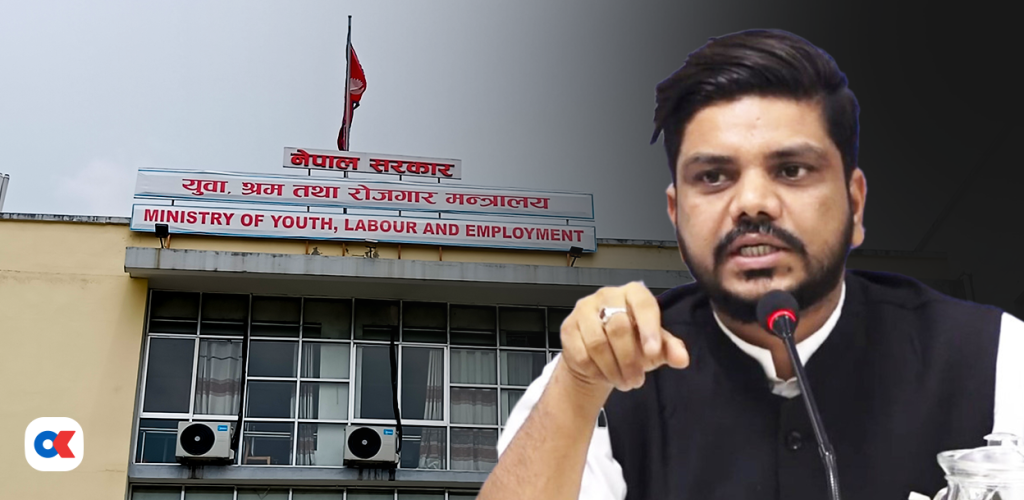
The Ministry of Labour, Employment and Social Security said it is aware of concerns that the dispute could affect the deployment of Nepali workers to Malaysia.
A ministry official said the government was not seeking to stop employment in Malaysia but had raised legal and institutional questions over the limitations introduced through FWCMS.
According to the official, Nepal’s Foreign Employment Act, regulations and Constitution do not provide for restricting competition in foreign employment in such a manner.
The bilateral labour agreement between Nepal and Malaysia also does not contain the concepts of “principal agency” and “support agency”, the official said.
“Active foreign employment agencies have been given equal status under the Foreign Employment Act 2007,” the official said. “They have equal standing to send workers to any destination country.”
The government has therefore clearly communicated its position on Malaysia’s new arrangement and proposed that outstanding issues be resolved through bilateral discussions, the official said.
The ministry said Nepal had responded to Malaysia’s arrangement through official correspondence soon after it was introduced.
The official also rejected claims that the government had remained inactive diplomatically on the issue.
Instead, the government has made it clear that it does not agree with the arrangement favouring a limited number of foreign employment companies, while focusing its investigation and possible action on the companies involved, the official said.
‘It may stop for some time, but not for long’
Tik Bahadur Khatri, president of the Nepal Association of Foreign Employment Agencies, said Nepal and Malaysia need immediate high-level diplomatic dialogue to resolve the dispute.
He said a solution would not be possible without dialogue and called for an early meeting of the Nepal-Malaysia Joint Committee.
Khatri also raised concerns over the vacant post of Nepal’s ambassador to Malaysia.
He urged the government to appoint an ambassador without further delay, arguing that an ambassador would be better positioned to engage in high-level diplomatic discussions.
“An ambassador has the standing to meet even with ministers,” he said. “At present, officials can meet only counterparts at the same level, so there is a question over how much influence such discussions can have on decision-making.”
Khatri, however, does not expect employment in Malaysia to remain suspended for long.
Nepali workers remain a reliable labour source for major Malaysian employers and industries, he said. Even if recruitment is halted temporarily, pressure from Malaysian employers could lead to its resumption.
“It may stop for a little while, but I am confident it could resume after a month or two because of the interests of Malaysian industries themselves,” he said.
‘How was a company with no record of sending workers to Malaysia selected?’
Bishnu KC, head of Aakarshan International, which has been sending workers to Malaysia through ethical recruitment practices for years, has questioned the basis on which the 25 foreign employment companies were selected.
According to KC, at least one company on the list had not previously sent even a single worker to Malaysia.
He said the selection criteria for the 25 companies should therefore be made transparent.
“It has not sent even a single worker until today. How was it selected?” he asked.
KC also warned that giving recruitment authority to a limited number of foreign employment companies could increase the amount charged to workers.
He claimed that complaints had already begun emerging that workers were being asked to pay between Rs 800,000 and Rs 1 million to go to Malaysia.
KC also called for diplomatic initiatives by the government.
Although the recruitment process could be put on hold for some time, he said Malaysian employers prefer Nepali workers and therefore employment opportunities were unlikely to remain suspended for a prolonged period.
Jobs or syndicate?

The current dispute over recruitment to Malaysia revolves primarily around two issues.
The first is ensuring that Nepali workers continue to have access to employment opportunities in Malaysia. The second is preventing a limited number of agencies from gaining a monopoly over the recruitment process.
The government has prioritised the second issue by launching investigations into the 25 designated main agencies and the 250 companies linked to them.
Recruitment agencies, however, are calling for immediate high-level dialogue with Malaysia alongside the investigation.
The government says its investigation and diplomatic engagement with Malaysia are being pursued simultaneously.
Former association president Bhandari also argues that the government’s move against a possible syndicate should not be interpreted as an attempt to stop employment in Malaysia.
Even if recruitment is affected temporarily, he said Nepal should not compromise its laws and workers’ interests by accepting a monopoly for a limited number of companies.
The immediate challenge for the government is therefore how to prevent a recruitment syndicate while ensuring that employment opportunities in Malaysia continue.
The answer is likely to depend on discussions through the Nepal-Malaysia joint mechanism and high-level diplomatic engagement.
Recruitment agencies warn that delays in dialogue could affect employment for some time, while the government maintains that it will not compromise Nepal’s laws or workers’ interests.
The dispute, therefore, appears to be less about whether Nepali workers should continue going to Malaysia and more about whether Nepal will accept Malaysia’s proposed model of recruiting workers through a limited number of designated foreign employment agencies.