

Nepal’s political landscape has undergone a generational change. For decades, its relationship with India was shaped by political leaders who shared deep personal, ideological and historical ties with New Delhi. That familiarity is now giving way to a younger political generation that grew up in a globalised Nepal, shaped by migration, technology, social media and new expectations of the state.
For India, the change presents both a challenge and an opportunity. Prime Minister Balendra Shah’s government has entered office without the traditional political relationships that defined Kathmandu’s engagement with New Delhi, while India itself is navigating a rapidly changing South Asian geopolitical landscape.
How should New Delhi understand Nepal’s new political leadership? Is the historically close relationship between the two countries changing, or simply taking a different form? And what does the rise of youth movements across South Asia say about the region’s political future?
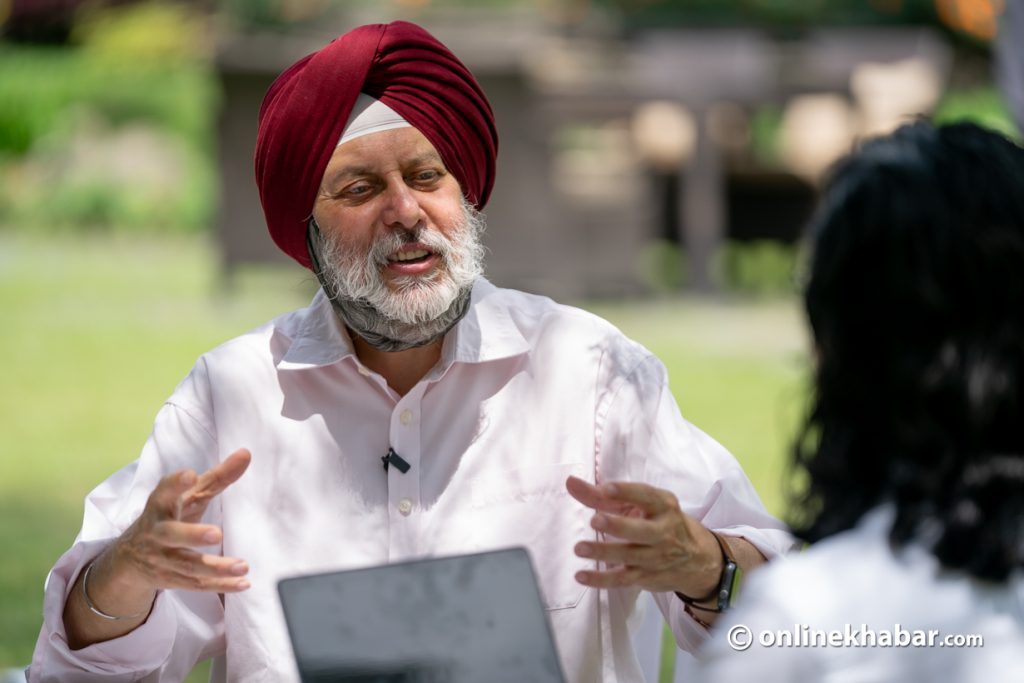
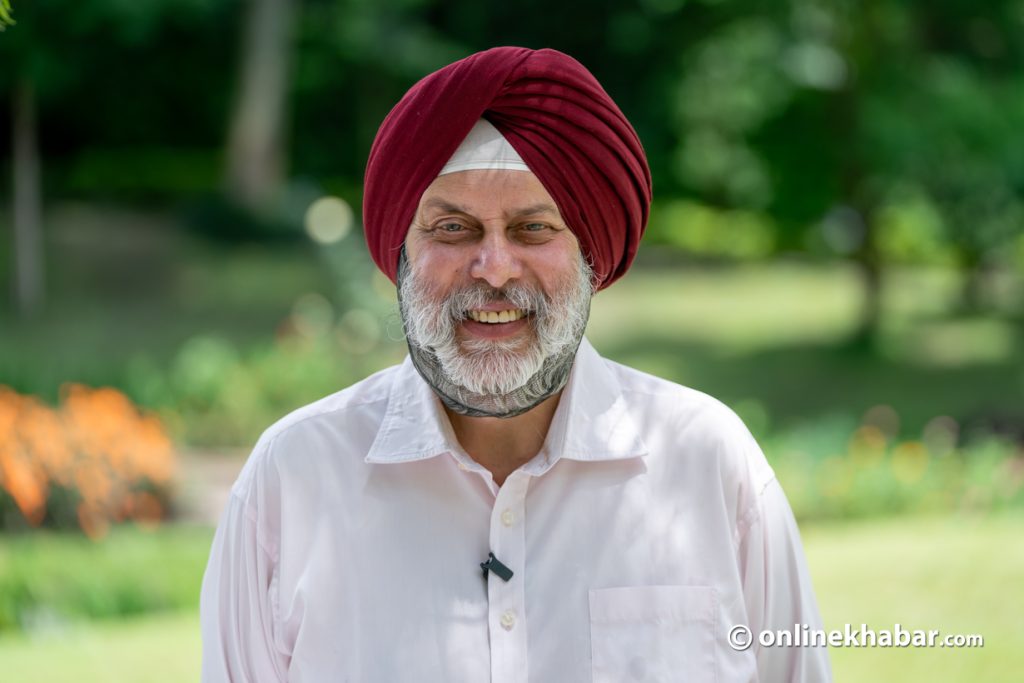
Manjeev Singh Puri, who served as India’s ambassador to Nepal from 2017 to 2019, spoke to Onlinekhabar about Nepal’s generational transition, the changing nature of India-Nepal relations, Kathmandu’s understanding of New Delhi, the shifting geopolitics of South Asia and the growing aspirations of its younger generation. Edited excerpts:
As soon as a new government is formed in Kathmandu, speculation begins about what its relationship with India will look like. It is relatively easier to make such assessments based on a political party’s legacy. But this time, the government has no traditional political baggage or legacy in its relationship with India. How do you see the relationship between this new government and India developing?
Thank you for this very interesting question. Let us look at it from a somewhat historical perspective. Until now, Nepal’s major leaders — Oli, Deuba, Prachanda and others — were products of their respective times. They were leaders who fought against the monarchy for democratic rights. Prachanda-ji is perhaps the most interesting example. His objective was to fundamentally transform the structure of Nepal, and he did so.
But let us consider the backgrounds they came from. Prachanda came somewhat later. Apart from him, all of them are now above 75 and belong to the generation shaped by India’s independence and the end of the Rana regime in Nepal.
But now, you are witnessing a genuine generational transition. You have a 36-year-old prime minister, the youngest prime minister in the world. The average age of the Cabinet is around 40, and the oldest member was 52, although Mahabir has since been added.
This is not simply a change in age. It has come at a time when Nepal is fully connected to globalisation.
With the beginning of constitutional monarchy in 1990, Nepal started opening up to the rest of the world. People began going abroad for education and employment. Today, a large Nepali population is spread across the world, including the United States, Europe, the Gulf countries, Southeast Asia and India, and remittances account for a significant share of the country’s GDP. All of this is a consequence of that openness.
So, apart from the transformation brought about during Prachanda’s time, the previous political movements were largely continuations of what had come before. This is the first real qualitative change since then.
It is a clear message of generational transition: ‘We already had democracy, we formed governments, and now it is our turn.’ That is why they came out onto the streets.
What you mean by the absence of a legacy is correct in terms of party or personal relationships. Leaders of the old parties knew India’s political leadership closely. But why do people talk about the legacy of relationships? Because its fundamental basis lies in people-to-people ties, history and civilisational proximity.
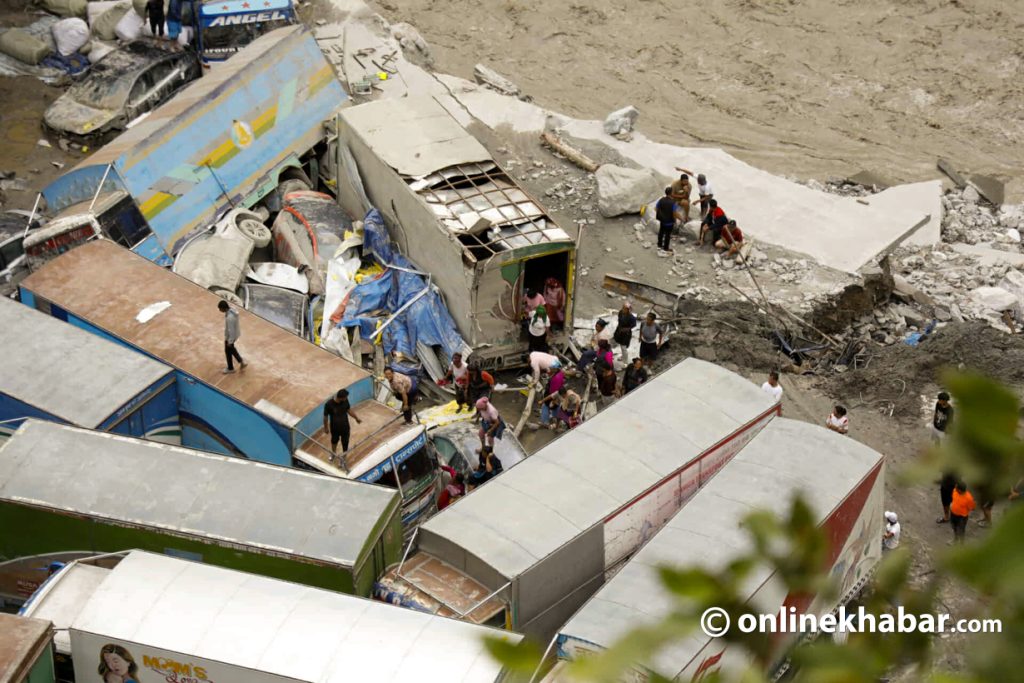
Look at what happened when Nepal suffered a major flood. Our Prime Minister Modi-ji directly called Nepal’s Prime Minister Balendra Shah. That was not a political stunt. It was civilisational and instinctive warmth. It comes naturally.
That is also why relief materials could reach Nepal from India that very evening, while it would take a day or two for them to arrive from elsewhere — because we are the closest neighbours.
That said, I was pleased to hear both the foreign minister and the finance minister, speaking at the NDTV conference in Kathmandu, say that there should be a high-level bilateral visit before the end of this year. That is a positive signal.
It is natural that a new government without the legacy of previous relationships would need some time initially to settle its internal affairs. But the experience of relief and rescue following the floods has itself reminded the government that Nepal is part of the global system and that continuous dialogue with its neighbours is necessary.
In my view, the most important aspect of any relationship is continuous dialogue.
Once you are neighbours, you have a border, and with borders, some problems or misunderstandings are inevitable. That is why continuous contact needs to be maintained at the technical level, between people, in trade, between the militaries and security agencies, and, most importantly, at the highest political level.
Dialogue is what opens the way to solutions. We have been doing this for centuries, and we should continue doing so.
India also appears to have maintained a flexible and positive approach towards the new government from the beginning. Prime Minister Modi himself congratulated the RSP leadership on its victory. But our prime minister introduced a protocol regarding meetings with foreign diplomats and officials. The Indian foreign secretary was reportedly preparing to visit Kathmandu to formally invite our prime minister to India on behalf of Prime Minister Modi, but the visit was called off because a meeting could not be confirmed. How exactly is New Delhi viewing this?
I am not the official spokesperson for the government. I know no more about the foreign secretary’s visit than what has appeared in the media. So it would not be appropriate for me to comment on that. But I would say this: let us remember the context of 2008. We made it clear that the people of Nepal themselves would decide Nepal’s future.
We have more than two and a half centuries of historical relations between us. That is one part of the story. There is also the roti-beti relationship. But modern nation-states have to adapt to changing times and interact with other nations accordingly.
The prime minister here has said that he will initially focus on domestic priorities. That is understandable. But the expectation is that once the internal preparations are complete, the old dynamism of the relationship will return.
Another point is that Nepal’s current prime minister studied in India. That is not merely a coincidence. It reflects a deeper cultural relationship that goes beyond ordinary educational ties.
So it was natural to expect his visit to India — possibly his first foreign visit — because we have all grown up with this tradition and pattern.
Circumstances change; change is the rule of the world. But just because technology and globalisation have changed the way relationships work does not mean we should completely forget the fundamental foundations of the past.
I hope he will visit India by the end of this year, and that it will send a positive message.
My understanding is that because this is a new situation, people are still trying to understand the landscape. Since a different style is emerging compared with the past, it is natural for people to wonder whether something unusual is happening.
But ultimately, the people of Nepal will decide Nepal’s destiny and future.
We have cultural, social and economic ties, as well as formal government-to-government relations. Those relationships should move forward according to the wishes of the Nepali people.
I think the relationship is on the right track.
Our prime minister has made some concessions to the protocol he initially established. He has met the ambassadors of India and China. There have also been reports that our prime minister’s chief political adviser, Kumar Ben, informally travelled to India and met some Indian officials. Our prime minister appeared keen to attend the BRICS summit, but no formal invitation came. Does this indicate that Singha Durbar’s approach towards India is changing?
If such initiatives are genuinely taking place, they are welcome. I would call it an ‘effort to expand relations’ rather than a ‘correction’. As for BRICS, I do not know much about its internal diplomacy. What I do know is that the invitation for Prime Minister Balendra Shah to visit India is always open.
A formal state visit carries both ceremonial and diplomatic significance. It reflects a shared understanding and trust between the two countries. Personal relationships or ‘chemistry’ between leaders can make a major difference. It is one thing to say that relations are good at the bureaucratic level. But when top leaders meet face to face, talk and untangle difficult issues, that is when a genuinely friendly relationship is built. Even though national interest is paramount in diplomacy, personal warmth can be extremely helpful in resolving complex problems.
I hope that visit will take place soon.
In the past, Indian ambassadors had relatively easy informal access to the prime minister’s office. They could even reach the prime minister’s residence in Baluwatar with ease. You have your own experience from your time as ambassador in Kathmandu. That no longer appears to be the case. How do you view this changing nature and style in Kathmandu?
Nepal’s previous prime ministers had a different kind of closeness with India. Most of them were in our age group, and sometimes even the same age as the ambassador. So many interactions were naturally informal.
I remember meeting Girija Prasad Koirala. Our conversations were not limited to formal matters. We would sit around a private dining table and talk even about our food preferences because our lifestyles and cultures are so similar.
Balen Shah-ji is much younger. He is an engineer by profession and studied in Bangalore. He has seen India from a somewhat different perspective — differently from my generation: a modern India connected to technology, IT and artificial intelligence.
So it is natural that the nature of the relationship should change.
Whenever a new government is formed in Kathmandu, a great deal of time is spent understanding one another and building an atmosphere of trust. As a result, fundamental development and bilateral issues are often pushed into the background. How can this be improved so that the relationship becomes more stable and predictable?
The current government in Nepal has emerged from a particular historical situation and a wave of generational transition. They believe there were flaws in the structures of the past and that these need to be corrected.
The government has been saying, ‘We will spend the first 100 to 150 days on internal reforms.’
What that means is that while the government is fully focused on internal management, there may be some slowdown in important bilateral trade, economic agreements and projects with neighbouring countries.
But this is a transitional phase. Four or five months have passed now, and the government is moving towards greater stability.
I believe cooperation with neighbours and diplomatic engagement will naturally become priorities.
There are possibilities for high-level visits. Continuous dialogue and warm relations are what remove misunderstandings and make a relationship more mature and predictable.
To put it bluntly, from Kathmandu’s perspective there is not one India but ‘many Indias’ operating through different centres of power: the BJP’s political India, the RSS’s cultural India, the bureaucratic India, the mysterious India of the agencies, the India of the military, and various other Indias represented by different lobbies. Nepal’s establishment often seems confused about which ‘India’ to deal with and how. Sometimes it appears exhausted by it. Don’t you see this difficulty in Kathmandu?
Umesh-ji, you have forgotten the most important aspect — where is the relationship created by cricket? What about Nepali artists working in Indian cinema and music? What about films, the warmth between ordinary citizens and commercial relationships? These are also parts of India. I do not think the Nepali establishment is confused.
Nepali leaders understand India better than we understand ourselves.
Why? Because despite all our diversity, there is a common ground.
All right, let us accept your argument that many ‘Indias’ are active in Nepal. Even then, Nepali politics knows very well how to balance its dealings with all these ‘Indias’.
A senior Nepali leader told me in Kathmandu a few days ago that his father, who was himself a major political leader, used to say, ‘My father knew India, understood Bharat and knew Hindustan — and he knew the art of negotiating and cooperating with all three.’
So you have understood India much more deeply than we have.
It is natural to think that Kathmandu’s centres of power may become tired while coordinating with all these different institutions.
But that is how large and diverse countries work.
When you deal with the United States, do you deal with just one person or one institution? Of course not.
India itself is a vast and complex society. If that is a challenge, it is also an opportunity. If one door closes, another 10 doors open.
To be honest, someone looking from outside can sometimes see things more clearly because someone living inside a house can be confined by their own surroundings.
I, too, continue to try to understand Nepal in all its diversity.
For a long time, it was believed that the United States viewed South Asia, particularly Nepal, through India’s eyes or effectively ‘outsourced’ the region to India. But that dynamic appears to be changing. The US has appointed a special envoy specifically for South Asia, and India-US relations also no longer appear as smooth as they once did. How is India viewing this changing situation in South Asian affairs?
I firmly believe that India-Nepal relations are sui generis — distinctive and unique in nature. As for the ‘outsourcing’ of international affairs, I would not describe it that way.
In this era of globalisation, it is natural for Nepal to expand its relations with countries large and small around the world, whether in Southeast Asia, Japan, Australia or the United States.
Your border is connected to China, an emerging global power, so it is natural that Nepal should be a country of interest to the international community.
We view every relationship on the basis of mutual interests. We are neighbours, but we are also sovereign nation-states with our own national and security concerns. These include issues such as border management, cross-border crime and the fight against extremism.
Where our interests converge, cooperation becomes deeper. We are a large country. China is equally large, while the United States and Europe are major global players. In such a situation, balancing relationships requires considerable diplomatic skill.
When India, China and Nepal were all at an early stage of development, the situation was different. Today, much greater maturity and openness are required.
In this modern era, flexibility and strategic skill are certainly necessary, but serious maturity is equally important.
Given Nepal’s progress economically and demographically, and its ongoing graduation from the least developed country category, I am confident that Nepal will be able to deal intelligently with the challenges arising from its geopolitical position.
Nepal’s five-time former prime minister Sher Bahadur Deuba and his wife, former foreign minister Arzu Rana, were attacked by protesters during last year’s protests and had to spend nearly a year in Hong Kong after leaving Kathmandu. They went to Hong Kong because, according to reports, they were neglected even by their old friends. How do you view this?
I was deeply saddened to see those unpleasant images of Sher Bahadur-ji and Arzu-ji. No one can feel comfortable seeing such scenes. But during periods of intense political upheaval, such tragic incidents occur in many parts of the world.
In Nepal’s case, however, one beautiful aspect is that you have managed major political transformations with relatively little violence.
This time, there was some disorder and property damage, and there was also some humiliating behaviour. Amid intense anger, they became targets and perhaps thought it appropriate to stay away for some time.
Sher Bahadur-ji has now returned home and is active in politics again. In my view, this is a sign of the great strength and tolerance of Nepali society. You can express strong disagreement and protest, but after a change you again make space for everyone to play a constructive role in society and politics. That is an admirable characteristic of Nepali society.
I do not think external powers have much of a role in this. It is something Nepali society itself has determined.
Two ‘Hindu’ voices are currently being heard prominently in Kathmandu — Shashi Tharoor, author of Why I Am a Hindu, and Sher Bahadur Deuba. Tharoor’s book has been translated into Nepali, while Deuba recently asserted his Hindu identity strongly at a public gathering. Has his message travelled across the border to India? Could it have any impact there?
As I understand it, both are Hindus and are expressing their respective views. Shashi Tharoor’s book is intended for intellectual discussion. What Sher Bahadur-ji said may have been part of his own political strategy, depending on the context in which he said it.
The fundamental point is that Nepal is a Hindu-majority country. That is part of its historical identity. A large proportion of India’s population also follows Hinduism.
This shared cultural and religious faith strongly connects the people of our two countries.
Whether it is Indian pilgrims visiting Pashupatinath or Nepali devotees travelling to Kashi, Gangasagar and Tirupati, these are living realities between our societies.
Politics tries to make use of such sentiments and issues.
Some people think politics is purely an ideological debate, like the Oxford Union. But in practice, politics works somewhat differently.
Take Donald Trump as an example. He raised issues that resonated with ordinary people rather than focusing on complex economic theories, and the people elected him for a second time.
The same thing is happening in developed democracies across Europe.
Ultimately, it is the people who decide how influential a particular message becomes.
Let us turn to a somewhat different subject — India-Bangladesh relations. Over the past decade, relations between the two countries were considered very close, but following the recent youth uprising, Bangladesh’s politics has changed completely. Ousted Prime Minister Sheikh Hasina has taken refuge in India, and there is anger towards India among sections of the Bangladeshi population. How is India managing this new situation?
At the time, Sheikh Hasina’s life was at risk. She came to India and is currently safe. I do not accept the idea that ‘the entire Bangladeshi population’ is against India. Some groups or elements may have tried to create such an atmosphere.
I believe politics will return to a normal rhythm as circumstances evolve. India has remained a democracy continuously since independence. When crises have occurred in neighbouring countries, political leaders from different countries have sought refuge in India. We have examples ranging from Nepal’s top political leaders to the Dalai Lama.
Although India is not a signatory to certain technical aspects of international refugee conventions, it has always given priority to humanitarian considerations and protection.
Of course, serious dialogue on both sides is necessary to resolve misunderstandings. Foreign policy is shaped by both domestic needs and the international environment. Emotional politics may exist on one side, but ultimately the livelihoods of people, trade and economic cooperation are the real foundations of relationships.
Neighbours cannot be changed, so there is no alternative to moving forward pragmatically.
Finally, how do you assess the Gen Z movements and youth discontent seen across South Asia and around the world? We have seen young people take to the streets in Nepal, Bangladesh and even India. How should governments respond to the aspirations of the younger generation?
We need to recognise one thing. Because of the information and communications revolution, young people in the modern world are immediately connected to developments taking place across the globe.
This has created high aspirations among them. This is not just a phenomenon in Nepal. It is a global phenomenon. The resources and capacities available to states and governments have their own limits.
In India’s case, when voices of youth discontent emerged, the state engaged in dialogue in time and addressed their demands. Mature democracies must listen to the voices on the streets and public discontent in time and respond to them.
Nepal now has the youngest and most youthful government in its history. In a sense, this leadership has come to power representing the anger and aspirations expressed on the streets.
But the new generation should not forget that while bringing in modern technology and new ideas is valuable, the institutions and traditions of the past also had their own historical reasons and accumulated experience behind them.
So there needs to be a balance between the experience of the older generation and the energy of the new generation.
As the English saying goes, ‘Don’t throw the baby out with the bathwater.’
When making changes, we should not lose sight of ourselves to the point of destroying the very foundations on which everything stands.