Kathmandu, September 29
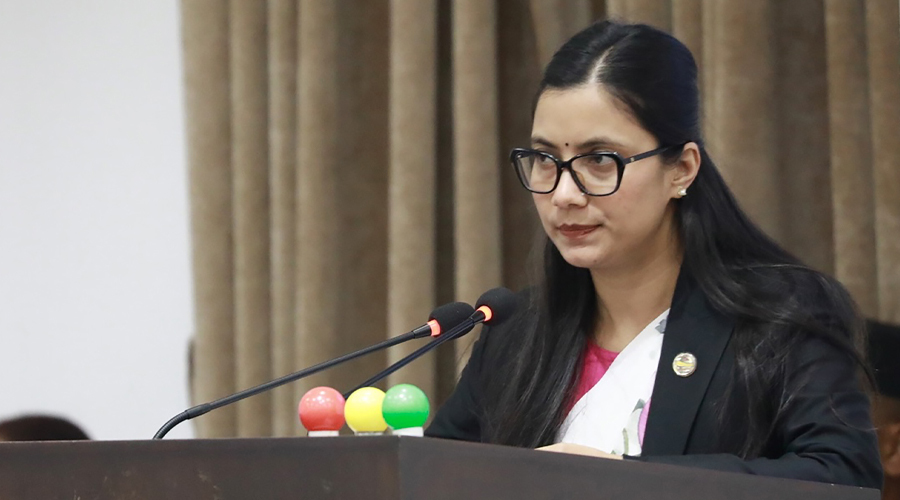
The National Defence University bill, proposed with a main role for the Nepali Army, has been presented in the House of Representatives. Law, Justice and Parliamentary Affairs Minister Sobita Gautam presented the bill in the House on behalf of Prime Minister Balendra Shah (Balen).
Presenting the bill at Tuesday’s sitting, she said its purpose is to protect, strengthen and promote national interest through advanced study, teaching and research on national security, defence, international relations and strategic affairs.
The National Defence University bill has been drafted with the aim of producing capable, skilled and responsible human resources, both Nepali and foreign, in this field.
The main reason for establishing and running the university is to set up a specialised academic centre at home to provide higher education and training to military and non-military officials, in order to address geopolitical sensitivities and changing security challenges.
The bill also aims to help the government by providing evidence-based advice when it formulates security and strategic policy, and to make an important contribution to strengthening the country’s security diplomacy.
Minister Gautam said the bill had to be introduced in the Federal Parliament because, with the construction of the National Defence University’s infrastructure in its final phase, a permanent and clear legal framework is needed to operate it and grant it academic autonomy.
Under the proposed bill, the Prime Minister will be the university’s chancellor.
This provision is contained in Section 19 of the bill, registered in the House of Representatives on Tuesday by Prime Minister and Defence Minister Balen Shah.
It states: “The Prime Minister shall be the chancellor of the university.” The chancellor will be the head of the university.
The university’s supreme body will be the “Assembly.” The Nepali Army’s Chief of the Army Staff will be an ex officio member of it. The chancellor will preside over Assembly meetings and the university’s convocation ceremonies. The Prime Minister will be chancellor and the defence minister pro-chancellor. The university’s Assembly will approve policy, rules, the budget and the annual program.
The Nepali Army’s Director General of Military Training will be an ex officio member of the university’s Academic Council. The council will handle tasks such as setting the curriculum and prescribing admission standards. The Nepali Army will also have a role in selecting the university’s executive leadership.
Recommendations for appointment to key posts such as the university’s vice-chancellor and registrar will be made by a committee led by the Chief of the Army Staff. The Nepali Army’s Director General of Military Training will serve as member-secretary of the appointment recommendation committee.
A legal provision is proposed under which a serving Major General of the Nepali Army would be posted as the education officer heading the National Defence College under the university.
There is a provision allowing Nepali Army personnel to be deployed on deputation to meet the university’s staffing needs. The university’s central office will be located at Perungedanda in Banepa Municipality, Kavrepalanchok district, Bagmati Province.
Under Section 4 of the bill, the university will be an autonomous, self-governing and organised institution. Sub-section 1 of Section 4 states: “The university shall be an autonomous, self-governing and organised institution with perpetual succession, and it shall acquire legal personality.”
As a legal person, the university will exercise rights, perform duties and discharge liabilities in accordance with prevailing law.