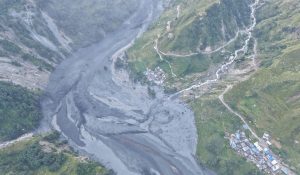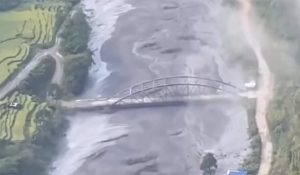
Gorkha, October 15
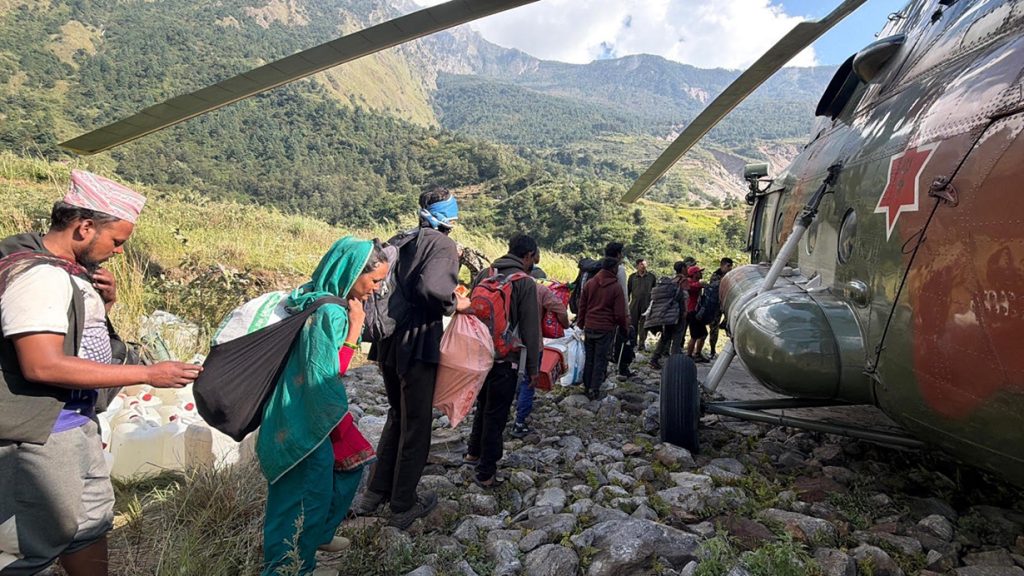
More than 1,000 people have been rescued by helicopter from the Budhigandaki flood-affected area. Assistant Chief District Officer Netra Prasad Sharma said 1,044 people were rescued between Sunday and Thursday.
He said 70 of them were foreign nationals. People in the area were stranded after the flood damaged the trekking trails and bridges leading to northern Gorkha. Sharma said they were rescued by Nepali Army helicopters.
According to him, 96 people from the affected area were rescued on Sunday, the first day of the flood. On Monday, 321 were rescued, and on Tuesday, 186. On Wednesday, 441 were rescued, according to Assistant CDO Sharma.
Relief distribution has also been stepped up along with the rescue work. Assistant CDO Sharma said relief materials, including food grains, tents, mats, pillows, quilts, tarpaulins, solar equipment and generators, are being distributed with the help of the government and various organisations. He said helicopters had to be used for rescue and relief after the flood cut off the road network as well as the trekking trails.
“Helicopters are being used to distribute relief as well. The helicopters going from here to carry out rescues take relief supplies with them, and on the way back they bring the rescued people,” he said.
Red Cross support
Meanwhile, the Nepal Red Cross Society has stepped up its response to the flash flood in the Budhigandaki River. Secretary General Rishi Khanal said volunteers were mobilised immediately for the flood response, along with an assessment of the damage, and that work was underway to deliver non-food items to the affected area.
“As soon as we received news of the flood, we mobilised volunteers from Gorkha, Dhading, Tanahun, Chitwan, and Nawalpur East and West. They relayed early warnings. The response continues,” he said.
The Nepal Red Cross said non-food and other items are being sent to the affected area for the immediate flood response, and that this work is continuing. According to Khanal, non-food items including tarpaulins, mattresses, blankets and dignity kits have been sent to the affected area in cooperation and coordination with the National Disaster Risk Reduction and Management Authority and the Nepali Army. He said two large tents that can be used to run hospitals have also reached the affected area.
“Expert personnel have already been deployed to the affected area to study the damage, and more of the required non-food items are being sent today in coordination with the government. Volunteers are devoted to delivering humanitarian service in the affected area,” Khanal said.