
Kathmandu, September 30
Up to 1 million passengers are expected to leave Kathmandu Valley for their home districts during this year’s Dashain festival, according to a report submitted to the government by the House of Representatives’ Infrastructure Development Committee.
The committee submitted its report on public transport management for Dashain to Prime Minister Balen Shah and Minister for Physical Infrastructure and Transport Sunil Lamsal. A team led by committee chair Ashish Gajurel handed over the report.
The committee estimates that between 600,000 and 1 million people will travel outside the Kathmandu Valley during the festival. However, transport entrepreneurs believe the actual number could be higher.
According to the report, passenger movement will begin to surge around Ghatasthapana, with the biggest rush expected on Phulpati.
The committee estimates that between 45,000 and 68,000 passengers will leave Kathmandu on Ghatasthapana. The number could rise to as many as 113,000 on Phulpati, when more than 7,000 vehicles are expected to operate.
An estimated 13 to 20 per cent of Dashain-bound passengers are expected to leave the Valley on Phulpati. The figure is projected to fall to around 4 per cent on Dashami.
The projections are based on historical data from the traffic police. Committee chair Gajurel said the committee had studied previous years’ practices and prepared a detailed report to help agencies involved in managing the Dashain travel rush.
Large buses expected to carry nearly half of passengers
Large buses are expected to carry the largest share of Dashain passengers, accounting for around 47.8 per cent of travellers, according to a survey conducted at the Nagdhunga checkpoint.
Microbuses are expected to carry around 42.9 per cent of passengers, while minibuses are projected to carry 9.2 per cent.
Public transport leaving Kathmandu generally sees two major rush periods. The morning peak runs from 6am to 9am, with 7am to 8am being the busiest hour. The evening peak is between 6pm and 9pm, with the highest traffic recorded between 8pm and 9pm.
Pokhara route expected to see highest traffic
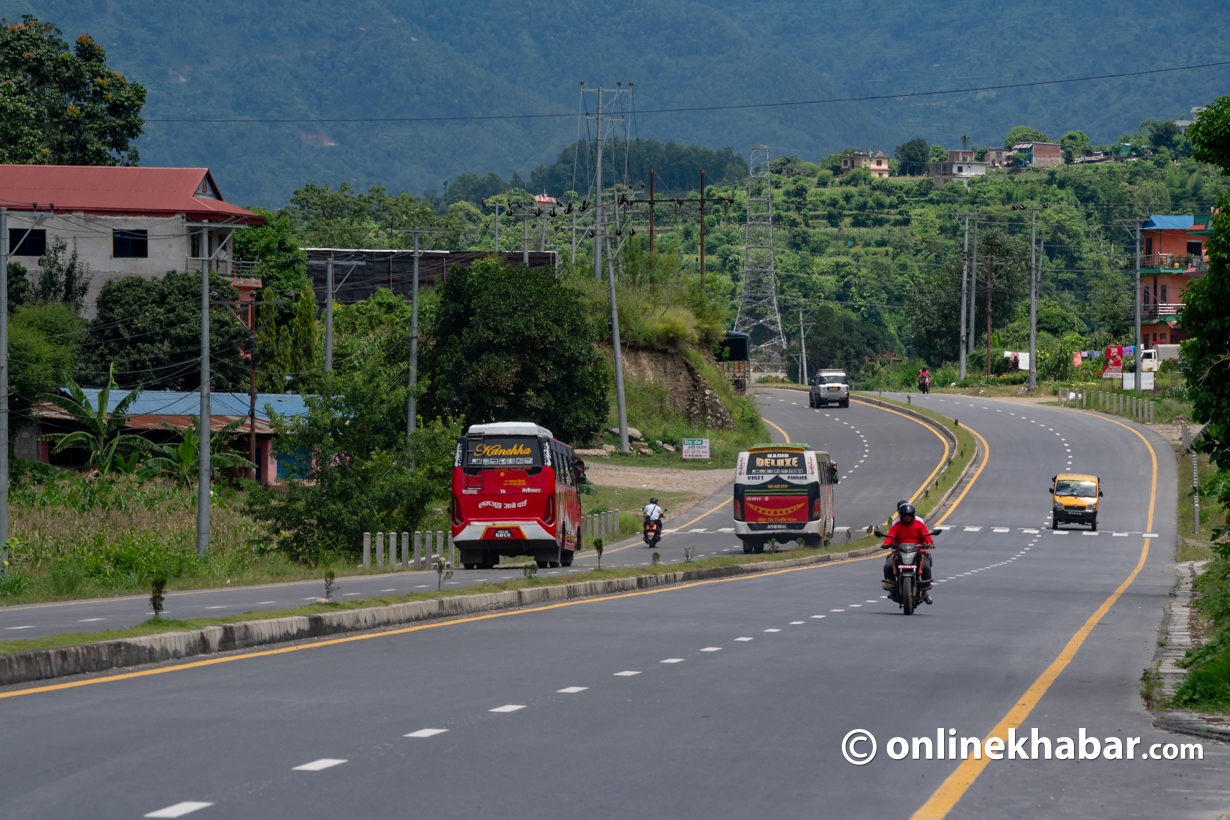
Among vehicles leaving the Valley through the Nagdhunga checkpoint during Dashain, those heading towards the Pokhara section are expected to account for the largest share.
Around 27 per cent of vehicles are expected to travel along the Muglin-Pokhara corridor, covering destinations including Kaski, Syangja, Baglung, Myagdi, Parbat, Gorkha, Lamjung and Tanahun.
The second-highest traffic volume is expected on the Butwal route towards western Nepal, including Dang, Banke, Surkhet, Kailali, Kanchanpur and the far-western districts.
The third-highest volume is expected on routes heading east via Narayangadh towards Birgunj, Janakpur, Dharan, Biratnagar and Jhapa.
The fourth-highest volume is expected on routes heading towards Muglin and districts including Dhading, Naubise, Malekhu, Trishuli and Nuwakot.
Vehicles travelling via Muglin and Butwal towards Nawalpur, Rupandehi, Kapilvastu, Palpa and Arghakhanchi are expected to account for another significant share.
The report estimates that around 55 percent of vehicles leaving through Nagdhunga eventually reach Narayangadh, from where they split towards eastern and western Nepal along the Mahendra Highway.
Up to 65,000 vehicles may be needed
The committee estimates that up to 65,000 vehicles may be required to transport passengers during the Dashain travel period.
Large buses are expected to remain the backbone of the system as they are projected to carry nearly half of all passengers.
According to transport entrepreneurs, around 150,000 vehicles are normally operated from the Kathmandu Valley.
Last year, an average of around 10,000 vehicles carried passengers out of the Valley each day from Shasthi to Navami. On Phulpati alone, 19,671 vehicles left the Valley.
Based on the availability of vehicles this year, the committee expects sufficient seats to be available to meet passenger demand.
Why do passengers still struggle to get tickets?
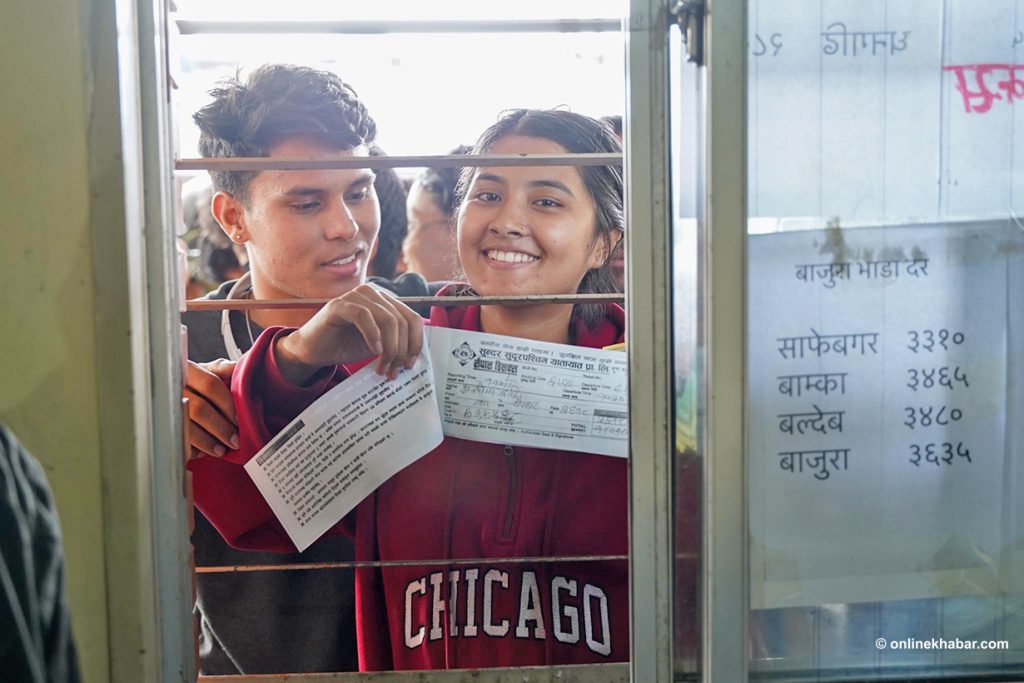
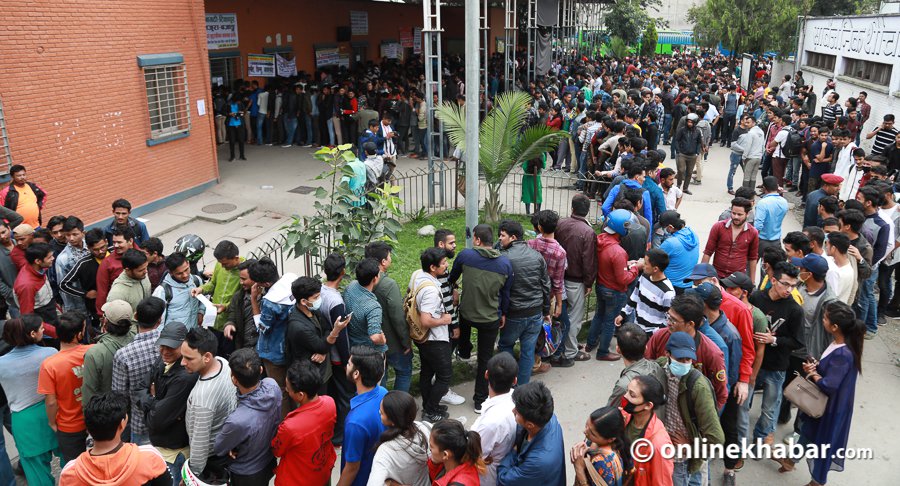
Despite the availability of a large number of vehicles, passengers often struggle to obtain tickets during Dashain.
The report attributes this partly to the fact that demand is not evenly distributed across different destinations, days or exit routes. Problems arise when vehicles cannot be deployed according to changing demand.
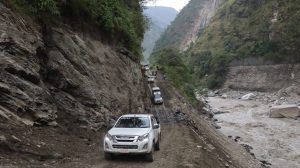
Poor road conditions also contribute to the problem. Vehicles may fail to reach their destinations on schedule, meaning they cannot return in time to carry another group of passengers.
The report also notes that complaints may arise when passengers are unable to get the particular seats they want.
Agencies prepare for Dashain travel rush
The parliamentary committee has itself become involved in efforts to improve Dashain travel management. It has launched an online portal to collect passengers’ experiences, complaints and suggestions.
The committee plans to use complaints received through the portal to issue directions to the relevant authorities.
The Department of Transport Management has already held an initial discussion on advance ticket booking, although a date for opening bookings has not yet been fixed.
The department has also instructed transport operators to facilitate ticket bookings primarily through online platforms.
Transport operators have been asked to provide identification cards to drivers and staff and prevent ticket sales through unauthorised locations, counters and individuals.
Authorities have also been instructed to ensure that passengers receive tickets and to monitor drunk driving. Long-distance services have been told to deploy two drivers and arrange vehicles according to passenger demand.
The Kathmandu Valley Traffic Police Office is preparing to mobilise more than 1,300 personnel during the festival period. Passenger assistance desks are planned at 10 locations across the Valley, while police will maintain regular checks at other major exit points.
The Department of Roads will keep emergency response and disaster rescue teams on standby. Fifty-three heavy machines will also be kept ready for emergency operations.
This year, transport management faces additional challenges following the Bhotekoshi floods, which swept away several vehicles and left some employees missing. The government also halted vehicle registration for an extended period following the disaster.
Committee calls for long-term reforms
The parliamentary committee has also recommended long-term measures to address the travel problems that recur during Dashain each year.
It has called for better collection and use of transport data, greater use of technology in public transportation, and the introduction of digital ticketing and digital challan systems.
The committee has also recommended developing a reliable system for providing travel information, increasing public awareness and providing adequate training to people directly involved in transport operations and service delivery.
It has further suggested establishing a Public Transport Authority to address the structural problems facing the sector.