
Nuwakot, August 27
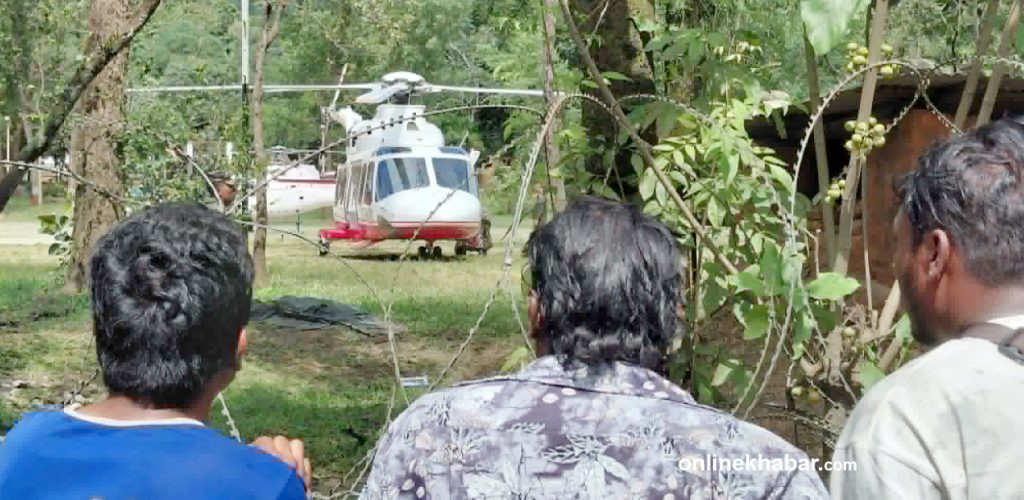
The helicopters arrive, and the crowd runs towards them.
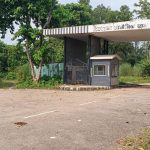
For a few moments, the road outside the No. 1 Army Training Centre in Battar falls into a strange rhythm: people look up, rush towards the gate and wait for those being brought back from flood-hit Rasuwa.
Then they watch.
If the person they are waiting for is not among them, they slowly return to the roadside and wait for the next helicopter.
Since Thursday morning, families of people missing after the devastating flood have gathered here, searching for any news of their loved ones.
Among them is Sabita Adhikari. Her husband, who works at the Trishuli Hydropower Project, has been out of contact since the flood struck. Until then, they had been speaking regularly.
Now she does not know whether he was swept away or escaped and is stranded somewhere. Clinging on, she keeps asking people arriving at the Army training centre whether they have seen him. Whenever a helicopter lands, she hurries towards the centre. She waits until everyone has been brought out.
But the helicopters do not always bring survivors.
Some people are carried down on stretchers. Others are brought out in bundles. People in the crowd try to work out what they are seeing.
“It looks like they have brought only a head,” some say.
For Adhikari, each helicopter brings a brief moment of hope, followed by disappointment.
She returns to where she was sitting.
“What might have happened to him?” she asks, her eyes filling with tears.
Still, she has not given up.
She has heard that employees at Trishuli Hydropower may have taken shelter inside a tunnel. She has also heard that the army has reached the site with equipment to rescue them.
“People are saying the employees are inside the tunnel,” she says. “They say the army has already reached there for the rescue.”
Others nearby repeat the same thing.
“They say the army went there this morning with all the equipment. We heard that too.”
For a moment, the news gives her hope.
Then another thought comes.
“What if he has suffocated?”
Her husband had shown her the inside of the tunnel during video calls. She remembers how enclosed it was. Now she has heard that the tunnel’s opening has been filled with mud.
Then she hears that the owner of the hydropower project has arrived at the Army training centre.
She goes straight to the gate.
“Please let me meet him. I want to understand what happened there. I want to know what it is like inside. Please let me meet him,” she tells the soldiers, crying.
She is eventually allowed inside with a relative.
“If he is hiding inside the tunnel and that is why he cannot contact us, maybe he is still alive,” she says. “I pray that the army rescues them soon.”
‘The helicopter comes, but my person does not’
Adhikari is one of many people waiting in Battar.
A few metres away, 74-year-old Padam Bahadur Kandel walks around with an old bag over his shoulder.
His eyes are wet.
Sometimes he stops and looks towards the Army training centre. Sometimes he walks quickly, as if he cannot bear to stand still.
Kandel has come from Nahar Daha village in Nuwakot. His relative, Khal Prasad Timilsina, is stranded in Rasuwa.
He has come to Battar hoping that an army helicopter will find Timilsina and bring him back.
“The helicopter comes every two minutes, but my person does not come,” Kandel says, his voice breaking.
“At this age, why did I have to see something like this?”
He can barely speak.
Instead, he gestures towards two men nearby.
They are relatives of another victim.
One is Basudev Rijal, who has come from Tadi in Nuwakot.
His nephew, from Suryagadhi-5, had been travelling to Gosainkunda for trekking. He and about 10 friends were planning to travel by bus for part of the journey.
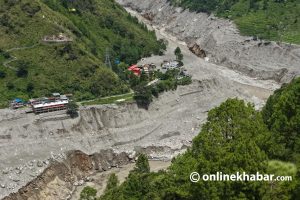
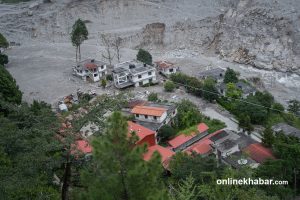
But when the bus reached Betravati, the flood from Rasuwa swept over it.
Rijal says his nephew and another friend managed to climb onto the roof of a house.
The nephew then called home.
“He called in a hurry and said, ‘If the house remains standing, I will survive. If it collapses, I will die.’ The flood took them away shortly afterwards, I think,” Rijal says.
“We came here yesterday and informed the army and police. We are hoping that he will be found. Even if it is his body, we want to see him.”
His voice falters.
“Now there is neither hope nor breath. We have lost all hope.”
Waiting has become a way of life
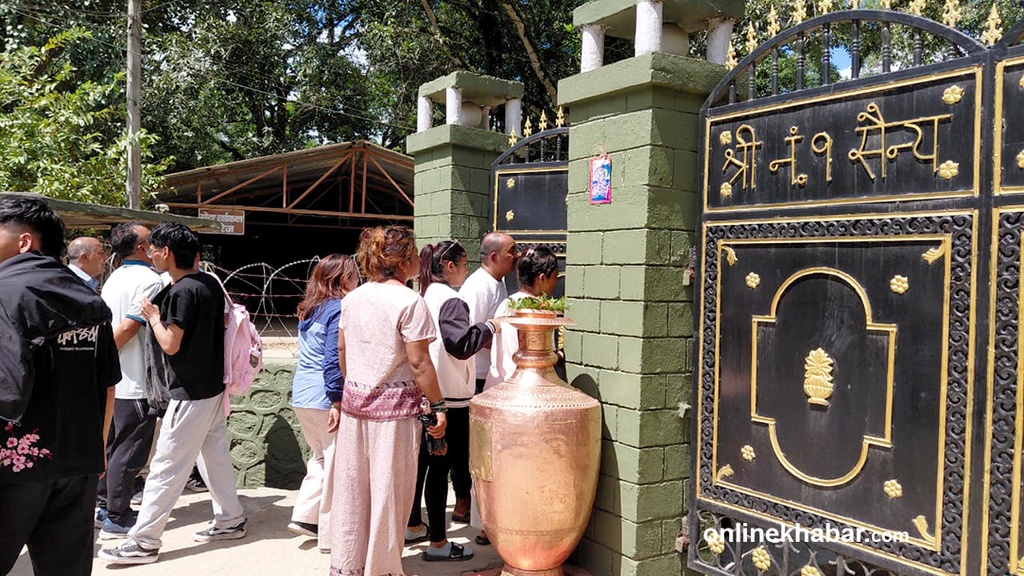
There are many families like them in Battar.
Some are crying. Some are pleading with security personnel. Others stand silently, watching each helicopter.
Battar has become a place where families come to look for people missing in the Rasuwa flood.
But the town itself has also been affected by the disaster.
People from communities on either side of the river remain stranded in one another’s areas.
The flood has also left schoolchildren shaken.
A group of students from Panchalinge Secondary School look distressed as they leave the Army training centre.
They had travelled to Bidur the previous day to play futsal.
Then the flood came.
They were stranded and could not return home that evening.
Some students from one side of the river are now stuck on the other. Others face the same situation in reverse.
The army has been using helicopters to move the students between the two sides.
“We had a game. We came here,” one student says anxiously. “Our families must already be very worried. We were lucky to survive. Now we just want to get home.”
The army has told them they will be taken home by helicopter.
So they wait.
The families wait too.
And when another helicopter appears over Battar, heads turn towards the sky.
For those standing outside the Army training centre, every helicopter carries the same possibility: perhaps this time, someone they love will come home.